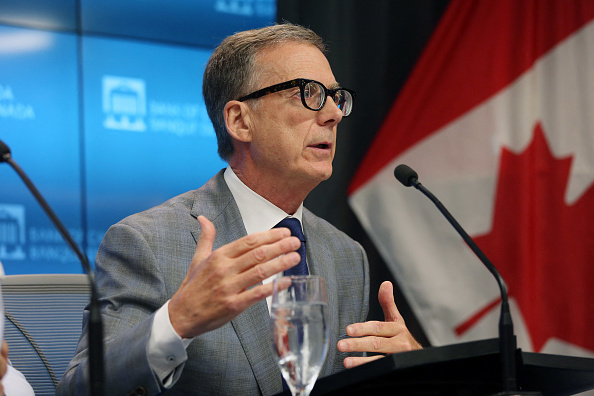
Tiff Macklem, Governor of the Bank of Canada, speaks during a news conference (DAVE CHAN/AFP via Getty Images)
NTDTV Staff
The Bank of Canada held its policy rate at 2.25 percent on Jan. 28, citing elevated uncertainty from ongoing trade disruptions and the upcoming review of the United States–Mexico–Canada Agreement (USMCA).
Bank of Canada Governor Tiff Macklem said the outlook for growth and inflation has changed little since October, but risks have increased. “Our forecast for economic growth and inflation in Canada has not changed significantly since our October projection,” Macklem said. “However, uncertainty around our forecast is heightened, and the range of possible outcomes is wider than usual.”
Macklem said the Bank’s governing council judged the current policy rate remains “appropriate,” provided the economy evolves in line with projections. He added that uncertainty makes it difficult to signal future moves. “The consensus was that elevated uncertainty makes it difficult to predict the timing or direction of the next change in the policy rate,” he said.
Trade-related uncertainty and tariffs continue to weigh on the economy. Macklem said growth was strong in the third quarter of 2025 but likely stalled in the fourth quarter as business inventory investment declined.
Inflation averaged about 2.1 percent in 2025 and has remained within the Bank’s one-to-three percent target range for two years. CPI inflation rose to 2.4 percent in December, largely due to base-year effects from the previous year’s temporary GST holiday. “The Bank expects CPI inflation to stay close to the 2 percent target over the projection as tariff-related cost pressures are offset by excess supply,” Macklem said.
The Bank said geopolitical risks remain elevated ahead of the USMCA review later in 2026. Macklem outlined a range of scenarios, from a relatively smooth transition supported by stronger spending to weaker labour markets and tighter financial conditions if trade disruptions deepen.
Canada’s unemployment rate remains elevated at 6.8 percent, despite recent job gains, and businesses have reported limited hiring plans. The Bank projects GDP growth of 1.1 percent in 2026 and 1.5 percent in 2027.
In its January Monetary Policy Report, the Bank said Canada’s economic outlook has changed little since October but remains volatile due to swings in trade and inventories as firms adjust to tariffs. U.S. tariffs have reduced Canadian exports by about four percent from pre-restriction levels, and Canada’s GDP is now projected to be 1.5 percent lower by the end of 2026 than forecast a year ago.
The Bank said the outcome of the USMCA review remains uncertain, with potential scenarios ranging from a long-term extension to more restrictive trade rules or ongoing annual reviews, any of which could affect Canada’s competitiveness and investment outlook.