The Roman emperor’s Stoic wisdom is as relevant to the human experience today as it was almost 2000 years ago
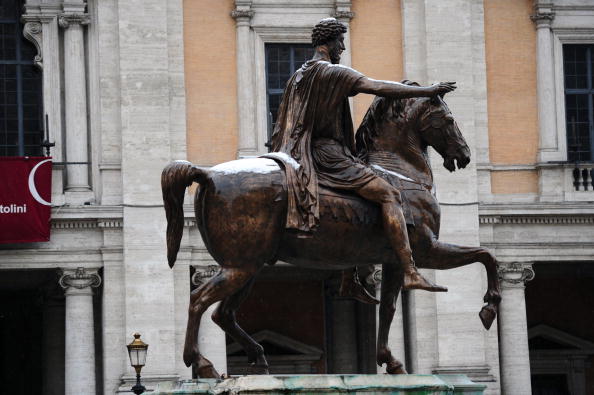
The statue of Marcus Aurelius on February 12, 2010 at The campidoglio in Rome. (Photo by CHRISTOPHE SIMON/AFP via Getty Images)
“Begin each day by saying to yourself: Today I am going to encounter people who are ungrateful, arrogant, deceitful, envious, and hostile.”
These words might sound like good advice for anyone setting off into rush-hour traffic to a thankless modern-day job, but they were actually composed more than 1,850 years ago by Roman emperor Marcus Aurelius.
“I can neither be harmed by any of them, for no one else can involve me in what is shameful or debasing,” Aurelius continued. “[Nor] can I be angry with my fellow man nor hate him, for we have been made for cooperation, just like the feet, the hands, the eyelids, and the upper and lower teeth.”
His book, a collection of short essays and aphorisms known today as “Meditations,” was written shortly before his death. Even though there is no evidence that Aurelius ever intended for his words to be seen or even published, they have remained popular for centuries.
Many of history’s great writers, statesmen, and philosophers have cited his work as an important source of influence, and his book, which has been translated into dozens of languages, continues to inspire countless people around the world.
One explanation for this enduring popularity is the timelessness of his insights. Aurelius wrote with refreshing candor about the nature and purpose of human life, and he provided unique observations about the immutable truths of the human condition.
Born in 121 AD to a prominent family in the Roman Empire, Aurelius was educated by some of the most renowned teachers and philosophers of the time. Though he did not crave political power—and was in fact suspicious of its trappings—he found himself in line to become the ruler of the empire and considered it his duty to fulfill his obligations.
In the first decade of his rule, the empire was struck by several large natural disasters as well as a plague that wiped out a significant portion of the army. This severely weakened the defenses of the far-flung borders of the empire, and as a result, Aurelius spent a considerable portion of his reign fighting off invasions from the north and east.
He spent the final years of his life commanding the army along the northern border, far from his home and family. It was during these years that he wrote his book of personal reflections.
1. Think and Act with Reason
Aurelius said in “Meditations” that one should perform every action in one’s life as if it were his or her last, “putting aside all aimlessness and emotional resistance to the choices of reason.”
Like most educated Romans of his time, Aurelius was fluent in Greek, and “Meditations” was originally composed in that language. The Greek word “Logos” has been translated as reason, cause, or discourse, and often described as the principle that orders all things in the universe.
Aurelius believed that all humans contained the element of reason, which could be used to determine what is good and right. “For it is not sanctioned by the Gods that anything else, such as the praise of the many, power, wealth, or indulgence in pleasures should be placed above what is in accordance with reason and the communal good,” he wrote.
Yet to him, it wasn’t enough just to tell what is right, but also to act on it.
2. Take a View From Above
“You must always keep this in mind: What is the nature of the Whole? What is my nature? And how is my nature related to the greater Nature?” Aurelius wrote.
One recurring theme of “Meditations” is awareness. The author considered it important to be aware of the transitory nature of the human condition and frequently compared the small portion of space-time occupied by a single human life to the vastness of the universe.
Aurelius also thought it important to be aware of one’s reactions to those short-lived human circumstances. He believed that each created life had a certain role to play in relation to the grand design of the Cosmos and that true liberation came only from within.
3. Accept What You Cannot Control
“The duration of a person’s life is only a moment,” Aurelius wrote. “[Our] substance is flowing away this very moment; the senses are dim, the composition of the body is decaying, the soul is chaos, our fate is unknowable, and reputation uncertain.”
What can guide us in such a fleeting and unpredictable life, he asked?
The answer he arrived at was philosophy, which consisted of “keeping the divine spirit within each of us … above pains and pleasures” and “accepting all that may happen and is allotted to us as coming from that source, whatever it is, from which we ourselves came.”
He recognized that much of human life is beyond our control, including the behavior of other people. However, we can still control how we perceive and react to them. In other words, if we can control our minds and refuse to let external factors upset us, then we can break the spell of any power those factors hold over us.
4. Work for the Common Good
“Take pleasure and rest in one thing only: making your way from one communal duty to another, always remembering God,” Aurelius wrote.
Throughout his writings, Aurelius frequently discusses duty. He believed that each person, whether a farmer, shopkeeper, soldier, general, senator, or even an emperor, has an important role to play in the whole, and that each has a role to play not only in one’s city or empire, but also in the broader world and the greater Cosmos.
Aurelius considers the fulfillment of one’s duties to the community, including family and all those with whom one comes into contact, to be the primary responsibility of one’s life.
He stressed the importance of asking, “How have you conducted yourself so far toward the gods, toward your parents, brothers, wife, children, teachers, friends, family, and servants?”
He also noted that one should always consider the question, “Are my actions appropriate for a communal being?”

5. Improve Your Inner Self
While Aurelius believed in the importance of helping other people, he also stated that one’s main obligation was to improve oneself.
After becoming emperor, Aurelius considered it important to continue his education and persisted in meeting and corresponding with his teachers.
“If someone is able to show me that what I think or do is not right, I will happily change, for I seek the truth, by which no one ever was truly harmed,” he wrote, “Harmed is the person who continues in his self-deception and ignorance.”
He also wrote, “Whenever you notice someone else going astray, immediately turn and examine how you yourself have gone astray, for example, esteeming money, pleasure, reputation, or something else, as if it were the highest good.”
6. Practice Unconditional Kindness
“It is possible not only to not be angry with the insensitive and ungrateful but even to care for them,” Aurelius wrote.
Throughout his book, Aurelius often points out the importance of treating people with kindness, especially those people who might not seem to deserve it.
He believed that selfish and rude people only acted that way because they had been misled and that they deserved sympathy and kindness. He also stated that if you are disappointed by others’ behavior, you should not admonish them but yourself for having unrealistic expectations.
Aurelius also said that treating such people well takes away their power to hinder you.
He wrote of the importance of treating everyone with respect and fairness. “Every human being is closely connected to us; therefore all people must be treated well and tolerated,” he said.
7. Be Grateful for the Gift of Life
“For the remainder of your life, whenever anything causes pain for you, remember this principle: ‘This is not unfortunate. Indeed, to bear such things nobly is good fortune,’” Aurelius wrote.
One of the main themes that runs throughout “Meditations” is gratitude. Despite the fact that Aurelius suffered great losses and dealt with difficult situations during his life—several of his children died at a young age, and he had to spend the final years of his life living in a military camp far from his family—he remained grateful.
He accepted all that had befallen him as from the same universe that had created him. He embraced the circumstances of his life, whatever they may be, with humility and gratitude.
Although the world has undergone many changes in the nearly two millennia since Aurelius lived, his words contain wisdom that transcends time and place.
Because Aurelius spoke directly and candidly about eternal truths of the human condition, his ideas are as relevant in today’s chaotic world as they were during the Roman Empire, and his book is a rewarding place for anyone seeking insights into the nature and purpose of human life.