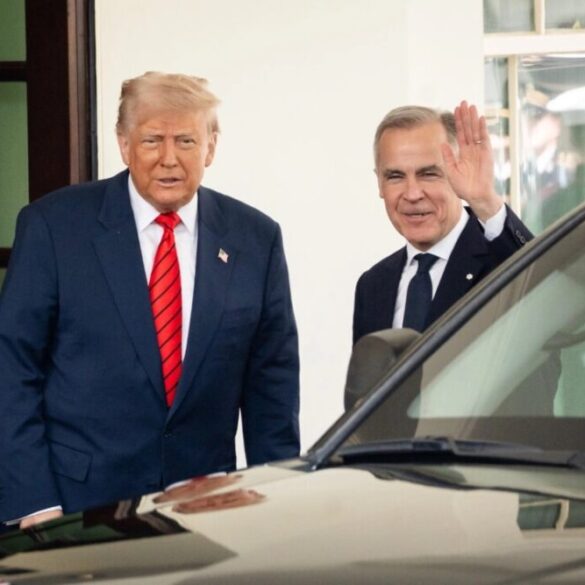
U.S. President Donald Trump greets Canadian Prime Minister Mark Carney at the White House in Washington on May 6, 2025. Madalina Vasiliu/The Epoch Times

Canadian Prime Minister Mark Carney said he spoke with U.S. President Donald Trump on June 22 and the two discussed the situation in the Middle East after Trump ordered strikes on Iran’s nuclear program.
In a post on social media early on June 23, Carney said the two leaders “focused on de-escalating the conflict in the Middle East” during the call. The call took place before Iran attacked U.S. interests in the region.
Carney departed for Belgium on June 22 to attend the Canada-European Union Summit and will attend the NATO summit later this week in the Netherlands.
Carney said he also discussed with Trump their “shared commitment” to see a stronger NATO emerge from the summit, as well as ongoing trade negotiations between the two countries. The two leaders had agreed to aim to reach a deal within 30 days at the G7 summit last week in Canada, which Trump left early to deal with the Iran conflict.
The call between the leaders followed the United States striking three of Iran’s nuclear sites over the weekend. The mission involved B-2 Spirit bombers delivering 30,000 pound bunker-buster bombs and the firing of Tomahawk missiles from a submarine.
In his address to the nation after the strikes were conducted on June 21, Trump said the targets were “completely and totally obliterated” and that there would now either be peace or “far greater” tragedy for Iran.
“If peace does not come quickly, we will go after those other targets with precision, speed and skill,” he said.
The Epoch Times reached out to the White House for comment about the call between Trump and Carney said to be about de-escalation efforts but didn’t immediately hear back.
The U.S. military action has been framed around the urgency of dismantling Iran’s nuclear program, while the president later floated the idea of regime change. “If the current Iranian Regime is unable to MAKE IRAN GREAT AGAIN, why wouldn’t there be a Regime change??? MIGA!!!” Trump wrote on his Truth Social platform on June 22.
White House spokeswoman Karoline Leavitt later told reporters on June 23 that the U.S. stance hasn’t changed, and that Trump was “simply raising a question.” She said that if the Iranian regime refuses to engage in diplomacy, “why shouldn’t the Iranian people rise up against this brutal terrorist regime?”
The United States had been bracing for Iran’s response, which came on June 23 by way of missiles fired at the U.S. military base in Qatar. The Qatari foreign ministry said all missiles were intercepted.
Iranian Foreign Affairs Minister Abbas Araghchi had said the day prior his country “reserves all options to defend its sovereignty, interest, and people.”
Canadian Foreign Affairs Minister Anita Anand said on June 22 she spoke with Araghchi about “the importance of the safety and security of Canadian citizens” in the region, and the need for de-escalation. Canada and Iran have not had a formal diplomatic relationship since 2012.
Anand, speaking to reporters in Belgium ahead of the Canada-EU summit, said the actions of the United States over the weekend were an attempt to alleviate the threat posed by Iran’s developing nuclear capacity and its role as a source of “grave instability in the region.”
“For our part as the Government of Canada, we want to see a resolution to this issue. We want to see the negotiations resume, and we want to see peace,” she said.
The conflict started when Israel attacked Iran on June 13, directing an air assault against nuclear and military targets. Iran has responded by regularly firing barrages of ballistic missiles at Israel.
This conflict, and the Russia-Ukraine war, are likely to take centre stage as leaders of NATO countries meet in the Netherlands this week.
NATO Secretary General Mark Rutte said in a pre-summit press conference on June 23 he believes the U.S. attack on Iran had not violated international law.
Rutte also said allies will agree on a plan to increase defence spending to 5 percent of GDP, up from the previous guideline of 2 percent.
Carney announced earlier this month Canada would reach the 2 percent target this year, several years ahead of schedule.
Reuters contributed to this report.