
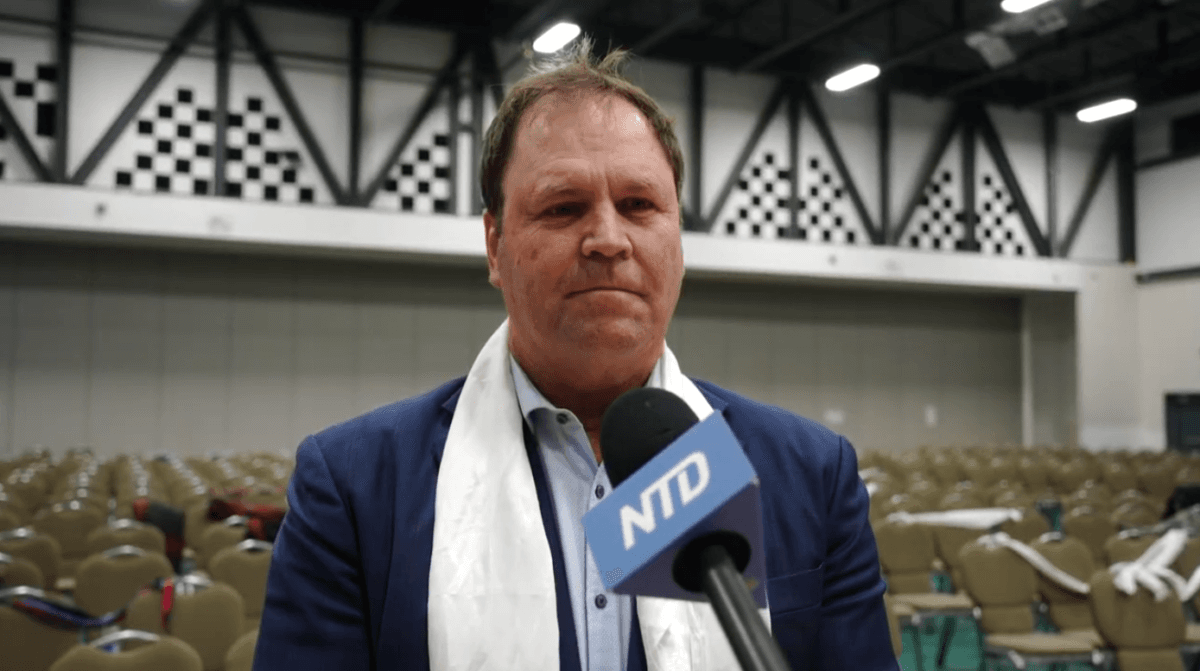
China scholar Charles Burton (C) speaks at a book launch event for his new book, “The Beaver and the Dragon: How China Out-Manoeuvred Canada’s Diplomacy, Security, and Sovereignty,” at the Tibetan Canadian Cultural Centre in Toronto on Nov. 29, 2025. NTD/Masih Ariani

Canada should avoid relying on China for exporting its goods, as such dependence would leave the country vulnerable to the Chinese regime’s economic coercion, says China scholar and Canadian author Charles Burton.
Burton launched his latest book, “The Beaver and the Dragon: How China Canada’s Diplomacy, Security, and Sovereignty,” at the Tibetan Canadian Cultural Centre in Toronto on Nov. 29.
His new book talks about his own 55-year history with China, where he had previously lived as a student and a diplomat, Burton told Epoch Times sister media outlet NTD at the book launch.
He said that in writing the book, he aims to “do something good for Canada-China relations,” noting that he continues to be concerned about “violations of human rights going on in China today, particularly the Tibetans in Tibet, the Uyghurs, and other groups that are being unfairly treated by the Chinese regime.”
“The main purpose of the book is for us to look at our past experience with China so that we can not make mistakes that we made in our past engagement with China as we go forward with [Chinese leader] Xi Jinping under Prime Minister Carney,” Burton said.
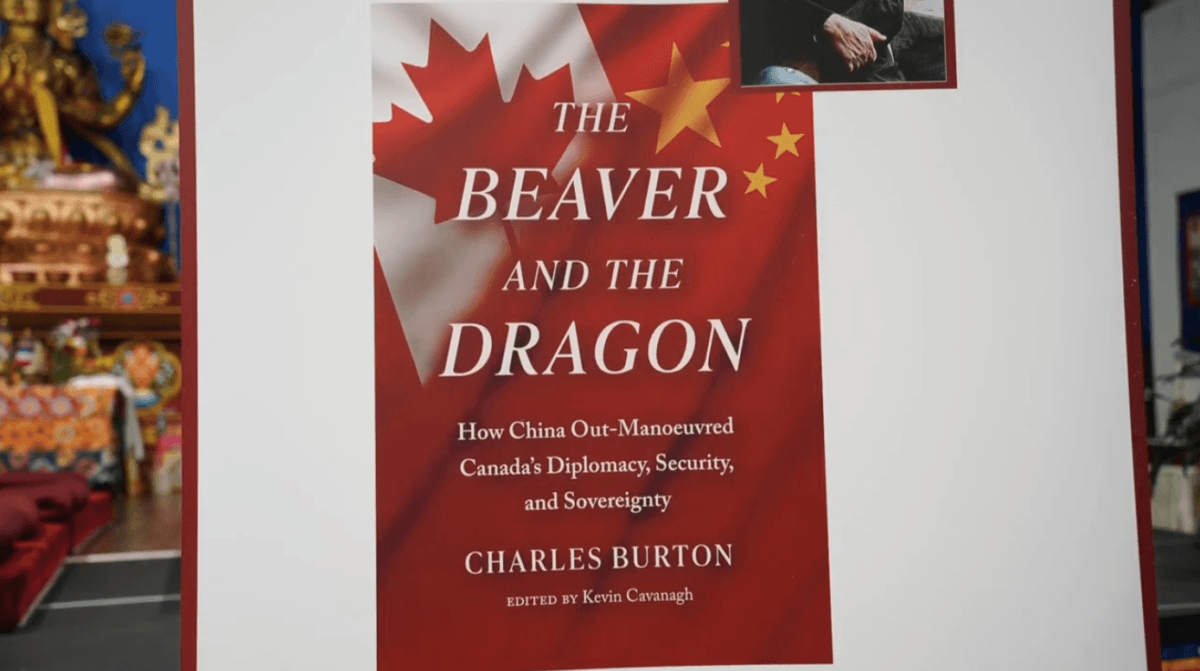
China scholar Charles Burton’s new book, “The Beaver and the Dragon: How China Out-Manoeuvred Canada’s Diplomacy, Security, and Sovereignty,” is seen at the Tibetan Canadian Cultural Centre in Toronto on Nov. 29, 2025. NTD/Masih Ariani
Burton noted that amid strained trade relations with the United States, Ottawa is “under pressure to quickly find new partners and markets” and this is something China “has the power to deliver if Canada agrees to revive the free trade negotiations bungled by Justin Trudeau in 2017.”
“It’s important that we not become dependent on the Chinese economy for export of Canadian natural resources, agricultural commodities, and mineral and wood products,” Burton said. Becoming overly dependent would mean the Chinese regime “can deny that access as a means of economic coercion to further their own geostrategic interests,” he added.
Canada’s primary focus for trade diversification should be with “democratic countries that pose no existential threat to Canada, as China does, Burton said.
Prime Minister Mark Carney met with the Chinese leader in South Korea on Oct. 31, during the Asia-Pacific Economic Cooperation forum. Both leaders described the meeting as a “turning point” in Ottawa-Beijing relations, with Carney saying the meeting opened the door to more business opportunities.
It was the first meeting between Canadian and Chinese leaders since former Prime Minister Justin Trudeau visited Beijing in December 2017. Relations broke down between Canada and China following the Meng Wanzhou affair in 2018 and recent revelations of China’s foreign interference and escalating transnational repression operations in Canada.
“Xi’s terse statement at the meeting made it clear that Canada is a supplicant to the Middle Kingdom [China], that Canada has been wrong, and Canada will change its ways,” Burton said at the Nov. 29 book launch.
The Chinese readout of the Oct. 31 meeting between the two leaders said Xi told Carney that both countries should “foster objective and rational perceptions of each other, view each other correctly, and advance the development of bilateral relations from the perspective of the common and long-term interests of the two countries”—points that were not mentioned in the Canadian readout.
The Prime Ministers’ Office said the two leaders “affirmed their commitment to renewing the relationship between their two countries in a pragmatic and constructive way.” Burton said the two words, “pragmatic” and “constructive” were “staple Chinese propaganda, words for not criticizing any Beijing actions that violate international norms in domestic terms.”
“It’s like China would be able to interfere in Canada’s democratic processes, or provide benefits to Canadians who are influential in policy formulation so they advance China’s geopolitical interests in Canada,” Burton said. “We’re really giving a tacit consent for these activities internationally.”
He said this could mean Canada wouldn’t speak out about China’s “policies of genocide” against various groups or its “violation of the language, cultural, and religious rights of Tibetans and other ethnicities.”

China scholar Charles Burton speaks to reporters at the book launch event for his new book, “The Beaver and the Dragon: How China Out-Manoeuvred Canada’s Diplomacy, Security, and Sovereignty,” at the Tibetan Canadian Cultural Centre in Toronto on Nov. 29, 2025. NTD/Masih Ariani
Transnational Repression
Earlier this year, leaders of the G7 countries signed a joint statement condemning transnational repression, pledging to support those who may be targets of this “aggressive form of foreign interference.”
Burton said the statement “acknowledges the existence of transnational repression, but it hasn’t resulted in Canada taking any effective measures against it as yet.”
“We haven’t expelled any of the diplomats and their proxies who are involved in transnational repression, nor have we declared persona non grata the senior levels within the embassy who are responsible for this kind of program,” Burton said, adding that he hopes Canada will take “a more serious and effective response” to the issue of transnational repression, “particularly against persons in Canada of Chinese origin.”
Having a foreign interference registry would also provide clarity about “actors in the policy process who may have a conflict of interest because they are receiving benefits from a foreign country,” Burton said.
In June 2024, Parliament passed Bill C-70, “An Act respecting countering foreign interference.” The legislation provided for creation of a foreign influence registry of those working in Canada as agents on behalf of foreign governments, as well as appointment of for a foreign interference transparency commissioner following consultation with opposition parties.
However, the registry has yet to be set up, and Public Safety Canada has yet to appoint a commissioner. Foreign Affairs Minister Anita Anand on Nov. 27 told MPs of the foreign affairs committee that, as stated previously by the public safety minister, the registry would be implemented by the end of the year.
“Unfortunately, we haven’t got the registry yet, and the fact that we’ve been so slow in implementing it, I think, has emboldened the Chinese [regime] to do more of this kind of interference, because there seems to be no consequences and no sincerity that they can perceive on the part of the Government of Canada to take effective measures to counter transnational repression,” Burton said.
Dean Baxendale, CEO of the China Democracy Fund and Optimum Publishing International, publisher of Charles Burton’s new book, “The Beaver and the Dragon: How China Out-Manoeuvred Canada’s Diplomacy, Security, and Sovereignty,” speaks to reporters at the book launch event at the Tibetan Canadian Cultural Centre in Toronto on Nov. 29, 2025. NTD/Masih Ariani
Burton’s new book is published by Optimum Publishing International. Optimum’s CEO and publisher Dean Baxendale, who is also CEO of the China Democracy Fund, told NTD at the Nov. 29 book launch that the G7 joint statement recognizes transnational repression as a problem but has yet to take concrete action.
“But there’s one thing about making a declaration, and then there’s backing it up. And so far, what we’re seeing from Canada is it’s not backing up those words with actual actions,” Baxendale said.
More and more people in Canada are being repressed and targeted by the Chinese regime using various forms of disinformation, intimidation, and coercion, he noted. He said Canada needs to create a database of these cases to demonstrate that the issue of transnational repression continues to be a global problem.
“The fact that governments are recognizing it is a great first step, so I applaud the nations that signed on to this, but we need to turn those words and that declaration into action,” Baxendale said.
Baxendale added that Canada can combat China’s transnational repression by being transparent about the issue, pushing back against the Chinese regime narratives that the problem isn’t happening, and continuing “to shine a light where no light has been shone before.”
Carolina Avendano and Paul Rowan Brian contributed to this report.
Olivia Gomm is a news reporter with the Canadian edition of The Epoch Times.