Source: The Epoch Times; Statistics Canada; Canadian International Merchandise Trade Portal

News Analysis
Canada’s economy faced significant shocks in 2025 due to a trade conflict with the United States, and the ripple effects are expected to carry into 2026.Several factors are still in play, including Ottawa’s increased spending to stimulate growth and its efforts to diversify trade beyond the United States. At the same time, the outcome of ongoing trade negotiations with Washington—and any relief they might bring—remains unpredictable.It also remains to be seen whether Ottawa’s Budget 2025 plan to create corporate incentives will attract investment, and whether this is enough to offset concerns about Canada’s lagging productivity and regulatory and tax burden.
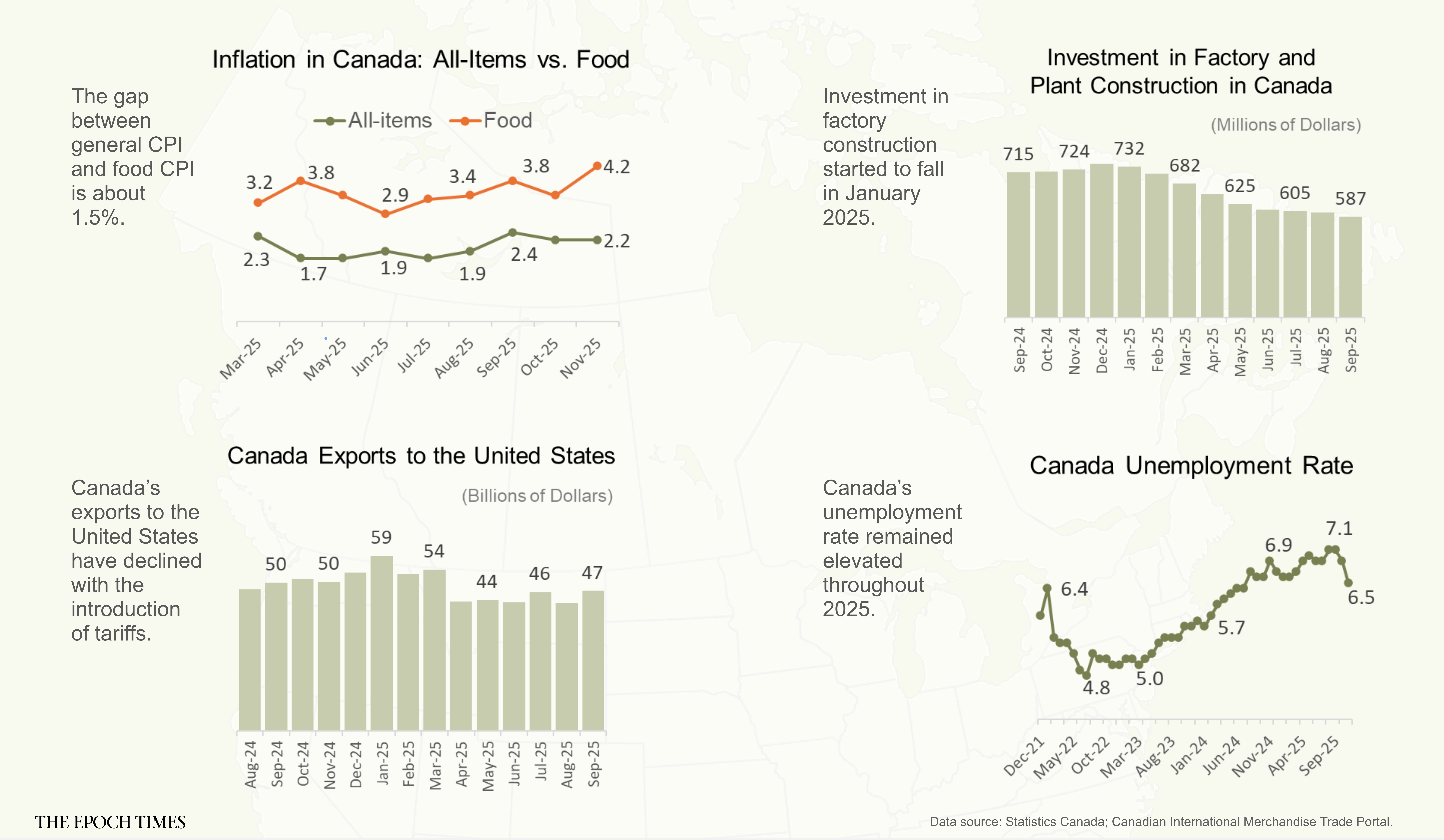
Amid the fog, the Bank of Canada recently said the impacts of U.S. tariffs on Canada have become “clearer.” And domestic business investment and exports south of the border have fallen, putting Canada’s economy on a lower growth path for the near future and putting upward pressure on inflation.

The central bank also said “considerable uncertainty” remains around the path U.S. tariffs will take, with U.S. President Donald Trump having wielded the measure in unpredictable ways throughout 2025. Another source of uncertainty that remains, the bank said, is the review of the United States-Mexico-Canada Agreement (USMCA) in 2026.
Eric Miller, founder of the Rideau Potomac Strategy Group, said Canada’s economic prospects for the new year will primarily depend on what happens on the trade front and on whether Ottawa is able to secure tariff relief. He said the prospects are also dependent on whether the United States falls into a recession.
Livio Di Matteo, an economics professor at Lakehead University, also noted the complexity of predicting the economic outlook.
“Forecasting the outlook for Canada’s economy in 2026 is ultimately an exercise in caution, given the large number of domestic and international economic moving parts,” Di Matteo told The Epoch Times. He pointed to U.S. trade issues as well as stimulus coming from proposed infrastructure projects and increased defence spending.
At the same time, Di Matteo said higher inflation and economic uncertainty could dampen consumer confidence and spending, which could be worsened by declining home construction and lower immigration.
Overall, the economics professor said there are “reasons to be optimistic” for Canada’s economic outlook, at least for the short term in 2026. He said elevated government spending and the growing trend of Canadians vacationing domestically are injecting stimulus into the economy, while the majority of Canadian trade with the United States remains tariff-free.
Di Matteo said that if trade issues with the United States are resolved and no major international crisis disrupts the global economy, increased defence spending and investment in major projects could support GDP growth of 2 to 3 percent in Canada, with unemployment potentially falling to between 5 percent and 6 percent.
The increased federal spending could come at a cost, however, according to a global credit rating agency following the tabling of Budget 2025 in November. The budget projected a $78.3 billion deficit for this fiscal year and a rising debt-to-GDP ratio.
Fitch Ratings said Canada’s rating is “broadly stable” but warned that “persistent fiscal expansion” and increasing debt have negatively impacted the country’s credit profile and could add more pressure over the medium term.
“This may be exacerbated by persistent economic underperformance caused by tariff risks and structural challenges, including low productivity,” said the agency. A country’s credit rating impacts its ability to borrow and attract foreign investment.
Fitch rates Canada “AA+,” a notch under “AAA.” Other ratings agencies like S&P and Moody’s rate Canada “AAA.”
Along these lines, Herbert Grubel, professor emeritus of economics at Simon Fraser University, has warned about Canada’s current fiscal track. He said in a recent Financial Post commentary that the country could be headed toward a “1990s-style fiscal reckoning,” where high debt levels lead to Canada’s credit rating falling further, interest rates rising, and the need for the government to declare bankruptcy.
Grubel told The Epoch Times he is concerned there will be more federal deficits “for the foreseeable future,” with no willingness to balance the budget. While Budget 2025 had the fiscal anchors of balancing day-to-day operating spending with revenues by 2028–29 and maintaining a declining deficit-to-GDP ratio, the budget does not commit to having a declining debt-to-GDP ratio as did the previous two budgets.
“Everybody agrees you can’t pile on debt forever. There must be a critical point at which people who are lending you money say we don’t trust that you can repay it, and you get into a crisis,” Grubel said, adding that he could not predict at what point Canada’s debt level would become unsustainable.
Monetary Policy Report
The Bank of Canada has produced an in-depth analysis of the economic outlook for 2026.
Its monetary policy report (MPR) release in October says that the trade dispute reducing Canadian exports to the United States and leading to falling business investment has put Canada’s economy on a “lower path.” The central bank says that uncertainty remains around how additional U.S. tariffs might shape up, how the USMCA will be reviewed, and how demographic shifts and the increasing use of AI will impact the Canadian economy.
The report projects Canada’s annual GDP growth will average 1.4 percent over 2026 and 2027, with a slow recovery as businesses adjust to the “new trade reality” and a weak labour market weighs on household spending.
The bank said population growth, which could give a boost to GDP, will likely remain low in 2026 due to Ottawa’s efforts to reduce immigration. Ottawa’s 2026–2028 Immigration Levels Plan reduces the target for new temporary resident admissions from 673,650 in 2025 to 385,000 in 2026, while reducing permanent resident admission targets from 395,000 in 2025 to 380,000 in 2026 and the same for the subsequent two years.
U.S. tariffs are anticipated to have “permanently reduced the level of Canadian GDP” when compared with the central bank’s January MPR, says the bank in its October MPR. The level of GDP is projected to be 1.5 percentage points lower by the end of 2026 than in the January report, with about half of the downward revision being due to a lower potential output, and the other half being due to weaker demand driven by a decline in exports.
Homebuilding may be slow in 2026, as the Canada Mortgage and Housing Corporation revised its national forecast for housing starts over 2025–26 back in July. The federal Crown corporation also said in its summer update that while housing activity had slowed in 2025, the housing market would see a gradual recovery in 2026 as “trade frictions ease, economic confidence improves and economic growth resumes.”
Inflation
Inflation is expected to remain moderate in 2026. The Bank of Canada’s October MPR projected that inflation would fall from 2.4 percent in September to around 2 percent in early 2026, as the removal of Canadian counter-tariffs on the United States will put downward pressure on the metric. The central bank predicts there will be an easing of inflation for services, excluding shelter, over its projection horizon of 2026 to 2027.
The bank said U.S. tariffs on global goods will put inflationary pressures on the cost of imports into Canada from the United States and goods produced in other countries, such as electronics and coffee beans. However, the MPR said overall inflation in goods “excluding energy” is expected to ease modestly over the projection horizon.

When it comes to food inflation, it is expected to keep outpacing general inflation.
The recently released 2026 edition of Canada’s Food Price Report, produced by Dalhousie University professor Sylvain Charlebois, says that Canadians will see food inflation of between 4 percent and 6 percent next year. This will lead the average family of four to pay up to $17,571.79 for food in 2026, or up to $994.63 more than in 2025.
The report forecasts that meat prices will see the largest increases, rising between 5 percent and 7 percent, followed by restaurant food prices at 4–6 percent and vegetables at 3–5 percent, while other food categories are expected to increase by 1–4 percent.
Charlebois said beef prices saw a large increase in 2025 due to falling cow herd sizes and higher costs for feed due to droughts in Western Canada.

The recently released 2026 edition of Canada’s Food Price Report, produced by Dalhousie University professor Sylvain Charlebois, says that Canadians will see food inflation of between 4 percent and 6 percent next year. nrd/Unsplash.com
With more Canadians turning to chicken as a more affordable protein source than beef, chicken prices are set to increase “substantially” in 2026 due to underproduction.
Charlebois told The Epoch Times that food inflation in 2026 will be due to “structural pressures that have been building for more than a decade.”
“Even with slower overall inflation, Canadians should expect grocery bills to keep rising because the system itself has become more expensive to operate,” Charlebois said, adding that addressing bottlenecks in food processing and logistics will not stop food prices from rising.
Interest Rates
The factors impacting the economy and inflation are diverse and will determine how the Bank of Canada sets its policy rate.
After the central bank reduced interest rates several times in 2025, it looks poised to keep them steady at the start of 2026.
The bank maintained its policy rate at 2.25 percent on Dec. 10, with governor Tiff Macklem saying that if inflation and economic growth in Canada remain in line with its projections, the current policy rate level would be at “about the right level” to keep inflation near 2 percent while helping Canada’s economy to grow.
The central bank also noted that Statistics Canada recently made revisions to the country’s economic growth numbers for 2022, 2023, and 2024, showing that Canada’s economy appeared “healthier than we previously thought” before U.S. tariffs were imposed.
On Dec. 4, the C.D. Howe Institute said the Bank of Canada should keep its policy interest rate at 2.25 percent in December and throughout 2026. Its Monetary Policy Council indicators around economic growth and inflation had created “no compelling evidence for a change in policy since the Bank’s last announcement in October.” The institute said weak domestic demand would likely move inflation gradually toward 2 percent.
BMO chief economist Doug Porter, who sits on the C.D. Howe Institute’s Monetary Policy Council, said the bank has recently revised its call to have no interest-rate changes throughout 2026, a view he said appears consistent with the central bank’s Dec. 10 announcement. With uncertainty over U.S. trade persisting, Porter added that BMO sees a greater likelihood of another rate cut in 2026 than a hike, even if the most probable outcome remains no change at all.
Tariffs and USMCA Renegotiation
Throughout 2025, Canada’s economy was affected by a series of U.S. tariffs. Washington imposed duties on a range of Canadian exports, including expanded 50 percent tariffs on steel, aluminum, and certain copper products; 25 percent tariffs on the non-U.S. content of vehicles and auto parts; and 10 percent tariffs on some energy products and potash that do not qualify for duty-free treatment under the United States-Mexico-Canada Agreement (USMCA). Canadian exports not covered by USMCA more broadly faced tariffs that were increased from 25 percent to 35 percent in August.
Tariffs are likely to continue impacting Canada’s economy in 2026, even if a deal is reached, given the Trump administration’s policy to maintain a certain amount of duties in place.
Could tariffs go higher and affect other sectors? Trump said on Dec. 8 that he was considering “very severe” additional tariffs on fertilizer imports from Canada in order to encourage the United States to produce its own fertilizer.
Trump ended trade negotiations between Washington and Ottawa in October because of an anti-tariff ad campaign by the Ontario government that he said misrepresented former U.S. President Ronald Reagan’s stance on tariffs. Trump announced days later that he would raise tariffs on Canada by an additional 10 percent because the “fraudulent” ad was not immediately pulled. This threat has not materialized.
Di Matteo said that despite Trump repeatedly saying the United States does not need anything Canada produces, he believes the United States “does need Canadian exports and there is going to be some type of trade agreement that will ensure reasonable access to the American market.”
The USMCA is scheduled for review in 2026, requiring the three governments to decide whether to extend the pact for another 16 years following the regular review, revise it, or risk its eventual expiration in 2036, which is 16 years after the agreement’s entry into force on July 1, 2020. Trump had touted the deal replacing the North American Free Trade Agreement as a major accomplishment during his first term, but he has criticized it of late, musing that he could let it expire.

U.S. Ambassador to Canada Pete Hoekstra recently said he does not believe the United States wants to “terminate” its trilateral trade agreement with Canada and Mexico. Canada-U.S. Trade Minister Dominic LeBlanc said he also believes the agreement will be renegotiated and not terminated.
However, U.S. Trade Representative Jamieson Greer said on Dec. 10 that the Trump administration was considering breaking up USMCA into separate agreements with Canada and Mexico, as the United States has a “very different” economic relationship with the two countries.
Rideau Potomac Strategy Group’s Miller said that if Ottawa were to negotiate “some modicum of a genuinely reciprocal bilateral deal,” it could increase the outlook for the economy.
Miller said that while there is “no guarantee” Canada can negotiate an advantageous deal, if Ottawa were able to reduce some tariffs, such as those on steel and aluminum, investors would “react very positively,” viewing it as a milestone on the road to trade normalization.