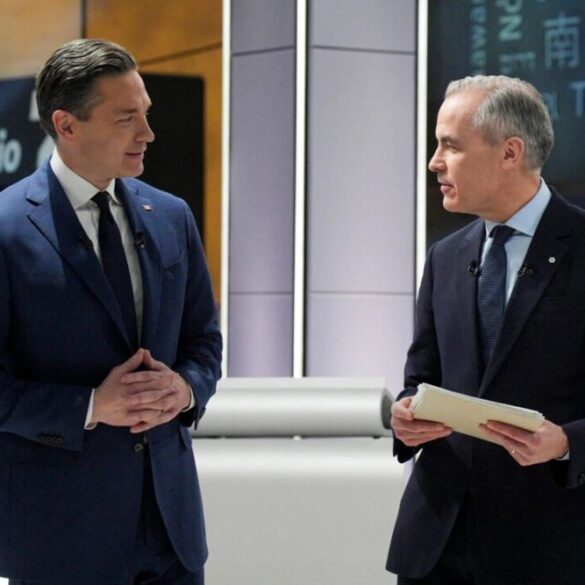
Conservative Leader Pierre Poilievre (L) and Liberal Leader Mark Carney talk following the French-language federal leaders’ debate at Maison de Radio-Canada in Montreal on April 16, 2025. Christopher Katsarov/POOL/AFP via Getty Images


News Analysis
This year was eventful, to say the least, marked in part by a change in leadership in Ottawa, and 2026 is likely to bring further shifts in party dynamics.
The year 2025 had started with Prime Minister Justin Trudeau announcing his resignation amid cratering support for the Liberal Party and poll numbers suggesting a Conservative majority.
Fast-forward to late 2025, and two Tory MPs have defected to the Liberals, bringing the minority government one seat shy of a majority.
Will this trend continue in the new year as Conservative Leader Pierre Poilievre prepares to face a leadership review in late January?
Will the Liberals be able to reach a majority, or will they themselves be affected by departures as former Trudeau ministers look to move on?
Meanwhile, the NDP doesn’t have many seats in the House of Commons but can still swing crucial votes, and the election of a new leader in March could impact that party’s strategy.
The lone Green MP Elizabeth May played a role in helping pass the budget, in exchange for a commitment to Paris Agreement climate targets from Prime Minister Mark Carney. However, she said she later regretted the move and may think twice before providing consequential backing to the government in future.
The Liberals
The Liberal Party has received a boost from the recent poaching of Tory MPs, using the floor-crossing to say that some Conservatives agree with the Liberals’ plan for the economy and disagree with Poilievre’s leadership style. The Conservatives’ main angle of attack against the Liberals has been the economy and affordability issues.
Liberal ministers say there are more Tory MPs who are unhappy and thinking about defecting. The Tories say they’re uniting on their core principles and pushing for affordability.
Government House Leader Steven MacKinnon has said a minority of Tory MPs are “frustrated” with their party leadership while the majority backs Poilievre.
Michael Ma, a former Tory MP for Markham-Unionville, crossed the floor on Dec. 11 to join the Liberals. MacKinnon told reporters on Dec. 12 that “there are others“ like Ma, who are dissatisfied with the Tories’ party leadership and are considering defecting.
Energy Minister Tim Hodgson was asked by reporters on Dec. 15 to comment on Ma’s defection. Hodgson is the MP for Markham-Thornhill, the riding neighbouring Ma’s in the Toronto area.
“Let’s say I’m getting lots of inquiries,” he said, when asked if he thinks he can convince more MPs to defect.
The Liberals are currently on the upswing boosting their numbers, with Ma following in MP Chris d’Entremont’s footsteps after the Nova Scotia MP left the Tories in November.
Though the Liberals have this momentum, their numbers could fall a bit, albeit temporarily, depending on what’s next for a handful of Trudeau-era ministers.
While there have been no signs that Steven Guilbeault is poised to leave the Liberal caucus, he reacted sharply to the energy agreement between Carney and Alberta Premier Danielle Smith signed in late November, resigning from cabinet and publicly accusing the government of abandoning its climate agenda.
For now, Guilbeault has remained within the Liberal caucus. His departure could impact the party’s standing in Quebec and caucus members who share his concerns.
Other former Trudeau ministers have kept a low profile and were rumoured as early as September to be under consideration for diplomatic postings in Europe. The Liberals needed the votes to pass their budget in November, and these moves have yet to materialize.
The Globe and Mail and CTV News have reported, citing anonymous sources, that Bill Blair was being considered for a posting in the United Kingdom, while Jonathan Wilkinson was under consideration for a diplomatic role in Brussels or Germany.
Blair, who previously held the defence and public safety cabinet portfolios, has only spoken once in the House of Commons since the opening of the new Parliament in May. He’s among only a handful of Liberal MPs to have spoken once or less.
Former cabinet minister Wilkinson is another of these low-profile MPs. According to OpenParliament.ca, he has not spoken in the House since December 2024.
The two former ministers are, however, members of House committees where they have participated in proceedings.
Blair was kept as defence minister when Carney appointed his first cabinet in March, but he was left out of the second cabinet announced after the April election. Wilkinson had a similar fate as energy minister.
Another prominent Liberal who could be on the way out is Chrystia Freeland.
Freeland lost the Liberal leadership race in March and served as transport and internal trade minister in Carney’s first and second cabinets.
She handed in her resignation on Sept. 16 and said she would not seek re-election. On the day of her resignation, Carney appointed her as special representative for the reconstruction of Ukraine. She has not spoken in the House since June 20.
Freeland was recently named the new administrator of the Rhodes Trust educational charity in the UK and is expected to move to Oxford, England, next summer. She has not indicated whether or when she intends to resign her House seat.
If any of these former Trudeau-era ministers resign their seat, the Liberals’ minority would weaken and byelections would likely be called in short order. The lower seat count would likely be temporary, however, given how Freeland, Blair, Wilkinson, and Guilbeault won their 2025 elections by significant margins and that their ridings are considered safe seats for the Liberals.
Along with these relatively minor potential internal changes, there could be broader shakeups in the government team.
Carney was new to politics when he became prime minister in March 2025, and by now he should know who the top performers are within his cabinet.
It’s hard to gauge the appetite for new blood, however, given the latest cabinet move involved appointing Marc Miller to replace Guilbeault on the Heritage file.
Miller was close to Trudeau and previously held the cabinet portfolios of immigration, Crown-indigenous relations, and indigenous services.
On the departure of Freeland, Carney also chose experience over novelty by adding her transport minister responsibilities to Steven MacKinnon’s, who also serves as House leader.
A majority of recent polls suggest the Liberals have not lost much support since the April election, with Carney maintaining the upper hand on Poilievre in terms of favourability.
Carney’s inability to reach a deal with the United States hasn’t had much impact on his popularity.
What to watch for with the Liberals is whether they’re able to reach a majority by poaching opposition MPs, and if this strategy doesn’t work, whether they’ll be tempted to call a snap election. They could also come under greater threat from the opposition parties after the Tories complete their leadership review and the NDP selects a new leader.
The Conservatives
Poilievre will begin 2026 with a referendum on his time as party leader, as the Conservative Party’s January 2026 national convention in Calgary will include a leadership review. The party’s constitution requires a leadership review 12 months after an election loss.
While the Conservative Party had been heavily favoured to form government throughout 2024, the resignation of Trudeau, his replacement with Carney, and a new U.S. administration contributed to a Liberal resurgence.
Poilievre lost both the election and his long-held Ottawa-area seat of Carleton, but he noted that his party made seat gains and obtained its best popular vote result since 1988, at 41.3 percent. The Progressive Conservatives of Brian Mulroney obtained 43 percent of the vote in 1988 and a majority, with 169 seats compared to 83 for the Liberals.
Poilievre returned to Parliament after winning an Alberta byelection in August but was beset by the first defection shortly after the fall session opened, when d’Entremont crossed the floor on Nov. 4. Around that time, Tory MP Matt Jeneroux was also rumoured to be contemplating defecting, but he instead announced he would be resigning his seat next year.
MP Michael Ma announced he was crossing the floor to the Liberals on Dec. 11.
Hours before Ma announced his floor-crossing, Poilievre was asked by a reporter how confident he was that he would receive good numbers from the leadership review vote. Poilievre simply responded, “very.”
Angus Reid polling numbers from a survey done from Nov. 26 to Dec. 1 indicated that 58 percent of Conservatives support Poilievre remaining leader of the party, while 26 percent said he should be replaced by a new leader and 16 percent were unsure. In an Angus Reid survey conducted back in August, 68 percent said Poilievre should stay on as leader, while 18 percent wanted him replaced and 14 percent were unsure.
It remains to be seen if more Tory MPs will defect in the new year and whether this will have an impact on Poilievre’s leadership review.
In any case, the Conservatives are likely to continue focusing on affordability in 2026, particularly around the rising cost of groceries. Poilievre has been calling for the government to end “hidden Liberal taxes on food” for months. He again highlighted rising costs in reaction to the recent Canada’s Food Price Report 2026 that found Canadian families will pay almost $1,000 more per year on food next year.
Criminal justice reform will also be a priority for the Conservatives in the new year, with several bills related to justice currently moving through the House of Commons. The Tories have been critical of Liberal criminal justice policies, which they say are soft on criminals and have led to rising crime rates in Canada.
The Conservative Party has argued that Bill C-14, which focuses on bail and sentencing reform, does not go far enough and has called for a “three-strikes” law that would deny bail and parole to those convicted of three serious offences. Although the Conservatives tabled multiple motions to make Bill C-14 a priority for the justice committee, those efforts were rejected in favour of completing the review of Bill C-9, also known as the Combatting Hate Act.
The battle on Bill C-9 within the justice committee will continue in the new year given clause-by-clause consideration was not completed before the House went on Christmas break.
The Conservatives had opposed the adoption of an amendment to C-9 in committee to remove the religious defence to hate speech in the Criminal Code. The Bloc Québécois introduced the amendment, which received support from Liberals in a deal to ensure the support of one opposition party to their piece of legislation.
The Tories have said that the amendment will impact freedom of religion and expression, while Justice Minister Sean Fraser said it won’t.
The NDP
In the April federal election, the NDP went from 24 seats in the House of Commons to seven, losing official party status. Party leader Jagmeet Singh resigned on election night after losing his own seat, and MP Don Davies became interim leader in May.
Given that the NDP’s loss of official party status prevents its MPs from participating in committees, and that its questions to the government only take place at the end of question period, the party had less visibility in the latest sittings of the House. Davies joked at the Parliamentary Press Gallery dinner on Nov. 29 that his “pronouns” were “broke” and “irrelevant.”
As the Liberal government is a few seats shy of a majority, the NDP’s seven seats became a topic of discussion during the confidence votes around the federal budget. The NDP held the balance of power during the vote, but two of its MPs abstained from voting on the budget on Nov. 17 while the remainder of the NDP MPs voted against it, which allowed the budget to pass and staved off a potential election.
On the Tory side, Jeneroux did not vote and neither did Shanon Stubbs, who was on medical leave.
If the Liberal government does not obtain a majority through more MPs crossing the floor in 2026, the NDP could again play an important role in confidence votes.
Davies told reporters on Dec. 10 that the party has had to deal with a “new political reality” following the election but has shown that “we are a relevant, strong, united, and very important voice in the House of Commons.” He added that Canadians repeatedly told him in 2025 that they do not want a “U.S.-style, two-party system.”
The New Democrats are also currently engaged in a leadership race. The five candidates are Edmonton-area NDP MP Heather McPherson, filmmaker and activist Avi Lewis, union leader Rob Ashton, B.C. city councillor Tanille Johnston, and farmer Tony McQuail.
According to a Pollara poll from October, none of the leadership candidates are widely known. McPherson was recognized by 20 percent of respondents, while Lewis was recognized by 16 percent and Ashton was recognized by 14 percent. The poll indicated that there was relatively low general public interest in the NDP leadership race.
The NDP leadership vote is scheduled for March.
The Bloc
Bloc Québécois Leader Yves-François Blanchet recently said it was “very possible” that Canada could be in another election campaign before the fall of 2026, as surviving the spring could be a “big challenge” for the Liberal Party. Blanchet said the Liberals have not been open to negotiations with other parties, including the Bloc’s demands when it came to Budget 2025.
The Bloc did not vote in favour of the federal budget because it did not contain any of the party’s demands, which included higher Old Age Security payments and increased health and infrastructure transfers to the provinces. Blanchet said on Nov. 18 following the budget vote that the Liberals had “exploited the momentary weaknesses of everybody” to win the vote and that they had not been good partners.
However, the Liberals recently agreed to support a Bloc amendment to Bill C-9 aiming to remove the religious defence to hate speech from the Criminal Code, in exchange for the Bloc supporting the bill as it moves through the House to become law.
The Bloc is likely to continue focusing on opposing the Liberal government’s position on a Supreme Court case around the usage of the notwithstanding clause. That clause, Section 33 of the Charter, allows the federal and provincial governments to override some provisions of the Charter by enacting a law and also prevents judicial review of the legislation for five years.
The Bloc introduced a motion in the House of Commons in September calling for the Liberal government to withdraw the factum it filed with the Supreme Court that cited concerns regarding Section 33, and Blanchet has raised the issue in the House several times. With the Supreme Court hearing the case in 2026, the Bloc is likely to continue pressing Ottawa on the issue.
Fall 2026 will also see an election in Quebec, with the Parti Québécois, which has ties to the Bloc, leading the polls. Blanchet said his party would respond to the demands of Parti Québécois Leader Paul St-Pierre Plamondon once they are formulated.
The Canadian Press contributed to this report.
Matthew Horwood is a reporter based in Ottawa.
Noé Chartier is a senior reporter with the Canadian edition of The Epoch Times. Twitter: @NChartierET