The Department of Transportation said it is preparing for ‘both human-driven and automated vehicles coexisting on public roads.’
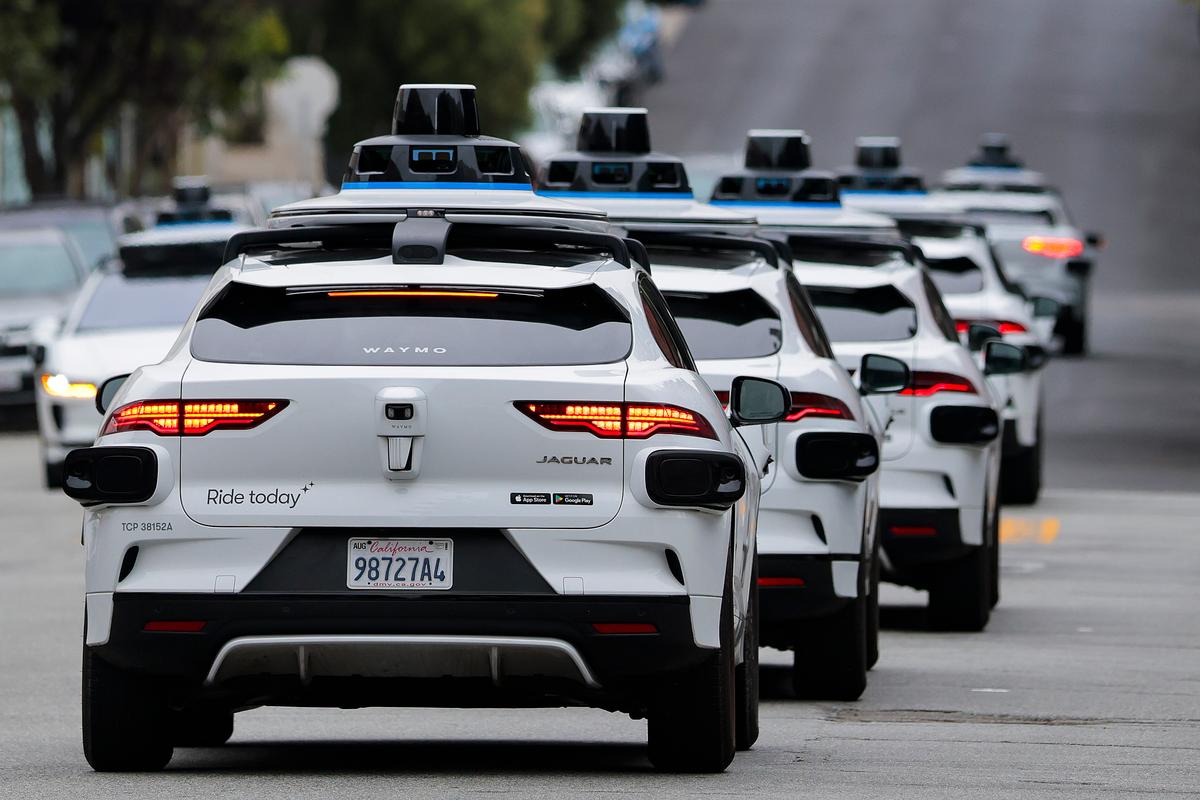
A line of Waymo robotaxis drives through North Beach in San Francisco, Calif., on July 7, 2026. Heather Diehl/Getty Images
The way automated vehicles (AVs) drive frustrates many motorists sharing the road with them, leading to more dangerous driving and possibly road rage.
That is one way to interpret the findings of researchers at Chinese universities in a newly released paper that aims to gauge the effects of integrating AVs into car fleets worldwide.
“Automated vehicles drive safer but induce riskier behavior in human drivers in car-following scenarios” is the title of the new paper, published in the journal Communications Engineering in October.
Researchers Yueying Chu and Peng Liu from Zhejiang University, and Ying Gao and Zhigang Xu from Chang’an University, sought to answer two questions using available AV driving data: Will AVs drive more safely? And will AVs make nearby human drivers drive safer?
The answer to the first question was yes.
“Our evidence clearly shows that AVs drive safer and smoother as compared to their human counterparts in car-following,” the researchers reported.
The answer to the second question was complicated, and potentially deadly.
Cars following AVs tend to drive more slowly because that is what drivers most often do when a slow car is in front of them. In that sense, the behavior of human-driven vehicles was coded as safer.
The reason AVs tend to be the slower cars is that they are programmed to obey all traffic laws and treat speed limits as an upper bound, not a suggestion.
Yet following behind AVs also led human drivers to engage in behavior that the researchers coded as risky. Human-driven cars followed AVs more closely, which is another way of saying they tailgated them.
The Chinese researchers examined several reasons why this might be the case. Their best answer was that because AVs in the lead do not tend to vary their speed, human drivers are more comfortable leaving a smaller gap.
“So, ironically, AVs’ better velocity and acceleration management might, unconsciously or implicitly, lead their human followers to maintain a shorter distance and create higher tailgating potentials,” they write.
The paper did not examine passing.
On a road with multiple lanes in both directions, passing is relatively safe behavior. Statistically, on two-lane roads, it is much more dangerous because it can lead to collisions with oncoming traffic, sideswipes, or other damaging, often fatal, outcomes.
More tailgating wasn’t the only potentially dangerous finding in the paper. It also found that because AVs tend to leave more distance than humans would between themselves and the lead car, other human-driven cars are more likely to “cut in” to that gap, which can lead to accidents, the Chinese researchers found.
That AVs leave significant room and that humans tend to tailgate them is consistent with other findings involving AVs and accidents.
Transportation Secretary Sean Duffy called safety “critical” to the success of the AV industry.
Duffy wrote in an introduction to a September report that AVs “don’t drive drunk, they don’t get tired, and they can’t get distracted by an incoming text message or notification—all significant contributors to crashes today.”
The Department of Transportation said it is preparing for “both human-driven and automated vehicles coexisting on public roads” for the foreseeable future.
The safety record of AVs is usually better than that of human drivers, studies have shown.
A July study released by the Insurance Institute for Highway Safety found that the L4 class of Waymo’s AV taxis crash at “police-reportable” rates that are 68 percent lower than those of comparable human drivers traveling the same roads under the same conditions.
“Waymo’s rate of rear-ending another vehicle was 91 percent lower; its vehicles’ rate of being rear-ended was 40 percent lower,” the study found.