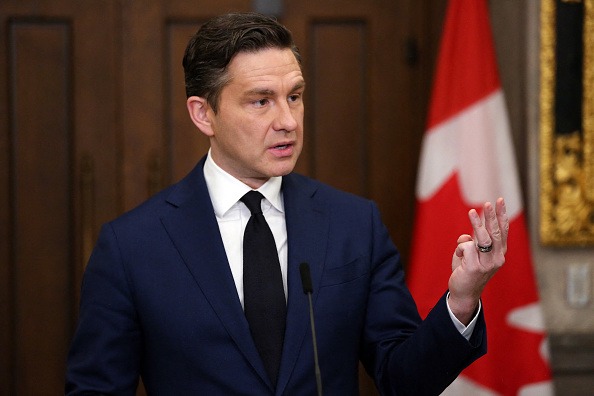
Conservative Party leader Pierre Poilievre speaks during a news conference on Parliament Hill on December 16, 2024 in Ottawa. (Photo by Dave Chan / AFP)
Leader of the Opposition Pierre Poilievre criticized Prime Minister Mark Carney’s apparent strategy of using closer economic ties with China as leverage in negotiations with Washington, saying China cannot replace the United States in trade.
“We cannot replace our number one customer with a strategic alliance for what Mr. Carney calls a new world order, with Beijing, a country that he said was the biggest threat to Canada a year and a half ago,” Poilievre said during a Nov. 22 press conference in Ottawa.
Poilievre questioned the effectiveness of Carney’s approach to China, saying, “So far, it hasn’t produced any results.”
Carney told The New York Times’ DealBook Summit on Nov. 18 that some progress had been made toward a trade deal with the United States, but “we’re not there yet” in finalizing an agreement.
Carney compared trade negotiations with the United States to those with China, describing Beijing as “very professional” and saying, “They moved forward in a very linear fashion. And it’s all very rational and moving forward.”
He also said Canada should have reached a deal with the United States six months ago.
Poilievre argued that Canada should instead focus on securing completely tariff-free trade with the United States.
Asked whether he would accept an interim agreement reportedly under consideration by Canada and the United States that would provide tariff relief for steel, autos, aluminum, and lumber while retaining some tariffs, Poilievre said he had not seen the proposed agreement and could not endorse it.
“We think the mission should be tariff-free trade,” he said.
“We have massive leverage with our resources and our military spending, the most successful historic trade relationship in the history of the world, and we should be fighting for a tariff-free trade with our biggest customer.”
Poilievre also argued that U.S. tariffs were hurting American consumers, citing automobiles, gasoline, and lumber as examples.
“Americans are paying more for Ford F-150s because of tariffs on the aluminum that form the shell of those vehicles,” he said.
“They’re paying more for gas because we’re not selling them as much oil as we could. They’re paying more for homes because of ridiculously high 45 percent tariffs on the lumber from Canada that could build American homes.”
Poilievre also said Carney had not briefed him on the progress of Canada-U.S. trade negotiations since August. He said the two last spoke by phone for approximately 40 minutes after negotiations fell apart that month.
“To my recollection, that’s the last time we discussed this particular issue,” he said.
The Canada-U.S. trade talks collapsed on Aug. 21, with the United States blaming Canada for the failure and Carney saying it was due to auto-sector tariffs and other demands that would adversely impact Canada’s sovereignty.