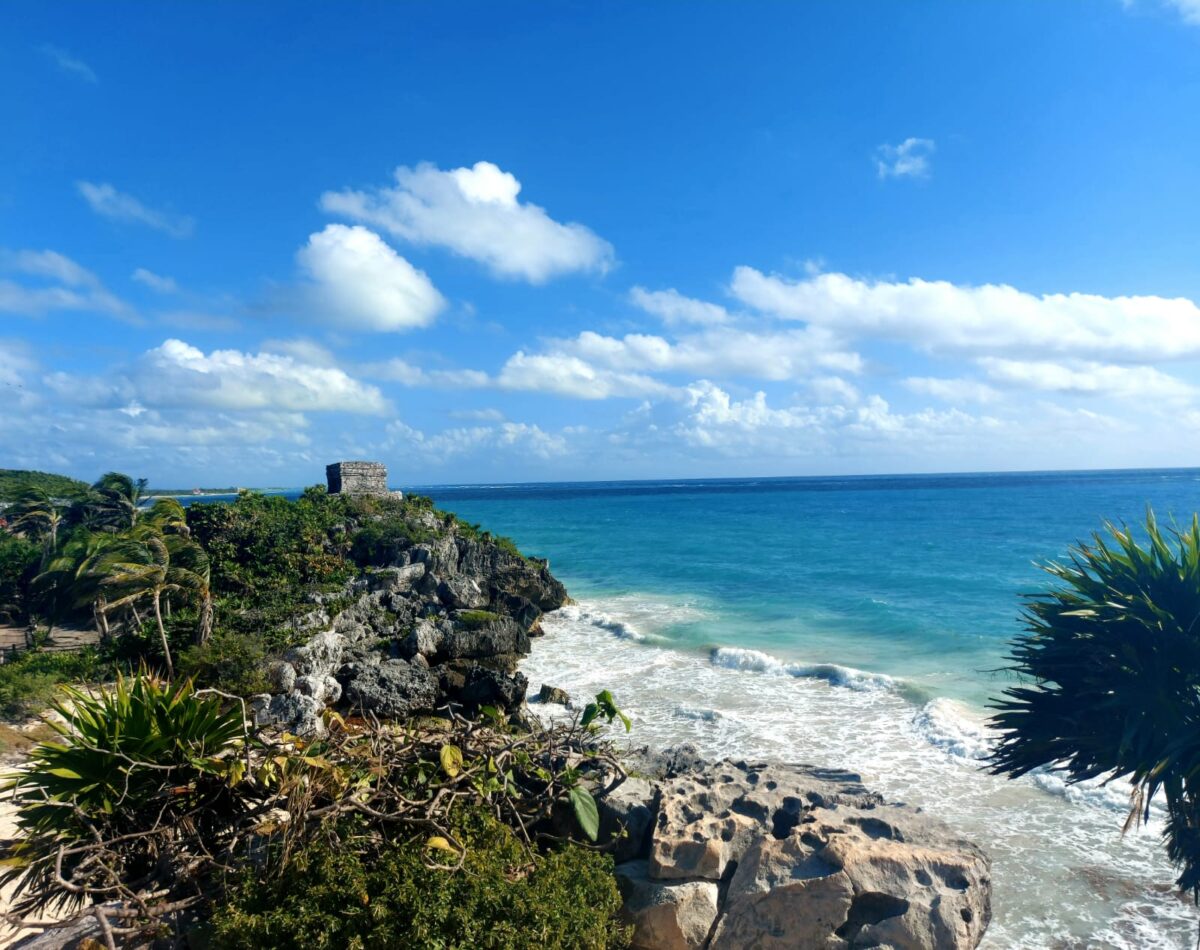
Tulum in Quintana Roo, Mexico, a popular spot for foreigners and digital nomads to work and live, is seen on Dec. 31, 2021. (Autumn Spredemann/The Epoch Times)
After serving more than five years as a pilot in the Royal Canadian Air Force, Daniel Pamudja wanted to settle down to a more traditional lifestyle. He got married, had children, and looked to buy a home and raise his family in the security of the country he had grown to love.
But in recent years, he began to sense that the values and history on which Canada was built were quickly eroding, he says. In his view, when laws and practices began to border on being unethical, and when government policy responses to the COVID pandemic infringed on the rights and freedoms he enlisted to defend, the country no longer felt the same.
Today, Pamudja and his family live in Cuauhtémoc, a borough of Mexico City. And they aren’t the only ones who sought a new life in Mexico.
The Pamudjas are part of a larger community of Canadians and Americans who have left for Mexico without any intention of returning. They are united, he says, by a common belief that Canada and the United States have abandoned, or are in the process of abandoning, the free and moral fabric in which they grew up.
“Life is a lot freer here. We’re in a good community with a good church. Everything is going well,” Pamudja said in an interview.
“We moved because of all this immorality and laws that have been put up in Canada. Especially for children, with Bill C-16 [gender identity rights] and all these other bills that make you, as parents, not able to have control over your own children. And the whole COVID [response], the fear. There’s a few reasons.”
Edmonton resident and business owner Gordon Bostad, 62, is also moving to Mexico with his wife, adult children, and grandchildren because of how things have changed in Canada in recent years.
“It’s heading down a bad road. I feel it’s turning socialist, which always turns into communism,” he told The Epoch Times. “We’d lived in Mexico before, we had a winter home there for nine years, so it just seems like a better option for us to live there.”
Bostad says one of the signs Canada is turning more socialist is how the government is racking up huge debt to support different programs, such as universal daycare, and it’s not getting opposition from other parties or scrutiny from the media.
“Ten years ago, that wouldn’t have been something that would have gone through in this country,” he said. “Who’s going to pay for that?”
In total, 11 members of the Bostad family are moving.
He says he and his family will be living in a five-acre estate south of Cancun and will be growing their own food. They’ll have solar panels to generate power locally, along with two wells and a rainwater irrigation system. He adds that his adult children are involved in computer-based businesses and so can work from anywhere.
Bostad says there are many good things about Mexico, such as better access to health care and health specialists as well as milder weather. He concedes that there are problems with corruption and major drug cartel operations, but he says his attitude is that he’s going to be responsible for himself and not “expect anything from the government.”
“Everybody looks after their own families, looks after themselves a little better. Here [in Canada], every single article in the mainstream news is about what the government is going to do to solve this or that problem,” Bostad says, adding that he thinks if people aren’t involved in the drug business, then there isn’t much risk facing them.
According to World Population Review for 2022, Mexico has a crime rate of 54 per 100,000 people, ranking 39th globally. Canada’s rate is 41.9, in the 82nd spot, and United States ranks 56th with 47.8 per 100,000 people.
In 2020, Mexico had a homicide rate of 28.4 per 100,000 people, according to United Nations data. Canada had a rate of 1.97, and the United States had 6.52.
The poverty rate in Mexico was 16.6 percent in 2019, the 9th spot among the OECD countries, according to Statista. In Canada it was 11.8 percent, the 18th spot, and in United States it was at 17.8 percent, taking the third spot.
According to Statistics Canada, emigration out of Canada in 2021–2022 was 49,769, higher than 35,838 in 2020–2021 and 34,835 in 2019–2020, as well as 47,337 in pre-pandemic 2018–2019.
Helping Others Relocate
Further south, Shari Gold shares a similar story. She and her family left Canada for Costa Rica in October 2021.
Gold was in the beauty business, with three locations, before COVID-19 lockdowns were implemented. Her sector was among the industries forced to close. And when vaccines were made mandatory, Gold and her husband were skeptical and cautious because one of their children, they suspect, developed an autoimmune disease from a previous childhood vaccination.

“In the beginning, we were kind of nervous like everybody was, and we didn’t know anything,” Gold told The Epoch Times. “But very quickly, you could tell what the objective was, and you could tell that the only solution that we were going to be provided for this was a vaccine.”
Moving from a spacious 4,000-square-foot house in Vaughn, Ontario, to a 1,500-square-foot “beautiful little oasis pad” in Playa Flamingo, Gold and her family left with six hockey bags of luggage and belongings to begin their new adventure.
“We’re just living and enjoying life right now,” she said. “My only regret is we didn’t leave sooner.”
Almost two years ago, Toronto native Mark Savoia and his wife also moved permanently to Costa Rica. Not only are they enjoying life in their new home, they have made it their profession to help relocate other Canadians to the country. And the demand from their countrymen isn’t slowing, he says, adding that on average he receives approximately 400 emails a day, many asking about moving to Costa Rica.
“It is insane the amount of Canadians, like ourselves, that are here,” he said.
Much of Savoia’s work involves finding real estate for people coming to the country. He also organizes flights for Canadians, including when the government barred many of them from travelling because of their vaccination status. Flights have often been weekly.
“I have access to one of the few companies that can fly people privately,” Savoia said. “And the way [my contact] did it, is he brought planes in from Colombia, the UK, Dominican Republic.”
‘I Keep Hearing the Same Stories’
Glenn Tellier, owner of Costa Rica Immigration Experts, a business designed to help foreigners get residency and integrate into Costa Rica, estimates that thousands of Canadians have left Canada for Costa Rica in the past two years.
“I don’t know the number, but I know they’re coming down in droves,” Tellier, a Toronto native who moved to Costa Rica 22 years ago, told The Epoch Times. “My wife does the residencies, so she’s jam-packed solid. She’s never been this busy, ever. And it’s pretty much all Canadians coming down.”
He says the Canadians moving virtually all tell him the same story.
“I don’t think they’re happy with all the stuff that good old Trudeau is doing,” he said. “They’re not happy with all the stuff that happened with the vaccinations, the way it was pushed on them. I keep hearing all the same stories.”
The emigration out of Canada doesn’t surprise David Leis, vice-president of development and engagement with the Frontier Centre for Public Policy. Governments and policy-makers, he says, have taken Canadians for granted.
“We’re in a challenging time as a country,” Leis told The Epoch Times.
“We know that although Canada is a country that’s blessed with incredible natural resources and assets, its most valuable asset truly is its people. And decision-makers would do well to remember that Canada is not the only choice where people can move to and establish a better life,” he said.
“People are increasingly concerned and worried, and it takes an awful lot of concerns to tip someone over in their decision-making process to move to another country. And so I think this should be a wake-up call for decision-makers and frankly all Canadians, that this is a time where a number of people are considering their options.”
The Epoch Times reached out to Ministry of Intergovernmental Affairs, Infrastructure, and Communities but did not receive a response.