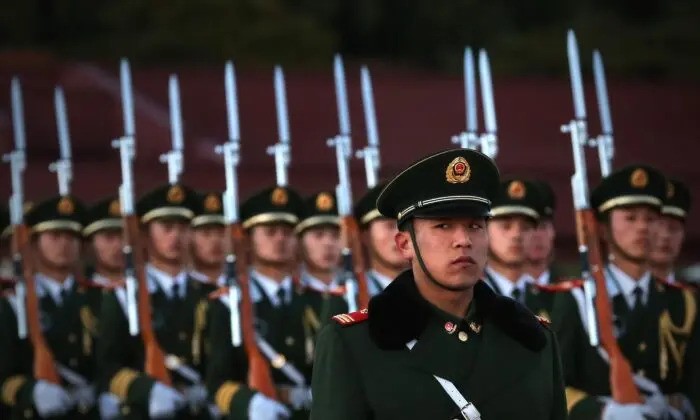
A paramilitary police officer stands guard during the flag-lowering ceremony at Tiananmen Square in Beijing on Nov. 13, 2012. (Feng Li/Getty Images)
Canada unveiled a list of foreign universities and research institutions linked to military, national defence, and state security entities. Predominantly composed of entities based in China, these organizations are identified as presenting the highest risk to Canadian national security.
Seven Sons of National Defence
The Seven Sons of National Defence refers to the seven universities directly overseen by China’s Ministry of Industry and Information Technology. This includes Beihang University, the Beijing Institute of Technology, Harbin Engineering University, Harbin Institute of Technology, Nanjing University of Aeronautics and Astronautics, Nanjing University of Science and Technology, and the Northwestern Polytechnical University.
Beihang University
Beihang University, previously known as the Beijing University of Aeronautics and Astronautics, focuses on aviation and spaceflight research. It has actively contributed to the development of Chinese military aircraft and missiles, according to the ASPI. Beihang is listed in both the Japan End-User List and the U.S. Department of Commerce Entity List. Additionally, its subsidiary, Beijing Tianhua, was added to the U.S. Entity List, alongside 17 aliases.
Beijing Institute of Technology
The Beijing Institute of Technology is recognized as a top institution in China for weapon science.
Espionage
The ASPI has cited reports of individuals charged with or allegedly involved in espionage activities who are associated with the other four of the Seven Sons universities, namely the Nanjing University of Aeronautics and Astronautics (NUAA), Harbin Engineering University (HEU), Harbin Institute of Technology (HIT), and Northwestern Polytechnical University.
Harbin Engineering University
Harbin Engineering University, recognized for developing China’s first experimental submarine, ship-based computer, and hovercraft, has close ties with the PLA Navy. In 2001, HEU entered into an agreement with the PLA Navy to provide training for military officers. In 2008, it established a Defense Education Institute, which has since trained up to 1,700 reserve officers, according to the university website.
Harbin Institute of Technology
Similarly, several cases of Chinese espionage activities have been connected to the Harbin Institute of Technology, according to ASPI. The university has connections with Dongfan Chung, a former Boeing engineer convicted in 2010 of economic espionage for China. Mr. Chung had reportedly expressed a desire to contribute to China’s modernization and sent technical materials to HIT, as reported by the Los Angeles Times.
Northwestern Polytechnical University
Northwestern Polytechnical University (NWPU), devoted to bolstering the Chinese defence science and technology industry, is known for its development of unmanned aerial vehicles (UAVs). It is the only Chinese university hosting a UAV defence laboratory. According to the ASPI, the Chinese military is reportedly the main customer of its subsidiary company, Aisheng Technology Group Co. Ltd., which once claimed to produce 90 percent of the Chinese drones market.
Organ Harvesting
Several universities listed in the Named Research Organizations have reported connections to the Chinese Communist Party’s (CCP) forced organ harvesting scheme. Universities implicated in this scheme, which heavily targeted adherents of the spiritual practice known as Falun Gong or Falun Dafa, include Army Medical University, Air Force Medical University, and Navy Medical University.
Revelations of these institutions’ participation in the scheme were disclosed by the World Organisation to Investigate the Persecution of Falun Gong (WOIPFG), an investigative body focused on exposing the persecution of Falun Gong practitioners in China with the aim of restoring justice.
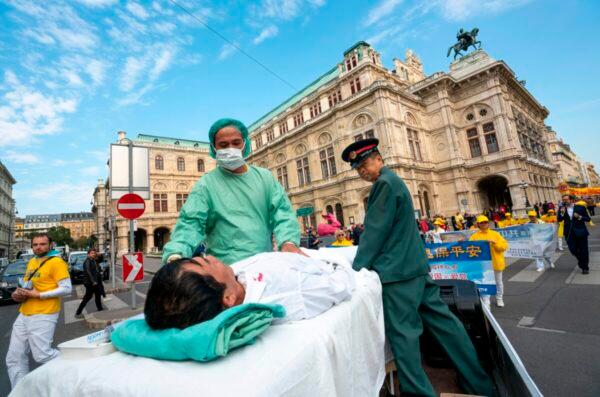
While the doctor denied ongoing participation in organ transplants, he acknowledged the existence of an “organ bank.” He confirmed continued organ transplant based on “donation after circulatory death,” referring to the organ donation option for patients with severe brain injuries after a decision has been made to remove all life-sustaining treatments.