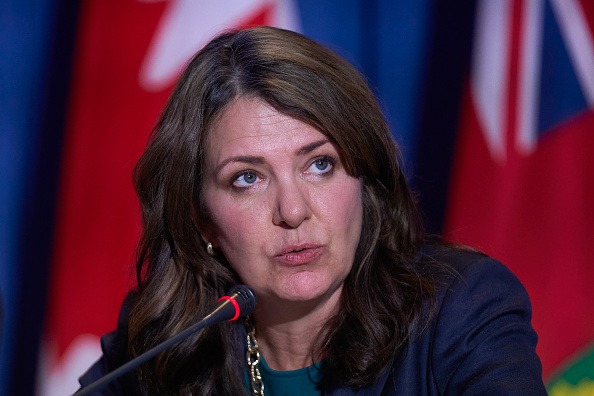
Alberta Premier Danielle Smith speaks during a press conference at Canada’s Premiers Conference in Toronto, Ontario, December 16, 2024. (Photo by Geoff Robins / AFP)
The Alberta government is taking measures to restrict the eligibility criteria for medical assistance in dying to prevent patients with mental illness or those who are not terminally ill from qualifying for the procedure.
Premier Danielle Smith’s United Conservative Party government introduced the Safeguards for Last Resort Termination of Life Act during a press conference on March 18. If enacted, it would limit medical assistance in dying (MAID) to individuals who are expected to die from natural causes within a year, while disqualifying those whose only underlying condition is mental illness.
Those younger than 18 would continue to be barred from MAID regardless of their condition, in alignment with current federal regulations, Smith said during the press conference with Justice Minister Mickey Amery.
The move comes amid federal expansion of the MAID regime in recent years and rising numbers of Canadians choosing euthanasia. Smith expressed concern that vulnerable patients are being put at risk.
“Alberta believes that patient safety is and must always be our first concern, and our government has been highly skeptical of federal moves to widen eligibility to those whose only medical condition is mental illness,” she told reporters, adding that receiving MAID is “permanent and irrevocable, and because of this, we have an obligation to consider MAID with the utmost care and caution.”
Ottawa initially planned to expand MAID’s criteria in 2024 to allow those facing depression or mental illness to be eligible, depending on certain criteria and other safeguards. But the final decision was delayed until 2027 as debate around the issue continues.
Smith said Alberta is taking measures to prevent that potential change from taking effect in her province, and expressed “profound misgivings” about it, saying care and treatment options are often available for those who aren’t facing a reasonably foreseeable death.
“MAID should not become a permanent response to a moment of crisis or despair that can change with care and time,” Smith said.
Alberta’s proposed MAID criteria closely mirrors the original framework of Canada’s MAID program established in 2016, when it was strictly limited to those who were terminally ill.
Canada expanded access to MAID in 2021 to include people whose death is not reasonably foreseeable, two years after a superior court judge in Quebec ruled it was unconstitutional for MAID to be restricted to those with terminal illnesses. Justice Christine Baudouin found the previous requirement that death be “reasonably foreseeable” violated the Canadian Charter of Rights and Freedoms.
Ottawa’s change to the law permits those affected by a non-terminal but critical illness or disability, who are experiencing a progressive state of irreversible decline, to obtain MAID.
Amery said the Quebec ruling isn’t binding on Alberta, and his government is prepared to defend the bill in court should it be contested.
“We think that this bill finds the appropriate balance between allowing people who are eligible for the original intention of MAID to be able to seek that, but also to find a balance in protecting our vulnerable,” Amery told reporters.
Bill 18
Alberta’s bill repeats many of the same safeguards established by federal law, including the prohibition against individuals deemed incapable of making their own health-care decisions from obtaining MAID.
Like Ottawa’s legislation, it also would also ban requests made by patients in advance, including individuals who have recently been diagnosed with conditions like dementia or Alzheimer’s, who may wish to give their consent for MAID prior to losing the ability to make that decision.
But it differs in several ways beyond limiting MAID to those who are terminally ill.
It prevents medical professionals from referring patients to providers in other provinces and would establish new professional penalties for physicians and nurse practitioners who violate provincial regulations. Government officials said sanctions would range from mandatory training to losing a licence.
The bill would also require all health-care providers offering MAID services to complete additional training.
It also aims to prevent medical professionals from initiating discussions about MAID with patients and bans hospitals, doctors’ offices, and continuing care facilities from showcasing MAID information, including on posters.
A spokesperson for federal Justice Minister Sean Fraser said in a statement that Alberta holds jurisdiction over the provision of health care.
“As for the federal government, Parliament is currently studying the question of eligibility expansion through (a special joint committee),” the spokesperson wrote. “We will be guided by that process and its findings before any decisions are made about next steps.”