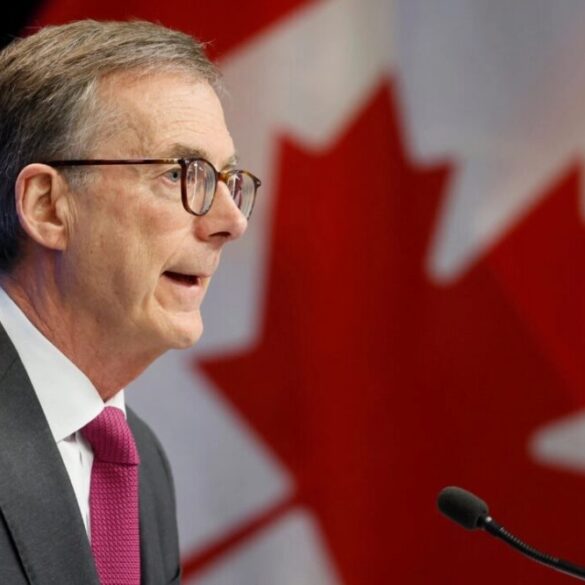
Bank of Canada Governor Tiff Macklem takes part in a press conference following the release of a Financial Stability Report in Ottawa, Ont., on May 8, 2025. Blair Gable/Reuters
OTTAWA—The Bank of Canada has raised its overnight policy rate by 25 basis points to 2.5 percent, warning that elevated energy prices could push inflation higher and necessitate further rate increases.
“The outlook for inflation has deteriorated. With the war in the Middle East persisting, global oil prices have increased, and are expected to remain higher for longer,” Bank of Canada Governor Tiff Macklem told reporters on Oct. 28.
Macklem said the Bank decided to increase interest rates because the war between the United States and Iran has persisted, leading to higher oil prices that are expected to bleed into broader prices for goods.
At the same time, the growth outlook for Canada has “modestly” improved, despite U.S. tariffs, he said. The Bank notes that growth has been supported by resilient consumer spending, higher oil and gas activity, and a recovery in business investment.
“With elevated inflation expected to last longer and the economy showing resilience, Governing Council agreed that risks to inflation had increased and there was less scope for monetary accommodation,” Macklem said, adding that there could be a need to raise rates further.
The Bank’s decision marks the first time it has raised rates since July 2023, amid rising global prices stemming from an end to COVID-19 restrictions and an energy shortage due to the Russia-Ukraine War. The continuation of the Ukraine war, coupled with the U.S.-Iran war and the conflict between the Houthis rebels and Saudi Arabia, have put pressure on global energy prices throughout 2026, the Bank said.
The Bank said there is currently “no clear path to resolution” in the U.S.-Iran War, as a result of which Tehran has reduced the number of oil tankers travelling through the Strait of Hormuz for nearly eight months. The Bank predicts higher energy prices will lead inflation to average 3 percent in 2027, compared to its earlier July prediction of just 2 percent for that year.
Macklem said the Bank expects the Consumer Price Index, which was at 3.1 percent in September, will rise to 3.5 percent by the end of 2026. While inflation has so far been mostly visible on gasoline, diesel, and heating oil, businesses have seen their costs rise and are likely to pass them on to consumers over the next year, Macklem said.
At the same time, Macklem said that with Canada’s economy expected to improve, there will be less downward pressure to “offset these cost pressures.” The United States has placed a broad range of tariffs on Canada, including recent 50 percent tariffs on $27.6 billion worth of Canadian goods, but Macklem said growth has been “better than expected.”
The Bank said GDP growth was around 3.3 percent in the second quarter of 2026, and is expected to grow by about 2 percent in the third quarter before growth slows in the fourth. Consumer spending has been strong despite slower population growth, exports have strengthened, and business investment has recovered with rising activity in the oil and gas sector and spending on machinery, the Bank said.
Economic activity across the United States, European Union, and China has remained steady, but the Bank noted that global financial conditions have “tightened” since July due to higher bond yields and equity and credit market volatility due to uncertainty around the growth of the AI sector.
Macklem said questions remain about how U.S. tariffs will impact Canada, and how much higher energy prices will “seep into consumer prices more broadly.” He said the Bank will “proceed carefully” on its interest rate policy, given the uncertainty.
The Bank will release its next interest rate decision on Dec. 9.
Monetary Policy Report
The Bank’s October Monetary Policy Report said inflation is expected to remain higher for longer compared to its July report, but the scope of this is unclear given the “rapidly evolving situation in the Middle East, and how quickly and fully higher costs will pass through to consumer prices.”
Pass-through to consumers has so far only happened with fuel prices and travel-related services, while pass-through on consumer goods will take longer to materialize, according the report. Around 60 percent of consumer-facing businesses surveyed by the Bank said they expect to pass costs on to Canadians within the next 12 months, while 40 percent of all businesses surveyed said the same.
The Bank said food inflation is also expected to remain higher than overall inflation throughout 2026 and 2027, due to high energy and import costs moving through supply chains and “deteriorating harvest prospects in several countries.”
The report said the majority of trade between Canada and the United States continues to remain tariff-free due to the United States-Mexico-Canada Agreement, but the average tariff rate for both countries has risen since July. The average U.S. tariff rate on Canada is 7.5 percent compared to 5 percent in July, while the average Canadian tariff rate on the United States is 3.9 percent compared to 1.5 percent three months ago.
The report said the outlook for Canada’s economic growth has improved since the July report, with expectations of 1 percent growth in 2026 and 2 percent in 2027, compared to July’s report predicting 0.7 percent growth in 2026 and 1.8 percent growth in 2027. The report said this reflects economic strength in mid-2026, along with higher business investment and consumer spending expected for next year.
Canada’s trade relationship with the United States and global energy prices remain the two most important risks to Canada’s inflation trajectory, according to the report. The Bank’s economic model assumes that shipping through the Strait of Hormuz will gradually return to normal, but said further supply disruptions could push prices higher and raise inflation further.
The Bank’s model also assumes U.S. tariffs will remain in place and the impacts of trade-related uncertainty on Canada’s economy will gradually diminish. Further U.S. tariffs could weaken Canadian exports and business investment, weakening growth, the report notes.