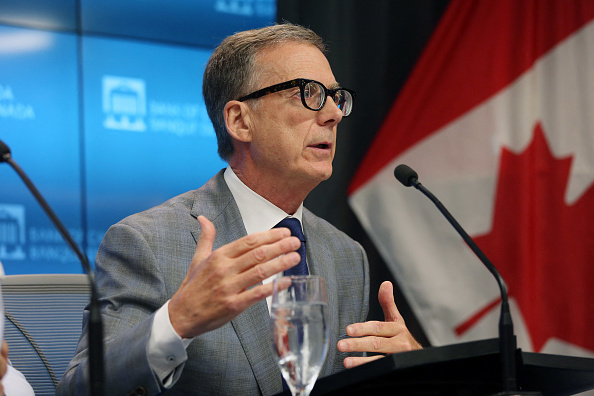
Tiff Macklem, Governor of the Bank of Canada, speaks during a news conference after announcing the Monetary Policy Report, at the Bank of Canada auditorium in Ottawa, Ontario, Canada, on July 12, 2023. (Photo by Dave Chan / AFP)
News Analysis
The Bank of Canada has restarted its “routine” purchases of short-term Treasury bills, commonly known as T-bills, reigniting debate among economists about what the move will mean for prices in 2026 and what the consequences of the last round of asset purchases are.
The central bank announced on Nov. 13 that it would restart routine purchases of Government of Canada (GoC) T-bills, which are debt securities issued by Ottawa to raise temporary funds and which typically mature within one year. The bank said it would restart this process on Dec. 16 to “restore a more balanced mix of assets on the Bank’s balance sheet.”
The bank said it likely would not need to resume the purchase of GoC bonds, which are classified as long-term debt securities, until 2027.
Some financial experts argue that renewed T-bill purchases will add inflationary pressure by expanding the money supply. Others say the move is a routine balance-sheet operation that will have little impact on prices.
There is also disagreement among the experts on the causes of the inflationary wave seen during COVID-19. Some put the blame primarily on supply chain problems, and others say Ottawa’s fiscal policies coupled with the central bank’s monetary policies pushed prices upward.

The Bank of Canada has said higher inflation was caused by a combination of rising food and energy prices across the globe, high inflation expectations that caused businesses to raise prices, and a higher demand for goods relative to supply in Canada’s economy.
Former Bank of Canada deputy governor Paul Beaudry says the central bank’s announcement on buying Treasury bills is a return to the “routine” operations of the bank, where more cash is put into circulation in a way that keeps pace with the growth of the economy.
Concerns about the Bank of Canada increasing the money supply in a way that will increase inflation is “fear-mongering,” said Beaudry, who was deputy governor from 2019 to 2023. He told The Epoch Times that the inflation surge of 2021 was primarily due to global supply chain issues and that those seeking to blame central banks for inflation should focus on how those banks managed interest rate levels instead.
Beaudry said the idea that the central bank would engage in “money printing” in a way that causes inflation is “kind of an old view.”
“Once you’re in an interest rate regime, there’s a very different view of how you think about what creates inflation,” he said, adding that critics of the bank’s monetary policy should be “complaining that the central bank didn’t have the interest rates right.”
Calgary-based economist and academic Jack Mintz has a different view on inflation and the Bank of Canada’s purchasing of Treasury bills. He told The Epoch Times that the central bank is now re-engaging in quantitative easing, which will increase the money supply and add inflationary pressures.

The American and Canadian flags fly at the Ambassador Bridge border crossing in Windsor, Ont., Canada, on Feb. 9, 2022. Geoff Robins/AFP via Getty Images
Under quantitative easing, a central bank stimulating economic activity by adding assets to its balance sheet—by purchasing government bonds and other securities that in turn can provide liquidity to banks and allow interest rates to further decline, making borrowing cheaper.
Mintz says the Bank of Canada is giving the federal government a “cheap source of finance” to continue running deficits, which will push prices upward. He also rejected the idea that the increase in the money supply was not responsible for the inflationary surges of a few years ago.
Carleton University business professor Ian Lee says that the Bank of Canada is not engaging in literal “money printing” seen in some countries that eventually fell into hyper-inflationary spirals, but that it is merely returning to routine balance-sheet normalization.
While Lee agreed with Beaudry that supply chain issues were a major factor for the inflation surge of 2021, he said in an interview that the Canadian government’s pandemic-era programs, which handed out cash to Canadians to stimulate the economy, also caused prices to rise. He said there is a risk this could happen again in the years to come.
2020 Purchases
Bank of Canada deputy governor Toni Gravelle, for his part, emphasized in his speech in January that the bank will “not be buying assets on an active basis to stimulate the economy like we did during the pandemic.” He added that when the central bank begins buying assets, these would be “normal” purchases reflecting the growth in currency, and not quantitative easing.
Meanwhile, the central banks’s latest announcement on purchasing T-bills indicates that it may be taking measures similar to those it rolled out in early 2020.
Canada began implementing COVID-19 lockdowns in early 2020. That year, the central bank announced on March 12 that it would be expanding the scope of its GoC bond buyback program to “add market liquidity and support price discovery.”

The bank then announced the following month that it would temporarily increase the amount of T-bills it acquires at auctions from 25 percent to up to 40 percent to support “continued liquidity and efficient functioning of the federal government’s treasury bill program.”
Through its quantitative easing program, the Bank of Canada’s balance sheet rose from $120 billion in assets in March 2020 to roughly $550 billion by the end of 2020. The bank said the injection of liquidity into Canada’s financial system helped support the economy and reach its inflation target of 2 percent after annual inflation dipped to -0.4 percent in May 2020.
The M0 money supply in Canada, which includes all cash in circulation along with assets that can be easily converted into cash, increased from roughly $95 billion in February 2020 to a peak of $492 billion by February 2021. That supply, also known as base money and is the most basic and most liquid form of money, has since steadily declined, hitting approximately $212 billion in September 2025.
The Bank of Canada also did three consecutive rate cuts in March 2020, lowering its key interest rate from 1.75 percent to 0.25 percent during that month. This move was made as the unemployment rate surged, hitting 13.7 percent in May. The central bank said in a July 2020 press release that it was continuing its “large-scale asset purchase program” of bonds because it would “keep interest rates low across the yield curve.”
The rate of unemployment declined throughout the rest of 2020 and contributed to putting in jeopardy the bank’s objective of keeping inflation at between 1 and 3 percent by the start of 2021. Inflation rose steadily throughout the year until it hit a high of 8.1 percent by June 2022, which led the bank to continue raising interest rates after starting rate hikes in March 2022.
What Caused Inflation to Surge?
Both economists and Canadians polled about inflation have said that a variety of factors led to inflation soaring in Canada and in other Western countries, such as disruptions to supply chains, the war in Ukraine, and even weather events reducing food harvests.
Some economists assign part of the responsibility for inflation to the monetary policy of the Bank of Canada, which expanded the money supply via “money printing,” as well as the government’s fiscal policy, which gave billions of dollars to citizens to kickstart the economy.
Beaudry says the inflationary wave of 2021 was primarily caused by supply chain breakdowns due to COVID-19 lockdowns. He also noted that consumers’ expectations around higher inflation can actually cause inflation to rise because businesses raise prices in anticipation of increases.
The former Bank of Canada deputy governor argued that quantitative easing played a minor role in increasing inflation, but he said Canadians should question whether interest rates stayed too low for too long. He said keeping interest rates low for too long can cause inflation to rise because it creates “demand for cash in the system.” However, blaming inflation on money printing is “not the way the system is working,” Beaudry said.
Lee says the central banks of Western countries do not “literally print money” in the same way countries like Argentina, Zimbabwe, or Weimar Germany did, which ultimately resulted in hyperinflation that made their currencies virtually worthless and forced people to turn to bartering. He said the Bank of Canada was “very careful” when purchasing government bonds and T-bills, which are an “IOU on the government” that eventually have to be paid back.
“All the money in currency and circulation is a liability of the Bank of Canada. … This is as part of their routine operations to balance their needs, because they buy bonds, they sell bonds, they have to manage the outstanding obligations called currencies, and so this is part of their routine monetary management,” Lee said.
Lee said he mainly agreed with Beaudry that “money printing” was not responsible for the inflation wave of 2021, but he argued that the federal government’s fiscal policies of giving money directly to Canadians primarily contributed to it. “The injection of billions and billions into the economy exacerbated the situation, the supply shock, and that made the inflation even worse,” he said.
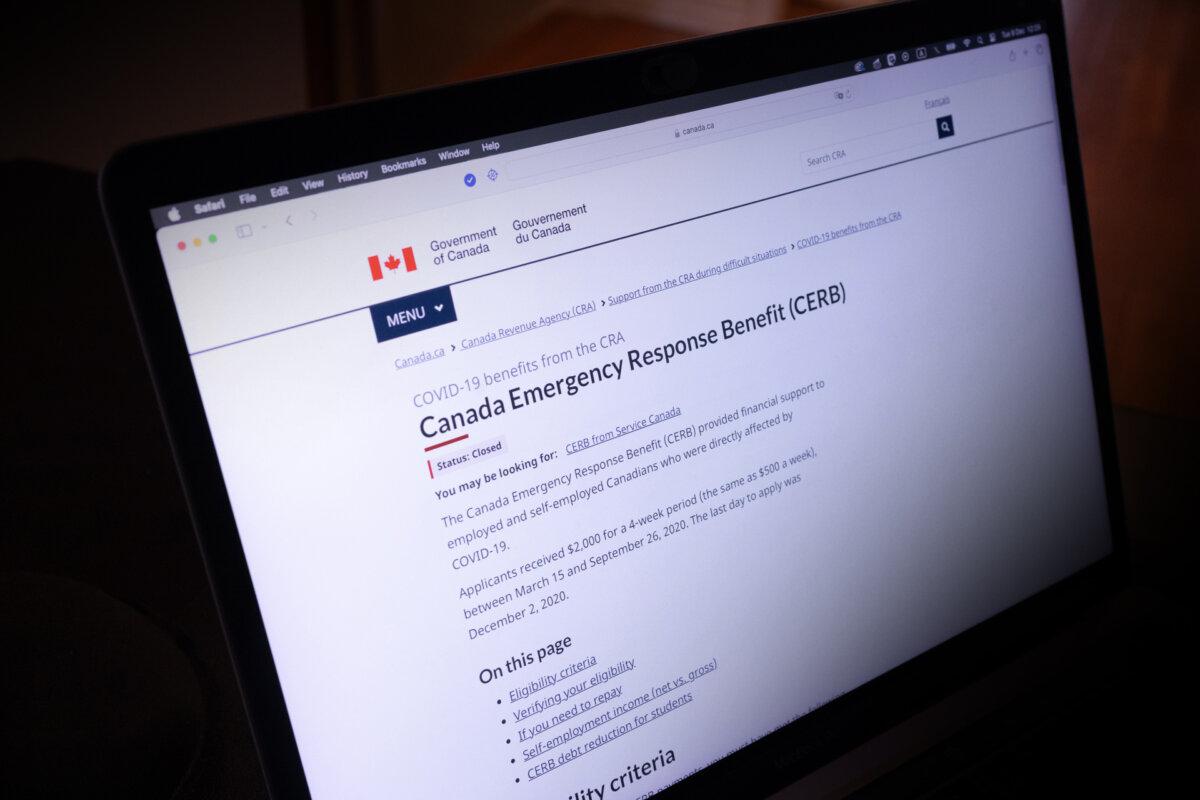
The landing page for the Canada Emergency Response Benefit is seen in Toronto, Dec. 9, 2025. Screenshot by The Epoch Times
A July 2025 report from the C.D. Howe Institute says government fiscal policy played a “critical role” in causing inflation to surge because the $360 billion in emergency transfers given to Canadians during the pandemic resulted in rising demand for goods.
The report put less blame on the Bank of Canada, saying that even if the central bank had raised interest rates earlier, this could have lengthened a recession without preventing inflation from rising.
“If fiscal policy is anchored, interest rate policy can be used to smooth out inflation dynamics. If fiscal policy is not anchored, then monetary policy will struggle to rein in inflation and—where it can, most notably in the short-run—it may do so at the price of a severe recession,” the C.D. Howe report said.
Treasury Bills and Inflation
Mintz said he disagrees with arguments that put the blame for inflation primarily on supply chains and the war in Ukraine, countering that the Bank of Canada “didn’t take inflation seriously” and contributed to higher inflation in 2021 via money creation. He also said the federal government’s pandemic spending caused inflation to surge.
“Yes, there was a supply constraint, all that happened. But I think [the central bank] pushed up demand, which also increased prices as a result. So I don’t think those arguments hold as much water,” he said.
Mintz says the bank’s recent announcement about buying T-bills, besides giving the federal government a “cheap source of finance,” will provide “more liquidity to the market.” He says that, with the central bank restarting quantitative easing, this will be “expanding the money supply, and that will be inflationary.”
The economist also said that with the U.S. Federal Reserve officially ending quantitative tightening on Dec. 1, and the incoming head of the Federal Reserve likely to lower interest rates further, this could be “potentially inflationary,” particularly if the central bank begins quantitative easing.
Lee said he does not believe the Bank of Canada’s purchasing of T-bills will lead to inflationary pressures, but noted that larger government deficits could lead to higher inflation.
“I know there are Liberals who have denied that there’s any correlation between fiscal deficits and inflation, but I’m of the camp that large and growing fiscal deficits are a long-term threat and a possible contributor to inflation,” Lee said.
The Liberal government’s Nov. 4 budget projected a deficit of $78.3 billion for the current fiscal year and forecasts that the deficit will drop to $65 billion next fiscal year before gradually falling to $57 billion in 2029–30. The budget does not outline plans to balance the overall budget, instead saying Ottawa will balance day-to-day operating spending with revenues by 2028–29.

Recent polling appears to show that Canadians continue to be concerned by inflation and the government’s role in causing it. IPSOS polling from October indicated that 61 percent of Canadians say the cost of living is worsening because the government is spending too much.
Abacus Data polling taken between Nov. 20 and 27, after the budget’s release, showed that the to issue for Canadians continues to be the “rising cost of living.” Sixty-four percent of respondents said it is their top priority, compared to 40 percent citing the economy and 35 percent citing health care.
The Bank of Canada’s October monetary policy report said inflation was 2.4 percent in September after being close to 2 percent for several months. It projected that inflation will remain at roughly 2 percent in 2026 as U.S. tariffs and the global restructuring of trade put upward pressure on prices and as excess supply places downward pressure on inflation.
Bank of Canada governor Tiff Macklem said on Oct. 29 that if Canada’s economy were to grow in line with its projections, the current interest rate of 2.25 percent would be “at about the right level to keep inflation close to 2 percent” while helping the economy through U.S. tariffs.