
The Chinese Embassy in Ottawa in a file photo. Jonathan Ren/The Epoch Times
Chinese authorities and their proxies monitor and repress Chinese citizens and diaspora members in Canada through a combination of digital surveillance, intimidation of family members, and proxy networks, a new report says.
The University of Toronto’s Citizen Lab recently submitted a report to the Immigration and Refugee Board of Canada examining how Chinese authorities and their proxies monitor Chinese nationals and diaspora members in Canada.
The report published on Sept. 22 found that Chinese authorities and their proxies employ diverse surveillance tactics using online and offline channels to carry out transnational repression campaigns. The authors also noted the country’s surveillance is not confined to a single country or region.
“Instead, techniques used to monitor targets outside Canada could be used against Chinese citizens or diaspora members in Canada, or may have already been used against targets in Canada but remain undocumented,” they wrote, describing the surveillance as “routine.”
Beijing has pursued a strategy to monitor and shape the behaviour of its citizens and diaspora communities globally for several decades, while efforts in Canada expanded after the 1989 Tiananmen Square massacre, the report noted.
“Under the administrations of Jiang Zemin (1989-2002) and Hu Jintao (2002-2012), Chinese authorities expanded the scope of these overseas monitoring activities to encompass a wider assortment of Chinese citizens and diaspora members, including Tibetans, Uyghurs, and Falun Gong practitioners,” the authors wrote.
These measures have intensified under the current presidency of Xi Jinping, the report said. Xi has led the People’s Republic of China since 2012.
The goal is to monitor the activities of the groups in a bid to quell foreign-based opposition to the Chinese regime by suppressing any critical voices that question the Beijing’s political narratives, the report said.
“These chilling effects extend beyond targeted individuals and impact other Chinese citizens and diaspora members in Canada,” the authors wrote. “The looming threat of state repression, referred to by some scholars of contemporary China as the ‘anaconda in the chandelier,’ can encourage a culture of political self-censorship among Chinese citizens and diaspora members.”
The Chinese regime’s diaspora “governance playbook” is built on two fundamental strategies, according to the report.
The first approach focuses on consent-building activities to foster backing for the Chinese Communist Party (CCP) among influential overseas groups. The second involves coercive tactics aimed at silencing dissent among select overseas Chinese citizens and diaspora communities.
Consent-building activities can range from lawful forms of foreign influence, such as China-sponsored cultural and language exchange programs, to more coercive activities, including foreign interference through disinformation campaigns and electoral interference, as well as transnational repression.
“Collectively these activities serve the common goal of buttressing the Communist Party’s power and prestige at home and abroad,” the authors said.
Surveillance Targets
The Chinese regime has been monitoring overseas Chinese citizens and diaspora members in Canada since the 1980s, but this practice has dramatically expanded and intensified during Xi’s tenure as president, the report noted.
The authors describe Xi’s government as “the most prolific perpetrator of transnational repression” in its report that cited multiple sources from think tanks to the Public Inquiry into Foreign Interference report, an independent Canadian investigation led by Quebec Court of Appeal Justice Marie-Josée Hogue.
“One of the chief causes for the Chinese government’s heightened attempts to monitor and harass overseas citizens is tightening state repression in China under Xi’s rule,” the authors wrote. “Experts on Chinese politics characterize Xi’s government as more authoritarian and repressive than previous administrations.”
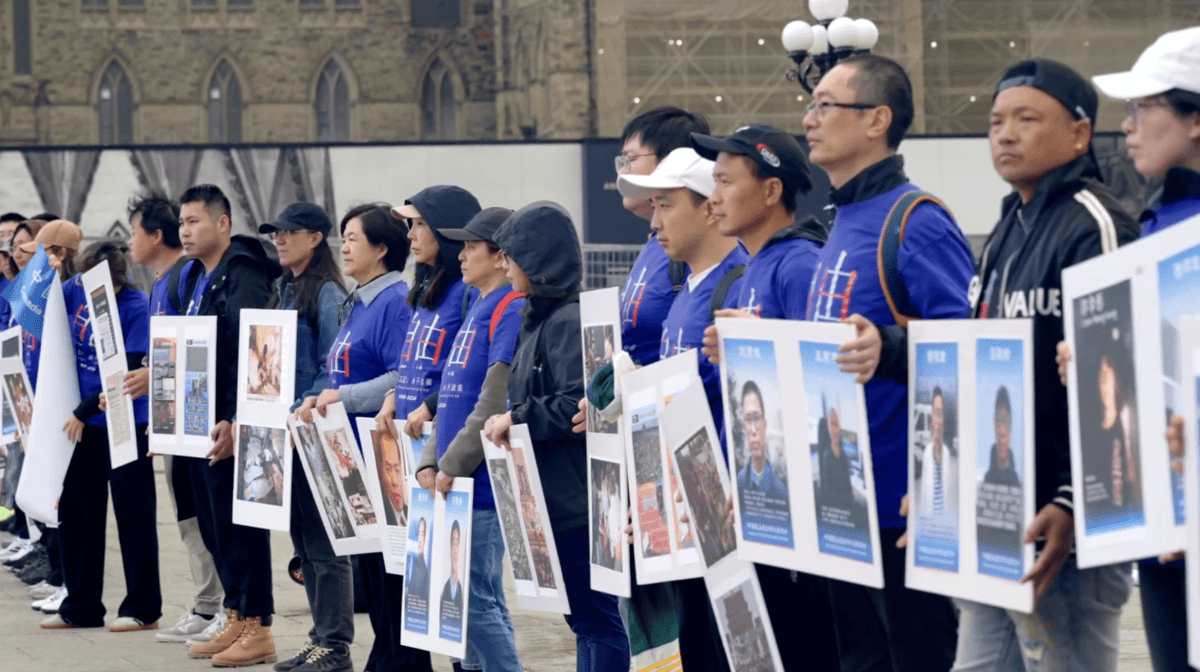
Members of the Canadian Committee of the Democracy Party of China protest in Ottawa as Chinese Foreign Minister Wang Yi meets with Canadian Foreign Affairs Minister Anita Anand and Prime Minister Mark Carney on May 29, 2026. NTD
The report describes the targets of Chinese state surveillance and repression as people whom Chinese authorities perceive as threats to the CCP’s authority, which it characterizes as a “single-party autocracy dominated by the Communist Party of China.” Targets may include individuals viewed as opponents of the regime because of their political beliefs, ethnic heritage, religious practices, or connections to people in these groups. They are not necessarily prominent public figures.
- Pro-democracy and human rights campaigners, exiled political dissidents, and civil society activists;
- Students, scholars, writers, journalists, artists, social media influencers, and new media professionals who express anti-CCP views or opinions that differ from the CCP’s “preferred narratives”;
- Members of ethnic or religious communities, including Tibetans, Uyghurs, Mongolians, and Falun Gong practitioners;
- Supporters of, or participants in, Hong Kong’s pro-democracy protest movement;
- Individuals, including current or former CCP members and state employees, who are accused of corruption, financial crimes, and/or official malfeasance; and
- The family members of any of the above individuals.
Surveillance Tactics
Chinese authorities use various surveillance tactics to identify members of overseas communities viewed as threats.
Online techniques include phishing campaigns, account hacking, the use of malware/spyware, or the monitoring of public social media accounts, the report said. Non-digital forms of observation and surveillance include in-person monitoring of peaceful protests and assemblies, stalking, and daily physical surveillance.
The two forms are often used together, the authors said. For instance, tracking someone’s social media account to determine the person’s location, the places they visit, their daily patterns, and their behaviours, to then pursue in-person surveillance.
The report also highlights how Chinese authorities and their affiliated operatives strategically blend traditional enforcement methods—deploying police, security personnel, paid enforcers, or local informants—with high-tech surveillance systems.
Chinese authorities have also developed a pattern of leveraging intimidation tactics against relatives living within China as a mechanism to exert control over Chinese citizens and diaspora members in Canada. This strategy, termed “coercion-by-proxy,” weaponizes domestic repression to punish, threaten, or manipulate those living abroad.
“These threats are intended to demonstrate the Chinese government’s control over a target’s relatives in China, and to warn activists that continuing public advocacy against the Communist Party would further imperil the well-being of their family members,” the report said. “For example, prominent Uyghur activists in Canada have reported receiving phone calls from Chinese authorities, informing them of the health or even death of relatives detained in Xinjiang’s complex of prisons and extrajudicial reeducation camps.”