
People at a press conference and rally in front of thae America ChangLe Association, a now-closed secret Chinese police station, highlighting Beijing’s transnational repression, in New York City on Feb. 25, 2023. Samira Bouaou/The Epoch Times
As Canada looks to diversify its trade partners, it can’t be “naive” in dealing with the Chinese regime, which is a leading perpetrator of transnational repression, researchers behind a new report say.
The Feb. 17 report by the Montreal Institute for Global Security (MIGS) says the issue of transnational repression is a “systemic threat” affecting thousands of people across the country and undermining Canada’s security, democracy, and sovereignty.
Speaking at a Feb. 17 press conference in Ottawa announcing the release of the report, MIGS co-founder and executive director Kyle Matthews said that as Canada undergoes a “geopolitical shift” amid U.S. trade tensions, it must be more discerning when it comes to dealing with the Chinese regime.
“We have to keep our eyes open. We can’t close our eyes to the authoritarian threat that China represents,” Matthews said. “Many countries around the world that deal with transnational repression will tell you that China is one of the biggest players, if not the biggest player.”
The report says the consequences of transnational repression are “profound,” adding that “individuals live in fear, communities become fractured and politically silenced, and democratic processes are weakened as voices are pushed out of public life.”
“The reach of authoritarian governments into Canada’s social and political space undermines the state’s sovereignty and its ability to protect those who seek safety within its borders,” the report says.
The report notes that Canada has “underestimated the scale and sophistication” of the threat of transnational repression, which has left gaps in policy, law enforcement capacity, legal tools, and victim support, and its “openness” and limited preparedness to deal with foreign threats has allowed foreign actors to monitor, intimidate, and harass diaspora communities in Canada.
Emerging technologies such as social media and “deepfakes” have made the threat “even more insidious” and has also made it more difficult to attribute these actions to any particular foreign actor, the report adds.
While the report indicates Canada does not have a single or codified definition of transnational repression in Canadian law, the Canadian Security Intelligence Service (CSIS) defined transnational repression in its 2024 public report as: “Any efforts undertaken by a foreign state, whether directly or indirectly, to intimidate, influence and/or exact reprisal against individuals or groups living outside their borders.”
CSIS said this includes, but is not limited to, “acts such as extrajudicial killing, physical assault, unlawful abduction, physical and online surveillance, and obstruction,” and could also include “pressuring or leveraging a targeted individual’s relatives in a foreign state as a means to influence/coerce them.”
Canada and other G7 countries said in a joint statement last June that transnational repression is “an aggressive form of foreign interference whereby states or their proxies attempt to intimidate, harass, harm or coerce individuals or communities outside their borders.”
‘Weaponized Trade’
The report comes a month after Prime Minister Mark Carney visited China and signed several agreements related to trade, law enforcement cooperation, and travel, among other areas.
Carney said after the visit that relations between Ottawa and Beijing had entered “a new era,” and that the two countries were in a “strategic partnership.” He also said the progress made in the relationship sets Canada up well “for the new world order.”
These comments were met with criticism by the Opposition Conservatives, who said the federal government must explain why its tone on China has changed so drastically from when Carney said during the 2025 election campaign that China is Canada’s “biggest security threat.”
The report also comes just days after China’s foreign affairs ministry announced Canadian passport holders will be able to travel to China without needing a visa starting on Feb. 17 for tourism and business stays of up to 30 days.
Matthews said at the Feb. 17 press conference that Beijing has “weaponized trade, it’s thrown Canadians in jail, and we should not for a moment think that Canadian citizens travelling to China are not under threat of being monitored.”
Report co-author Phil Gurski, a former CSIS and public safety official who also spoke at the press conference, said CSIS should screen visitors coming from China.
“If there are visitors coming from the People’s Republic of China, they should be vetted through CSIS, that has its own intelligence sources, has alliances with its counterparts around the world,” Gurski said.
“If CSIS comes up against information that indicates somebody is not being truthful or forthcoming in their background or their intentions on coming to Canada, they should be denied entry. There’s no right to come to Canada—it is a privilege.”
The report says China “regularly subjects anyone who attempts to express views critical of the Chinese Communist Party to harassment–and sometimes even subjects those who have never spoken out to harassment tactics as a reminder to not try.”
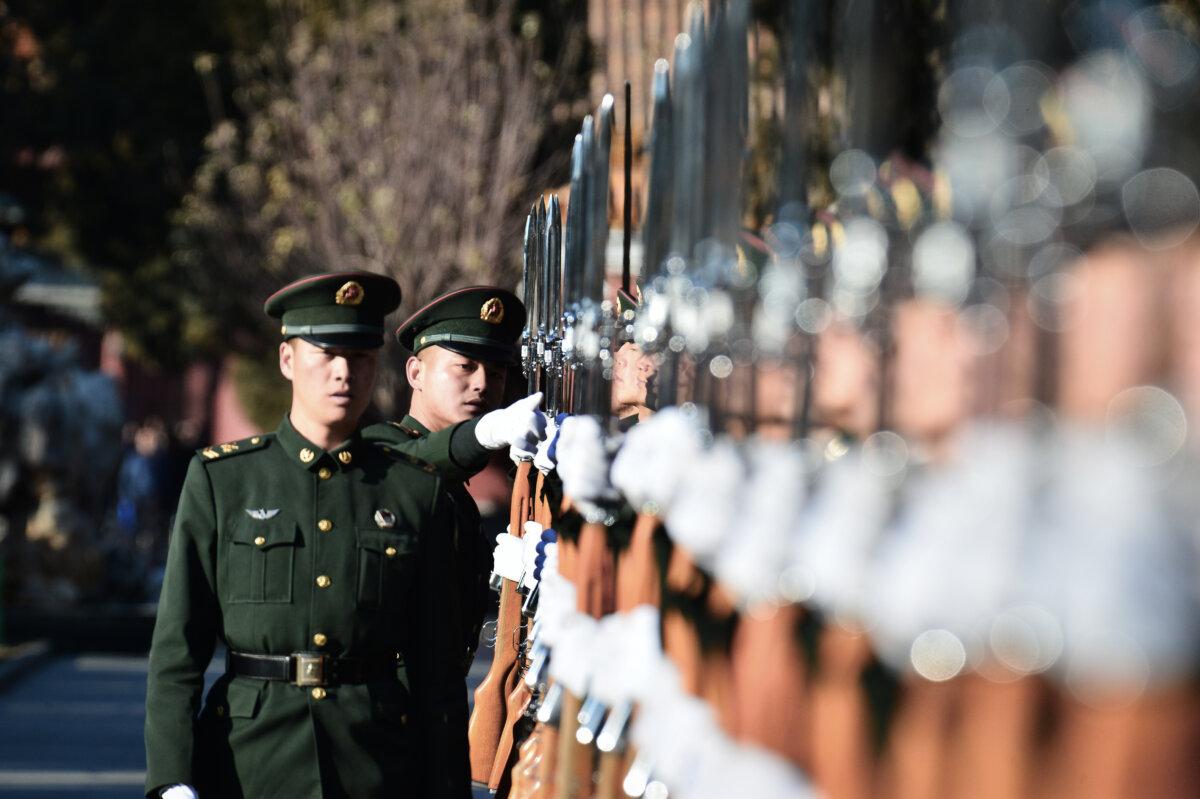
Members of the Chinese People’s Liberation Army honour guard train in Beijing on Jan. 1, 2018. AFP via Getty Images
In Canada, events that feature speakers who intend to shed light on practices in China have been disrupted, dissidents have received threatening phone calls or have been targets of online harassment, and Beijing has created secret “police stations” to keep tabs on and attempt to influence Chinese diaspora communities, the report says.
A House of Commons report released in 2023 said there were “at least five” illicit police stations operating secretly in Canada. Parliamentary committee notes about overseas police stations in 2023 said the RCMP “continues to investigate the transnational repression activity, and those responsible for transnational repression, to ensure Chinese and other Canadians are safe from foreign influence.”
A public inquiry into foreign interference in 2024 found that China is the most active foreign actor targeting Canada.
Other Foreign Actors
The MIGS report also outlines cases of transnational repression in Canada by other foreign states including India, Iran, Russia, Algeria, and Rwanda.
Relations between Canada and India deteriorated in 2024 after former Prime Minister Justin Trudeau said Indian government agents had engaged in violent acts, “including murder,” on Canadian soil. The comments followed the 2023 killing of Sikh separatist leader Hardeep Singh Nijjar in B.C. India denied the allegations, and the two countries expelled each other’s diplomats.
The two sides have since sought to repair relations and restore diplomatic ties, and Carney is set to visit India in March.
Canadian authorities have also noted Iranian efforts to suppress criticism of its regime abroad, often through threats of violence, the report says. “Investigations suggest hundreds of regime-linked individuals may be present in Canada, raising concerns about infiltration and foreign interference,” it adds.
The Canadian Centre for Cyber Security has also said Iranian state-sponsored actors have engaged in digital transnational repression, such as by doxing journalists, spreading disinformation, and threatening activists online.
Meanwhile, the MIGS report said Russia has engaged in transnational repression in Canada through “a combination of intimidation, surveillance, cyber operations, and influence campaigns.”
The report adds that Algeria and Rwanda have also targeted critics in Canada.
Canada’s Response
Canada’s early response to transnational repression has been limited by longstanding gaps in awareness, a lack of a foreign agent registry or foreign human intelligence agency, and fragmented coordination, the MIGS report notes.
Parliament passed Bill C-70, “An Act respecting countering foreign interference,” in June 2024, which mandates the creation of a foreign influence registry to keep track of those working in Canada as agents on behalf of foreign governments, as well as the appointment of a foreign interference commissioner.
The legislation was passed amid heightened public awareness about China’s meddling in Canada’s affairs via intelligence leaks in the media; however, the registry’s implementation has been delayed.
In late January, the government proposed appointing Anton Boegman, a former chief electoral officer of British Columbia, as Canada’s first foreign influence commissioner. The government must consult with opposition parties and Senate leaders, and receive approval by resolution of the House of Commons and Senate, before he is officially appointed. Public Safety Minister Gary Anandasangaree said the registry should be up and running this spring.
In signing the joint statement with other G7 leaders last June, Canada also condemned transnational repression and pledged to support those who may be targets of this “aggressive form of foreign interference.”
The MIGS report says that to effectively counter transnational repression, Canada needs to strengthen its legal and enforcement framework, build trust within diaspora communities, work closely with G7 partners and “like-minded” democracies to develop coordinated responses, and adopt measures to ensure accountability and resilience.
This includes ensuring the RCMP, Public Safety Canada, municipalities, and policymakers are trained to recognize and respond to transnational repression; implementing criminal sanctions against foreign interference, sabotage, and perpetrators of transnational repression; and establishing a G7 watchlist of officials and companies implicated by spyware abuse and impose entry bans, asset freezes, and procurement restrictions, among other recommendations in the report.
“Ultimately, defending against transnational repression is about more than protecting individuals from harm,” the report says. “It is about preserving Canada’s democratic integrity and ensuring that those who seek refuge and opportunity here can live free from fear.”