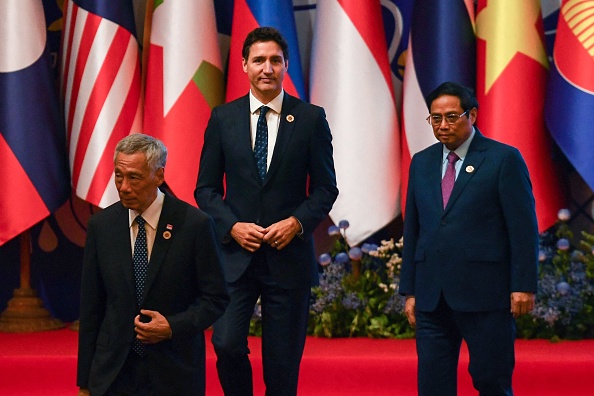
(L-R) Singapore’s President Lee Hsien Loong, Canada’s Prime Minister Justin Trudeau and Vietnams Prime Minister Pham Minh Chinh attend the ASEAN-Canada Summit as part of the 40th and 41st Association of Southeast Asian Nations (ASEAN) Summits in Phnom Penh on November 12, 2022. (Photo by Nhac NGUYEN / AFP)

Mr. Trudeau held bilateral talks on Sept. 5 with Indonesian President Joko Widodo, who is also the current chair of the Association of Southeast Asian Nations (ASEAN). The strategic partnership will be launched during the bloc’s summit over the next few days.
International Trade Minister Mary Ng told reporters in Indonesia on Sept. 5 that ASEAN is deepening ties with Canada in response to the Canadian government’s Indo-Pacific Strategy launched last year.
She said the sentiment of countries in the region towards Canada is changing and that she’s seeing a “momentum.”
Ms. Ng was also in Indonesia two weeks ago to meet with a bilateral economic task force, and she mentioned the upcoming opening of an Agri-Food office in the Philippines. The prime minister also announced the opening of an Export Development Canada office in Jakarta.
Ms. Ning said those types of initiatives are getting noticed. “I think that’s what they’re seeing, and it’s because of that you’re seeing Canada being elevated to strategic partner status,” she said.
Ms. Ng was speaking alongside Canada’s Ambassador to Japan, Ian McKay, who was also appointed as special envoy for the Indo-Pacific in April 2022. He called the federal government’s Indo-Pacific Strategy Canada’s “biggest foreign policy shift in decades.”
The policy has five core objectives along the themes of security, trade, and the environment. It also identifies China as a strategic challenge, saying it is actively seeking to reinterpret international rules to “gain greater advantage.”
Mr. McKay said that with its increased engagement in the Indo-Pacific, Canada will be better placed to have a “more sophisticated bilateral relationship” with China.
Trade Deals
Part of the increased focus on Asia involves securing a trade deal with ASEAN, a bloc of 10 countries representing nearly 700 million people.
Ms. Ng was asked by reporters whether Canada seeking to impose its values as conditions in the trade agreement was slowing down negotiations.
“Trade negotiations are complex and they do take time,” Ms. Ng responded, pointing out that some ASEAN member countries are also part of the Comprehensive and Progressive Agreement for Trans-Pacific Partnership (CPTPP), which she called a “high standard” trade agreement.
“And it took many years to do that, and we’ve been at the negotiating table, and we’re going to work with the ASEAN countries,” said Ms. Ng.
The CPTPP came into force in 2018 and includes 10 countries from the Pacific area, with Brunei and Vietnam being members of ASEAN as well.
Ms. Ng didn’t explain why her government is putting things on ice and repeated that trade agreements are complex. “All we’re doing at this point is taking a reflection, to take stock of where we are.”