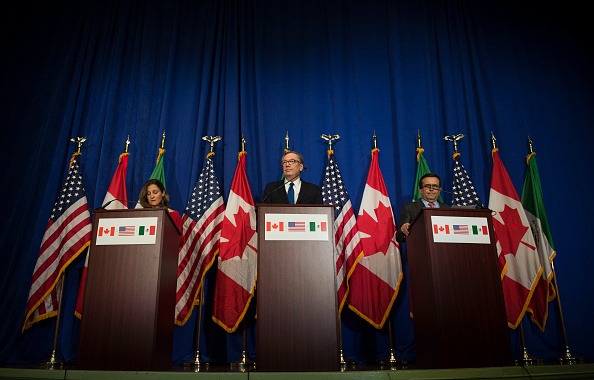
US Trade Representative Robert Lighthizer (C), Canadian Foreign Minister Chrystia Freeland (L), and Mexican Secretary of Economy Ildefonso Guajardo Villarreal hold a press conference at the conclusion of the fourth round of negotiations for a new North American Free Trade Agreement (NAFTA) at the General Services Administration headquarters in Washington, DC, on October 17, 2017. / AFP PHOTO / ANDREW CABALLERO-REYNOLDS
Canada has told its counterparts in the North American free trade agreement that it hopes to see the pact renewed for 16 years ahead of the review set to begin in July.
Canada-U.S. Trade Minister Dominic LeBlanc has sent a letter to U.S. Trade Representative Jamieson Greer and Mexico’s Economy Secretary Marcelo Ebrard formally notifying them of Ottawa’s intention, as required under the terms of the Canada-United States-Mexico Agreement (CUSMA).
“Canada looks forward to continued engagement with both the United States and Mexico on opportunities to expand our trading partnership and is willing to consider any proposal that can be beneficial to all three nations’ long-term prosperity,” LeBlanc says in the letter.
“In parallel, discussion with the United States on addressing sectoral tariffs will be essential.”
Activity around the CUSMA review beginning July 1 is ramping up, with LeBlanc holding consultations with stakeholders in Canada in recent days.
LeBlanc travelled to Washington, D.C., on June 2 and met with Greer. It was the first face-to-face meeting between the two since early March, although they have remained in contact remotely via other means.
LeBlanc told reporters after the meeting that Canada received CUSMA letters from the United States and Mexico, but he declined to provide information on their content.
The minister said the meeting with Greer was “positive” and downplayed the lack of formal talks being announced between Canada and the United States. LeBlanc said a lot of work around the CUSMA review is being done “now.”
“The Americans have decided to publicly say that they’re doing that work with the Mexicans, that doesn’t surprise us in a sense,” he said. “We always knew there would be these bilateral conversations. We had some with the Americans today, we had some a couple of weeks ago with the Mexicans. That’s a continuation of an ongoing process.”
Trade talks between Canada and the United States have seemingly progressed slowly compared to U.S.-Mexico negotiations. A first round of formal talks around the CUSMA review between the United States and Mexico was concluded last week and two more rounds in June and July have already been scheduled.
After July 1, CUSMA members will have to decide whether to renew the agreement for a certain number of years, with or without modifications, or continue annual reviews if no consensus can be reached. A partner could also decide to pull out of the agreement.
U.S. President Donald Trump and his officials have criticized the agreement and cast doubts about its usefulness, but the North American economies have become highly integrated under CUSMA and its predecessor NAFTA. U.S. Ambassador to Canada Pete Hoekstra said this week he’s optimistic a deal can be reached.
Prime Minister Mark Carney addressed the status of trade talks when speaking with reporters ahead of the cabinet meeting on June 2. He said there’s a “bifurcated discussion” between the CUSMA partners because the United States has different technical issues with Canada and Mexico.
Carney said there’s about 30 trade issues between Canada and the United States, whereas there’s around 60 between the United States and Mexico.
“We’re working through a series of those issues, they’re of varying technicality, if I can put them, and some of them are provincial,” Carney said without elaborating. The United States has expressed frustration with the provincial liquor boards’ ban of U.S. alcohol.
Carney added that for Canada, the more “fundamental structural issues” relate to U.S. tariffs on sectors deemed strategic. Those include the universal duties on autos, steel, aluminum, and lumber, which have been imposed on national security grounds using Section 232 of the Trade Expansion Act of 1962.
“We’re looking to determine whether there’s a possibility of a new partnership,” Carney added.
The prime minister’s comments come a few days after some details from the U.S.-Mexico CUSMA talks surfaced. The United States has reportedly proposed raising the North American content requirement for automobiles from 75 percent to 82 percent and requiring that 50 percent of a vehicle’s value originate in the United States to qualify for lower tariffs under CUSMA.
The Trump administration wants to bolster its domestic car industry and reduce reliance on foreign parts suppliers like China.
Carney said the U.S. proposal would hurt Mexico more than Canada, given that the “50 percent U.S. content which has been floated is actually the average level of Canadian exports.”
The Canadian car industry is deeply integrated with the United States and tariffs have heavily impacted its operations. Most cars manufactured in Canada are shipped south of the border and tariffs have caused a sharp drop in exports.
The metals sector has also been negatively impacted. Trump issued a proclamation on June 1 which modifies U.S. tariffs on steel, aluminum, and copper. Tariffs on some derivative products such as types of agricultural and industrial equipment will be lowered from 25 percent to 15 percent.
Canada and the United States were getting closer to reaching a tariff deal on steel, aluminum, and energy in October 2025. Trade talks were cancelled by Trump after the Ontario government ran an anti-tariff TV ad campaign in the United States.