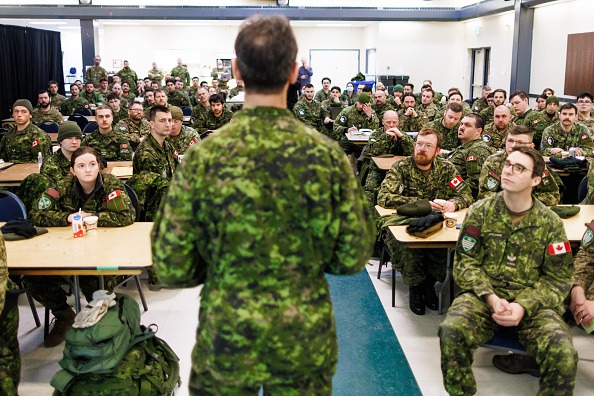
A briefing was given to soldiers from the 5th Canadian Division inside the Midnight Sun Complex in Inuvik, Northwest Territories, Canada, March 2, 2025. (Photo by Cole BURSTON / AFP)
The Canadian Armed Forces says it is changing its recruitment policies after a report raised concerns about challenges linked to an easing of recruitment standards, including a rise in mental health cases, language barriers, and cultural infighting.
The concerns appeared in a report prepared in January by Lieutenant-Colonel M.R. Kieley, commandant of the Canadian Forces Leadership and Recruitment School (CFLRS) in Quebec. The report, which included a series of recommendations to boost the quality of applicants, was leaked to the media and first covered by Juno News on April 28.
“I accept all 10 recommendations at the end of the report, and I am pleased to report today that eight of those recommendations at the end have already been implemented,” Chief of Military Personnel Lt.-Gen. Erick Simoneau told MPs as he testified before the House of Commons national defence committee on May 6.
Simoneau was responding to inquiries from Tory MPs, who have raised concerns in committee and in the House of Commons this week about what appears in the Kieley report.
“How can we keep our country safe when we rely on people who do not understand our culture, do not understand our language and do not want to listen to orders from women?” Conservative MP Pierre Paul-Hus said on May 5, in reference to issues cited in the report related to permanent residents in basic military training. “It is a total mess.”
The CAF has made a number of changes to its recruiting process in recent years to boost enrolment, such as eliminating the aptitude test, ending language testing, halting pre-enrolment security reviews for permanent residents, and accepting candidates with mental health issues and certain other conditions. The CFLRS says these changes have contributed to the training issues the military now faces.
In his report, Kieley said the training school has experienced increases in the number of candidates who have “significant” mental health concerns and those who are “unable to learn in the military environment.”
The CFLRS has also experienced challenges in training permanent residents due to a lack of proficiency in either official language, unrealistic training and job expectations, a lack of respect for younger instructors or women, and cultural infighting.
Kieley’s recommendations include maintaining “strong control” over enrolment of candidates with pre-existing mental health concerns, minimizing communications that state those suffering from mental health issues can freely join the CAF, and re-establishing aptitude testing during recruitment.
He also recommended the CAF conduct formal first official language testing for all permanent and naturalized Canadian citizens, adjust the scored application form to make younger applicants more competitive, and establish that permanent residents account for no more than 20 or 25 percent of the recruits on a basic training course.
Other recommendations included requiring all applicants demonstrate a basic understanding of their potential trade enrolment and the military lifestyle, implementing a standardized trade “ranking” system, updating trade descriptions, and re-establishing fitness testing as part of the recruitment process.
The Epoch Times reached out to the Department of National Defence (DND) to ask which eight recommendations have been implemented, but didn’t hear back by publication time.
Future Meetings
Conservative MP James Bezan, who serves as his party’s defence critic, introduced a motion at the May 6 meeting requiring the committee to devote six meetings to the issues outlined in Kieley’s report.
Bezan also motioned to invite Defence Minister David McGuinty, the Chief of Defence Staff, Kieley, Simoneau, and other expert witnesses to testify before the defence committee on the matter, and to have the committee report its findings to the House of Commons.
Liberal MP Chris Malette introduced an amendment to Bezan’s motion to undertake four meetings on the military’s recruitment and training programs instead of six, and to look at the programs in light of the CAF reaching a 30-year high in recruitment this year, instead of in light of Kieley’s report.
Malette’s amendment would also change the witness list to “relevant officials from the Department of National Defence,” instead of the individuals Bezan listed.
Bezan protested that the Liberal amendment changes the intent of his motion and should be ruled out of order. The meeting was suspended before a vote and is expected to be reviewed at the committee’s next meeting.
Minister’s Response
MP Paul-Hus brought up Kieley’s report during question period in the House of Commons on May 5 and asked: “Does the minister understand that these policies aimed at meeting quotas have undermined the cohesion of the Canadian Armed Forces?”
McGuinty responded that CAF recruitment has reached its highest level in 30 years. The CAF announced on April 20 that it took in 7,310 new Regular Force recruits, including 1,400 permanent residents, in the last fiscal year.
“Our soldiers, sailors and airmen do essential and remarkable work, and we need them,” McGuinty said. “That is why we are reinvesting in our personnel. We have given our forces a pay raise, we are providing them with the tools and equipment they need and we are speeding up their training.”
Paul-Hus responded that while 192,000 Canadians wanted to enrol in the CAF between 2022 and 2025, only 15,000 were accepted.
“Meanwhile, the government recruited permanent residents, non-Canadians and people who do not speak English or French and enrolled them in officer courses,” he added. Paul-Hus is a former lieutenant-colonel in the CAF.
Pressed further to respond to the findings in Kieley’s report, McGuinty reiterated that the number of applicants to the CAF has more than doubled over the last year, and 70 of 97 critical roles have been filled.