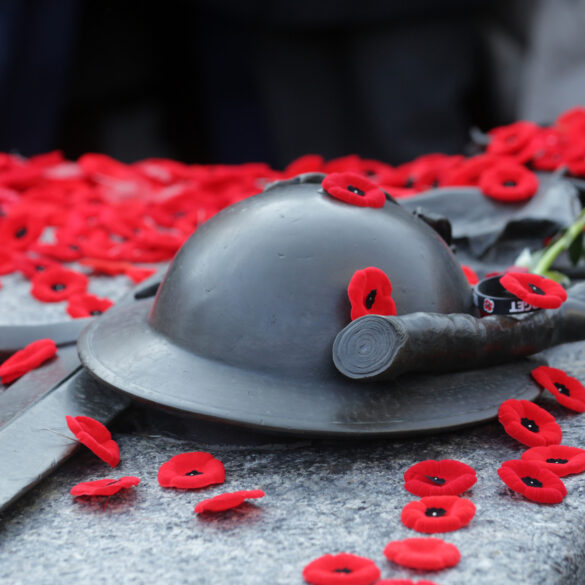
OTTAWA, CANADA – NOVEMBER 11: Poppies sit on the Tomb of the Unknown Soldier after this morning’s Remembrance Day ceremony, November 11, 2014 in Ottawa, Canada. (Photo by Mike Carroccetto / Getty Images)
An active-duty chaplain says morale remains low among Canadian military chaplains as the Canadian Armed Forces maintains its ban on public prayers at official ceremonies ahead of Remembrance Day.
The chaplain, who asked to remain anonymous due to being in active duty, says there is considerable frustration among chaplains caused by the military’s instructions enshrining its ban on prayer and faith-specific language in official ceremonies, issued this past July. The chaplains believe their traditional role in commemorating fallen soldiers has been undermined.
“We’ve got extremely low morale from many, many chaplains,” the chaplain told The Epoch Times.
“Chaplains have always had a sacred duty to honour and commemorate the dead, especially on Remembrance Day. We’ve always done this, and we’ve always done it in a way that is diverse, and respectful, and inclusive,” he added.
The chaplain said he’s heard some of his colleagues express regret about joining the military in light of the new directive, describing the order as “a huge shift in chaplain services.”
“They’ll say things like, ‘If I knew this when I signed up I wouldn’t be risking my life … for a country that doesn’t respect religion in the public square,’” he said.
The chaplain added that the military has had diversity in the chaplaincy, having those of various faiths serve, realizing that there are people of different religions who serve. But he said the latest instructions go against that recognition of diversity and appear to be catering to a “tiny, tiny minority of radical atheists.”
“We’ve gone from this robust spiritual inclusionism to just putting the hammer down and being radically secular for some reason. It makes no sense,” he said.
The chaplain added that he hopes the instruction will be reversed.
“My hope is that the people will recognize that this is egregious, and put enough political pressure on to reverse this policy,” he said.
He added that it’s important for chaplains to be allowed to lead prayers at ceremonies such as Remembrance Day so that everyone can pray for peace and the avoidance of war. “Let’s get back to diplomacy. Let’s get back to dialogue before we cross a bridge that we cannot cross anymore,” he said.
The Canadian Armed Forces (CAF) banned chaplains from delivering faith-specific prayers or using religious language, including references to God, during public military functions back in October 2023. The order required chaplains to instead deliver “spiritual reflections.”
The restrictions were made official, and were also expanded, under a new instruction issued July 29, 2026, extending the requirements to all CAF personnel. It also set out requirements for Department of National Defence (DND) employees and others supporting the military, including volunteers, students, casual workers, and contractors, when delivering spiritual reflections in military settings.
The new instructions require CAF members delivering public remarks in their official capacity to maintain religious and spiritual neutrality by avoiding words, actions, or symbols specific to a particular faith tradition. When prayers or religious observances are requested at official events where CAF members are expected or required to attend, chaplains must instead provide “spiritual reflections.” These may address themes such as remembrance, hope, gratitude, and integrity.
The policy does not prohibit private prayer, pastoral counselling, or attendance at voluntary religious services, including religious aspects at military funerals. It also allows indigenous spiritual practices to take place if they are done for educational, cultural, or historical purposes.
DND has defended the policy, saying it’s meant to better accommodate the religious diversity of the military and uphold the Charter rights of religious and non-religious CAF members.
DND spokesperson Maj. Soomin Kim told The Epoch Times in August this year that the updated instructions are intended “to better respond to the moral and spiritual needs of all members” and that they align CAF more fully with a pivotal Supreme Court of Canada decision from April 2015 requiring state religious neutrality.
The chaplain who spoke to The Epoch Times is among many to voice concerns about the directive.
Catholic military bishop Scott McCaig criticized the restrictions this past August, saying requiring chaplains to exclude references to God may itself violate freedom of religion under the Charter.
“For a great many people, chaplains and members alike, one cannot separate ’meaning, purpose, and spiritual well being‘ from ’God, etc.’ Yet they are required by this instruction to do precisely that,” he said.
In addition to the concerns raised by chaplains, the federal Conservatives have criticized several measures carried out by the CAF that they say contravene Canada’s Christian roots.
Speaking in the House of Commons on Nov. 3, Conservative MP Mike Dawson criticized the CAF’s decision to remove Christian symbols including crosses from St. Luke’s Protestant Chapel at Canadian Forces Base Gagetown in New Brunswick in order to convert it into a “multi-faith” space.
“For more than a decade this Liberal government has been questioning and erasing the very values that define this nation,” Dawson said of the issue, adding that the removal of the items from the church represents a “new low.”
Conservative MP Chak Au also recently decried the prayer ban as being harmful to military members and at odds with Canada’s values.
“In the trenches, countless soldiers found hope and courage through their faith in God. Yet this Liberal government has directed military chaplains to exclude references to God from prayers and public ceremonies,” Au said during Oct. 29 comments in the House of Commons.
“Our Charter recognizes the supremacy of God. Our anthem declares ‘God keep our land glorious and free.’ How can we sing those words, yet bar chaplains from invoking God at our ceremonies?” he asked.
Minister of National Defence David McGuinty responded that the instructions are intended to increase inclusiveness and morale.
“The spiritual health and well-being of Canadian Armed Forces members is vital to our operational effectiveness,” McGuinty said in the House of Commons on Nov. 3.
“These guidelines do not ban private or personal faith and are meant to be more inclusive for a wide range of spiritual and faith traditions.”