Despite the expansion, China’s military remains riddled with corruption, and an ongoing purge may affect its short-term nuclear readiness, the Pentagon says.
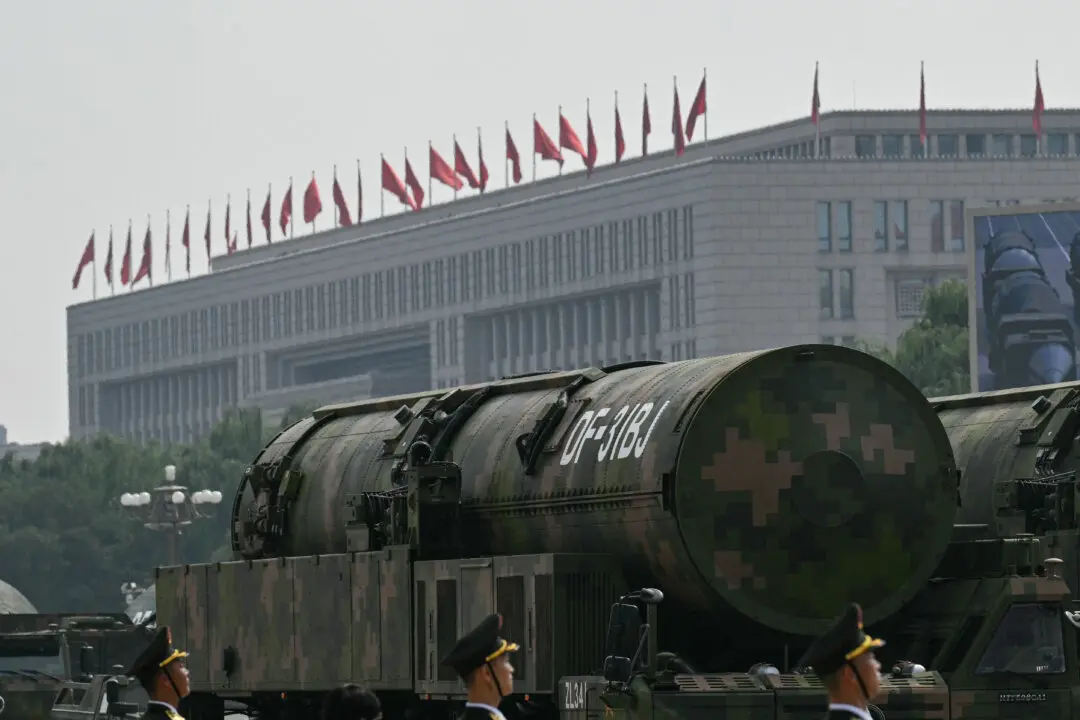
DF-31BJ intercontinental ballistic missile during a military parade marking the 80th anniversary of the end of World War II, in Tiananmen Square, Beijing, on Sept. 3, 2025. Greg Baker/AFP via Getty Images
China’s military is undergoing a massive nuclear expansion and remains on track to have as many as 1,000 nuclear warheads by the end of 2030, despite a slowdown in production last year, according to the Pentagon’s latest assessment of the country’s armed forces.
“China’s historic military buildup has made the U.S. homeland increasingly vulnerable,” the Pentagon said in an annual report submitted to Congress on Dec. 23.
“China maintains a large and growing arsenal of nuclear, maritime, conventional long-range strike, cyber, and space capabilities able to directly threaten Americans’ security.”
The 2025 China Military Power Report assessed that the pace of producing deliverable nuclear missiles had slowed over the past year, although it didn’t mention the reasons for the slowdown.
“China’s stockpile of nuclear warheads remained in the low 600s through 2024, reflecting a slower rate of production when compared to previous years,” the report reads.
Nevertheless, the People’s Liberation Army (PLA) has “continued its massive nuclear expansion,” it notes, and is still on track to have 1,000 nuclear warheads by 2030.
Aside from expanding its nuclear arsenal, the report highlighted that Beijing has made progress toward an “early warning counterstrike” capability, similar to the West’s “launch on warning.” This would enable Chinese authorities to authorize a nuclear retaliatory launch once an enemy strike is confirmed but before detonation.
“China likely will continue to refine and train on this capability throughout the rest of the decade,” the Pentagon said.
The Chinese Communist Party (CCP) has never publicly disclosed the size of its nuclear stockpile. In September 2024, the Chinese military test-fired an intercontinental ballistic missile (ICBM), the first in decades. Analysts have speculated that the tested missile was a DF-41, which is capable of traveling an estimated 9,300 miles, but the Pentagon report assessed it was an older version, the DF-31B, stating that the missile flew approximately 6,835 miles before impacting the ocean near French Polynesia.
In addition, the report notes that China’s military had likely loaded “more than 100” solid-propellant ICBMs into silo fields at three facilities in northwestern China that house DF-31-class ICBMs.
However, a far-reaching anti-graft campaign in the military establishment “is very likely creating reverberations within China’s nuclear forces and may be raising questions among leadership about force readiness,” the report said.
China’s conventional and nuclear missiles are managed by a secretive PLA unit called the Rocket Force, established by CCP leader Xi Jinping on the final day of 2015. Over the past three years, the force’s four commanders—Wei Fenghe, Zhou Yaning, Li Yuchao, and Wang Houbin—have been ensnared in the anti-corruption campaign.
Purges
The report assessed that the ongoing purge of military chiefs could hinder modernization goals for China’s armed forces, a transformation the CCP has devoted billions of dollars to achieve by 2027. This finding was roughly the same as the Pentagon’s assessment last year.
“The number of personnel removed likely has implications for the PLA’s progress towards its 2027 modernization goals,” the report reads. “Given the PLA’s continued progress against these goals, it is difficult to ascertain how significant these implications have been.”

Gen. He Weidong, vice chairman of China’s Central Military Commission (CMC), attends the opening ceremony of the Chinese People’s Political Consultative Conference in Beijing on March 4, 2025. Pedro Pardo/AFP via Getty Images
The latest Pentagon report notes that the sweeping purges had led to the removal of senior leadership across all theater commands in the PLA.
As of July 2024, nearly one-fifth of the military members on the CCP’s governing Central Committee had already been removed or placed under investigation, according to the report.
In the defense industry, at least 26 top and former managers from state-owned arms suppliers have been placed under investigation or removed from their positions, it said. That includes the chief designer of the J-20 stealth fighter—a large warplane that China relies on to narrow the gap with the United States—who was placed under investigation in January.
The campaign shows little sign of abating. The Rocket Force recently barred nearly 200 equipment suppliers and experts from participating in procurement bids, citing misconduct in contracts dating back to 2016, the first year the forces were established.
Earlier this month, the PLA opened a rare probe into corruption related to procurement practices within the air force, calling on the public to come forward with tips on any wrongdoing.
On Dec. 22, a day before the Pentagon released its annual assessment, Xi appointed new commanders overseeing operations in Beijing and Taiwan.
Gen. Yang Zhibin now serves as the head of the PLA’s Eastern Theater Command, which oversees some of the country’s most strategically important areas, including the East China Sea and the Taiwan Strait.
The promotion of Yang comes amid uncertainty surrounding the leadership of the crucial command theater after Yang’s two direct predecessors—Lin Xiangyang and He Weidong—were expelled from the Party and the military, in the largest single-day purges of senior commanders in decades.
The reason the defense ministry’s spokesperson cited for the dismissal at the time was severe violations of Party discipline and serious duty-related crimes “involving an extremely large amount of money.”
According to military insiders who previously spoke to The Epoch Times, the renewed purges in the defense establishment were driven by political infighting between the chair and vice chair of a CCP body that runs the PLA—namely, Xi and Gen. Zhang Youxia, respectively.
Taiwan
The Pentagon report also outlined China’s progress toward its 2027 targets, which it describes as achieving a “strategic decisive victory” over Taiwan, a “strategic counterbalance” against the United States in the nuclear and other strategic domains, and “strategic deterrence and control” against other regional countries.
“In other words, China expects to be able to fight and win a war on Taiwan by the end of 2027,” it said.
The CCP views self-ruled Taiwan as a breakaway province, despite never having governed the archipelago of 23 million people. The Party leaders have repeatedly declared that “reunification” with Taiwan “must be achieved” and has not ruled out the use of force to achieve that goal. Taiwan rejects the regime’s stance, vowing to maintain the status quo and defend its democracy.

The Arleigh-Burke class guided-missile destroyer USS Kidd (DDG 100) transits the Taiwan Strait during a routine transit on Aug. 27, 2021. U.S. Navy/AFP/Getty Images
The Pentagon report said “the PLA continues to refine multiple military options to force Taiwan unification by brute force.” These include an amphibious invasion, a firepower strike, and possibly a maritime blockade.
“Over 2024, the PLA tested essential components of these options, including through exercises to strike sea and land targets, strike U.S. forces in the Pacific, and block access to key ports,” the report notes.
Although CCP officials view the PLA’s capabilities as improving, the report said, they “remain unsure of the PLA’s readiness to successfully seize Taiwan while countering U.S. involvement.”
Correction: An earlier version of this article misstated the number of Chinese military nuclear warheads in one instance. The Epoch Times regrets the error.
Dorothy Li is a reporter for The Epoch Times. Contact Dorothy at dorothy.li@epochtimes.nyc.