Another Asia scholar notes language used in the strategy for the United States was previously used for Canada’s approach to China
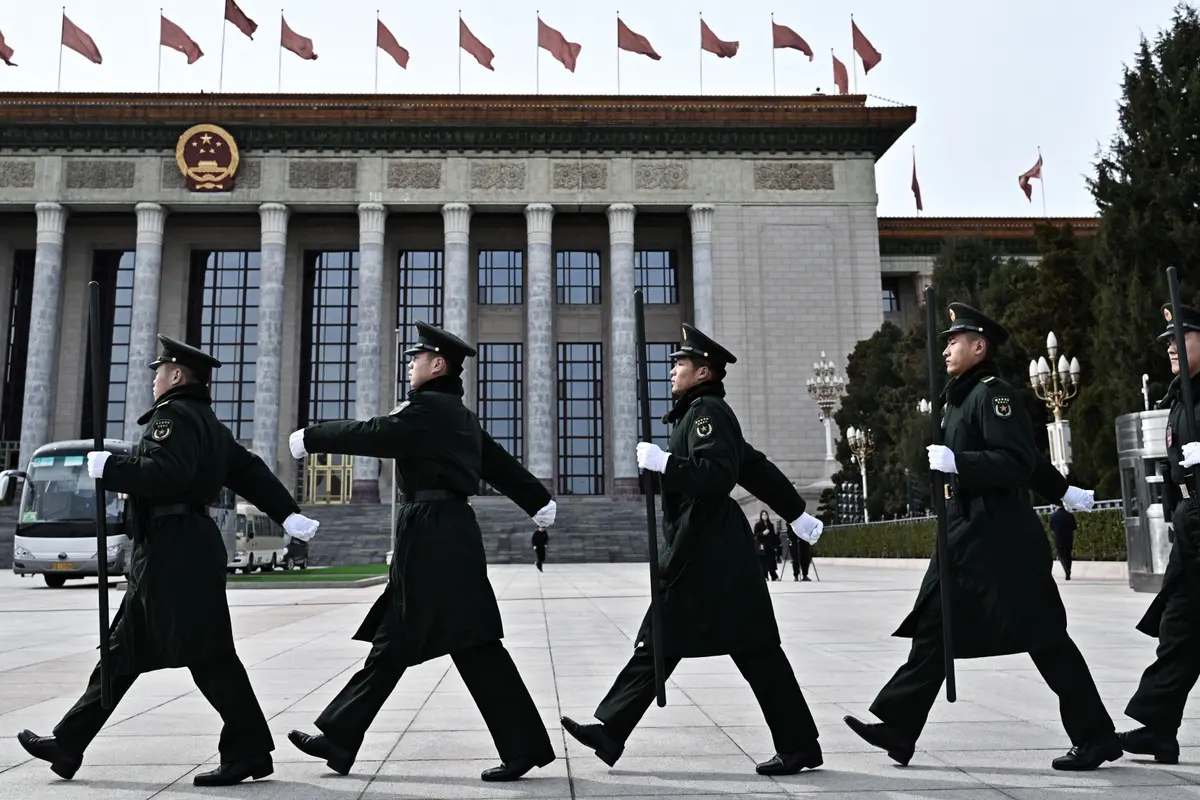
Chinese People’s Liberation Army (PLA) soldiers are seen outside the Great Hall of the People in Beijing on March 3, 2025, ahead of the country’s annual legislative meetings known as the “Two Sessions”. (Photo by Pedro Pardo / AFP) Photo by PEDRO PARDO/AFP via Getty Images
A leading China analyst is raising concerns over the absence of any direct mention of China in Ottawa’s new national security strategy, saying the omission may reflect the government’s reluctance to speak critically about Beijing.
University of Ottawa researcher Margaret McCuaig-Johnston said leaving China out of the document, which outlines national security threats such as foreign interference and espionage, appears to be “an indication that the government doesn’t seem to want to mention China in a negative light in any way whatsoever.”
“I think it is interesting that the word China, Russia—those words do not appear in the strategy,” McCuaig-Johnston said on Oct. 29 at an appearance before the House committee on science and research.
“I sincerely hope that that they appear in all the planning documents and implementation documents that go along with the strategy.”

Margaret McCuaig-Johnston testifies before the House of Commons industry committee on March 26, 2025. House of Commons/Screenshot via The Epoch Times
McCuaig-Johnston, who previously served as executive vice-president of the Natural Sciences and Engineering Research Council of Canada (NSERC), added that the exclusion of China in the document follows a pattern of avoidance from the Liberal government when questions are asked about Beijing.
“We’ve seen that multiple times, where ministers are asked obvious questions about China and the risk, and they don’t—they won’t say anything about it at all,” she told MPs.
Vina Nadjibulla, president and research director of the Asia Pacific Foundation of Canada, also noted a tone change in how U.S. relations are defined in the new strategy. She said that the language describing the desired relations with the United States is similar to that previously used to describe Canada’s approach to relations with China.
The new national security strategy states that Canada’s ties to the United States must form a “cooperative, clear-eyed relationship” that respects mutual sovereignty and a shared responsibility for safeguarding North America.
“Perhaps most revealing is the call for a “cooperative, clear-eyed” relationship with the US — language previously associated with Canada’s approach to China.”
New National Security Strategy
On Oct. 29, Prime Minister Mark Carney released Canada’s first new national security strategy since 2004, entitled, “The Plan for a Stronger Canada—National Security for Canadians.”
The 13-page document focuses on policies to bolster Canada’s military strength, counter foreign interference threats, and lessen economic dependence on other nations, including the United States.
“What were once strengths—our strong connections and deep integration with other countries—have become vulnerabilities,” the document reads, echoing past statements Carney made when he announced his goal of doubling non-U.S. exports by 2035 and while speaking at the World Economic Forum.
The document identifies great-power rivalries, the rise of artificial intelligence (AI), climate change, foreign interference, espionage, authoritarian aggression, economic threats and pandemics as challenges to Canada’s national security. It does not directly name any foreign adversaries, including China or Russia.
The document mentions Ukraine as an example of lessons to be learned from modern warfare and identifies the United States as an ally with which Canada should maintain a cooperative relationship. Otherwise, it refers primarily to regions, including Africa, the Middle East, the Indo-Pacific and Europe, rather than naming individual countries.
The strategy also calls for stronger intelligence information-sharing with the private sector and research institutions, as well as closer collaboration with industry and academia, to protect Canada’s strategic industries and guard against foreign interference and espionage.
China and the Arctic
The strategy calls for Canada to keep a permanent presence in the Arctic and work with “like-minded Arctic countries.”
McCuaig-Johnston’s criticism of the strategy’s omission of China came after Conservative MP Connie Cody asked her whether China could be considered one of the “like-minded” countries Canada might cooperate with on Arctic security.
“No, I don’t. And I think those words were very, very carefully chosen,” McCuaig-Johnston replied to Cody, adding that China is neither like-minded nor actually a near-Arctic power.
She added that it troubles her that China isn’t specifically named in the recently-released strategy.
Canada’s last Arctic-specific policy document, entitled, “Canada’s Arctic Foreign Policy,” was released in December 2024, and named both China and Russia as threats to Canada in the region.
This includes specifying China as a non-Arctic power seeking more influence in the region via control of natural research, expansion of scientific research, and via shipping and economic leverage.
Canada-China Relations
McCuaig-Johnston’s criticism comes in the wake of the Carney government seeking closer diplomatic and trade ties with Beijing, representing a significant shift from the approach under former Prime Minister Justin Trudeau.
The Trudeau government’s Indo Pacific-Strategy document, released Nov. 27, 2022, named China as an “increasingly disruptive global power” and warned about the growing strength of China’s military as well as its usage of economic coercion and disregard for international norms and rules.
The Trudeau government’s Indo-Pacific Strategy, released on Nov. 27, 2022, explicitly described China as “an increasingly disruptive global power” and warned about Beijing’s growing military capabilities, economic coercion, and disregard for international rules.
By contrast, Foreign Affairs Minister Anita Anand described Canada as being in a “strategic partnership” with Beijing on Oct. 20, 2025. She went on to announce during a House committee appearance 10 days later that she had directed Global Affairs Canada to update the Indo-Pacific Strategy.
The term “strategic partnership” in regards to China was later affirmed by Carney while visiting China in January.
During the official visit to China, Anand declined to confirm whether she agreed with the 2022 Trudeau-era document in its characterization of China as a “disruptive” power and said it was important for Canada to focus on positive engagement and economic ties with China.
“I believe the Indo-Pacific strategy needs to be updated, because we have a new government, a new foreign policy and a new Prime Minister,” Anand told media Oct. 14, adding that Canada has a “very complex relationship” with China and there are “many issues we need to address.”
During the same visit, Carney signed several memoranda of understanding and cooperation agreements with China, covering areas including law enforcement, energy, construction, food safety, agriculture, culture and tourism. The two countries also reached a trade arrangement under which Canada would allow an initial annual quota of 49,000 Chinese-made electric vehicles at a 6.1 percent tariff, while China agreed to ease duties on several Canadian agricultural and seafood products.
During a dinner with Chinese officials and Chinese Premier Li Qiang, Carney praised the deepening bilateral ties between Ottawa and Beijing, saying the progress made in the partnership “sets us up well for the new world order.”
The comments from Carney stand in contrast to his remarks during the 2025 federal election campaign, when the then-Liberal candidate described China as Canada’s biggest security threat.
During Oct. 29 testimony McCuaig-Johnston said she agrees with Carney’s earlier comments that China is Canada’s top security threat.
“I completely agree,” she said.
US Relations
During remarks at his Jan. 16 dinner in China, Carney said Canada must be “clear-eyed” about its international relationships, being honest about differences and divergent interests but working together and cooperating where possible.
The Conservatives have been critical of the agreements signed with China this past January, and the deepening partnership between Ottawa and Beijing, saying the warming relations raise serious national security and economic concerns.
In a Jan. 22 response to Carney’s remarks at the World Economic Forum and in the wake of the agreements signed with China, Poilievre said Canada should be focused on repairing and improving ties with the United States rather than seeking out increased trade with other nations like China.
“I know it’s tempting to say our relationship with America is over forever. But here is the reality: We still live next door to the biggest economy and military the world has ever seen. We sell 20 times more to the U.S. than to China. 1 in 10 Canadian jobs rely directly and indirectly on trade with America,” Poilievre said.
The Conservative Leader further stated that Canada’s “prosperity and security are inseparable from a stable relationship with the United States.”
“That is why we should not declare a permanent rupture with our biggest customer and closest neighbour in favour of a strategic partnership for a new world order with Beijing – a regime the prime minister himself said was the biggest threat to Canada just a year ago,” he added.