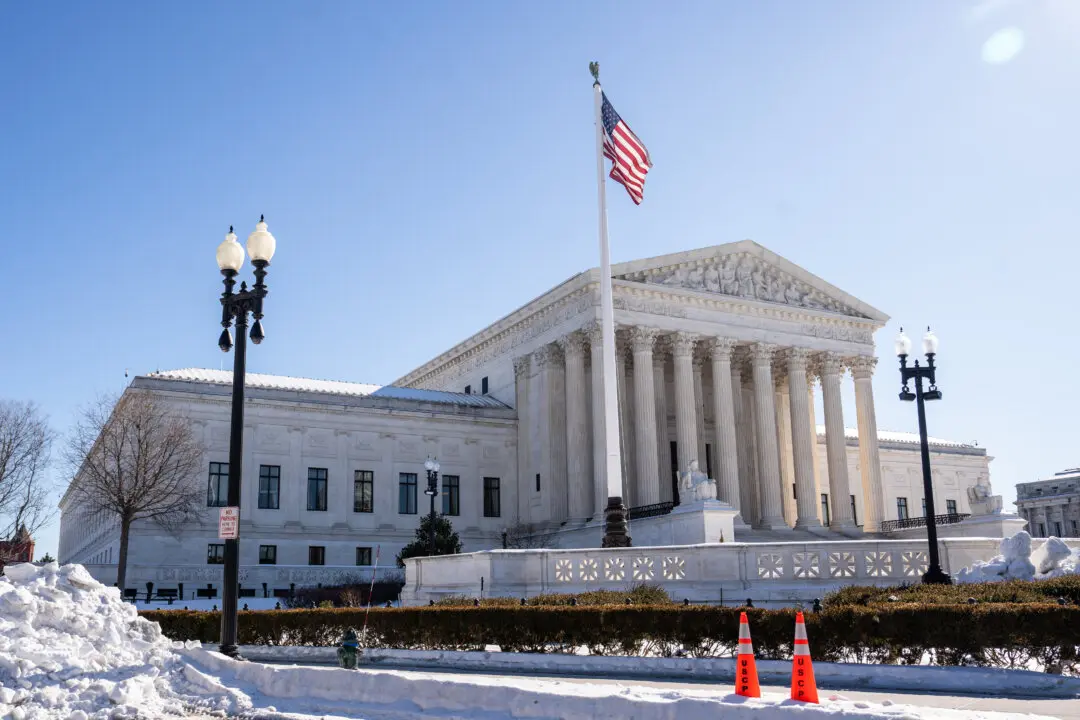
The U.S. Supreme Court in Washington on Feb. 2, 2026. Madalina Kilroy/The Epoch Times
The U.S. Supreme Court’s ruling that one set of U.S. tariffs on Canada is illegal strengthens Canada’s position, but the economic impact is expected to be limited—particularly after U.S. President Donald Trump announced a new 10 percent across-the-board tariff.
Canada had mostly been spared from the controversial tariff struck down by the Supreme Court on Feb. 20, as goods covered by Canada’s free trade deal with the United States were exempted. Now it remains to be seen if and how the new 10 percent U.S. tariff will apply to Canada.
Trump said during a press conference on Feb. 20 that he would use Section 122 under the Trade Act of 1974 to impose the new tariff. The statute allows the president to impose tariffs up to 15 percent to redress “large and serious” balance of payments issues, for a duration of up to 150 days.
Asked by reporters whether the new tariff would be limited to 150 days, Trump said it would be charged “indefinitely” and that “we have a right to do pretty much what we want to do.”
Trump made the announcement after the Supreme Court ruling, which he called “very disappointing.” The U.S. president has been wielding tariffs for a variety of reasons, including redressing trade imbalances, on-shoring manufacturing, increasing federal revenues, and as a negotiating and pressure tactic—including to solve armed conflicts.
In its much-anticipated ruling, the top U.S. court declared on Feb. 20 that Trump overstepped his authority in imposing tariffs on countries using a specific piece of legislation.
The ruling could require the U.S. government to refund importers who paid the tariff, with the Supreme Court describing the refund process as “likely to be a ‘mess.’” Corporate giants have previously filed lawsuits seeking compensation.
Trump used the International Emergency Economic Powers Act (IEEPA) to impose tariffs on Canada and other countries early in his term.
Canada, Mexico, and China were the first to be affected by the IEEPA tariffs, with Trump declaring in February 2025 a national emergency related to issues including drug trafficking. Later in April, Trump used the IEEPA to impose “reciprocal” tariffs on multiple U.S. trade partners.
The Supreme Court, in a 6-3 decision, said using the IEEPA to impose tariffs would “would represent a transformative expansion of the President’s authority over tariff policy.” The majority opinion written by Chief Justice John Roberts also said that no president had ever invoked the IEEPA to impose any tariffs, “let alone tariffs of this magnitude and scope.”
In a dissenting opinion, Justice Brett Kavanaugh wrote that under the interpretation of the majority of his colleagues, the president would be able to block all imports from China, but wouldn’t have the power to impose even a $1 tariff on goods imported from the country.
“That approach does not make sense,” Kavanaugh said. “Properly read, IEEPA does not draw such an odd distinction between quotas and embargoes on the one hand and tariffs on the other.”
The ruling was welcomed by the Canadian government, which has so far been unable to secure a trade deal with the Trump administration to obtain tariff relief, unlike some other peer countries.
With talks not progressing at the end of summer 2025, Ottawa started messaging that Canada already has the best trade deal with the United States compared to other countries due to the United States-Mexico-Canada Agreement (USMCA). Prime Minister Mark Carney said that 85 percent of goods are crossing the border tariff-free.
According to the Fitch Ratings agency, which monitors U.S. tariffs, the effective U.S. tariff rate (ETR) on Canada is 5.9 percent. By comparison, Mexico’s ETR is 5.8 percent while only two European countries have lower ETRs with Ireland at 2.8 percent, and Slovenia at 3.7 percent.
Some of the goods that have been affected by the IEEPA tariffs in Canada include electronics, scientific instruments, and machinery, since they may contain components not complying with the USMCA rules of origin.
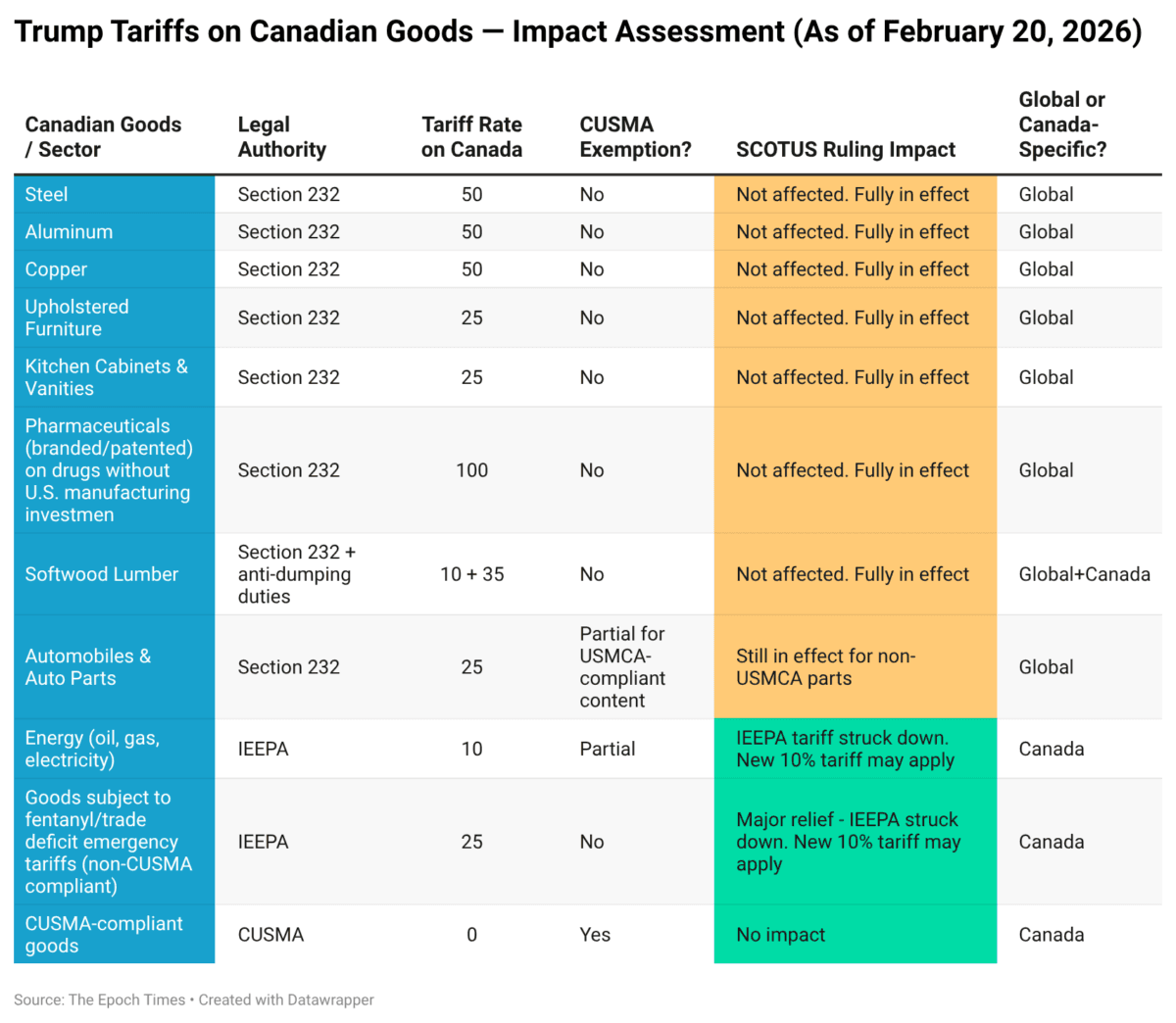
Canada has avoided the brunt of the IEEPA tariffs, coming with a steep 35 percent rate, due to the White House exempting goods covered by the USMCA.
This was part of the message put out by Ottawa following the Supreme Court’s decision. Canada-U.S. Trade Minister Dominic LeBlanc said that Canada has the “best trade deal” with the United States while noting that the top court’s ruling “reinforces Canada’s position that the IEEPA tariffs imposed by the United States are unjustified.”
LeBlanc added that “critical work lies ahead” to address the impacts of other tariffs impacting Canada.
Trade Talks
Trump has used Section 232 under the Trade Expansion Act of 1962 to impose universal tariffs on national security grounds on a range of goods, including steel, aluminum, and automobiles. These sectors of the Canadian economy have been particularly affected, with layoffs and production moving south.
Ottawa and Washington were inching closer to reaching a deal related to these tariffs in October 2025 until the Ontario government ran an anti-tariff TV ad in the United States. Trump cancelled trade talks at that time, accusing Canada of trying to interfere with the Supreme Court’s review of the tariffs.
Trade talks have now shifted to the upcoming joint review of the USMCA later this year.
There’s been related messaging on all sides, with Trump officials suggesting the tripartite deal could be scrapped and replaced by bilateral deals.
Meanwhile, LeBlanc just completed a visit to Mexico with a large delegation. He said at the end of his visit on Feb. 18 that Canada remains “fundamentally committed to a true free trade agreement with the United States and with Mexico.”
LeBlanc added that Canada has not discussed any contingency plan with Mexico in case the U.S. pursues bilateral deals instead, something that U.S. Trade Representative Jamieson Greer has said could be possible.
LeBlanc did not immediately comment on Trump’s announcement that he will impose a new universal 10 percent tariff or his broader stance on the Supreme Court’s decision.
While Trump criticized the Supreme Court’s decision, he also said the ruling has a positive side for his trade agenda. He said the ruling has “made a president’s ability to both regulate trade and impose tariffs more powerful and more crystal clear” and that alternative authorities could allow him to levy “even more tariffs.”
Trump noted that several investigations into alleged unfair trade practices would begin under Section 301 of the Trade Act of 1974 and other provisions, and said that all national security tariffs under Section 232 and existing Section 301 tariffs “remain in place, fully in place, and in full force and effect.”