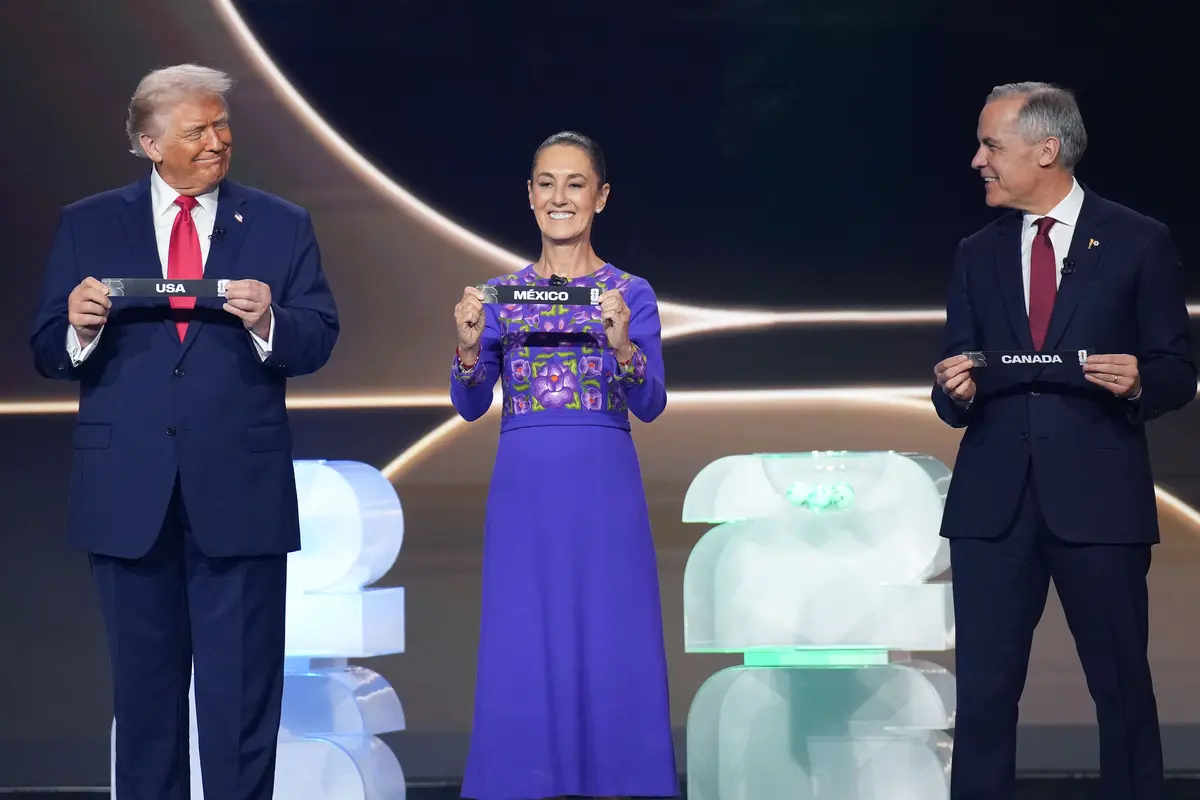
(L-R) U.S. President Donald Trump, Mexican President Claudia Sheinbaum, and Canadian Prime Minister Mark Carney participate in the FIFA World Cup 2026 Official Draw with at the John F. Kennedy Center for the Performing Arts Dec. 5, 2025, in Washington, D.C. Photo by Andrew Harnik/Getty Images
Mexico has pushed for trilateral talks on the review of the continental trade pact, while the United States has opted to negotiate separately with Canada and Mexico, according to Mexican President Claudia Sheinbaum.
Sheinbaum made the comments on June 22 during her daily press conference in Mexico City while responding to questions from a Canadian media outlet on the the review of the Canada-United States-Mexico Agreement (CUSMA) on free trade.
Sheinbaum said the trade talks are taking place in the framework of the U.S. administration adopting measures to protect its economy.
“What is certain is that there are separate talks. That’s how the United States decided. We have always insisted on tripartite talks,” she said.
In late May, Mexico and the United States held a formal round of bilateral talks on the review of CUSMA, and two other rounds have been scheduled for June and July.
There have been no similar talks announced between Canada and the United States, although Ottawa says progress continues to be made with Washington on various trade issues.
Prime Minister Mark Carney said in early June the United States has around 30 “technical” trade issues to iron out with Canada, and around 60 with Mexico.
The CUSMA review is set for July 1, and both Canada and Mexico have already formally indicated their desire to extend the agreement for an additional 16 years.
The United States has yet to state its official position, but U.S. President Donald Trump suggested in recent days that he may choose not to renew the pact—or could even move to terminate it altogether.
If CUSMA is not renewed in July, it remains in force for another 10 years with annual reviews, unless one party decides to withdraw or all parties agree to extend it for a longer period.
Sheinbaum did not express concerns the deal could be abandoned, noting it’s a treaty that the three countries’ legislatures have approved.
“If something very fundamental had to change, it would have to go through the Congresses,” she said. “And we don’t believe that’s the position of Canada, nor the position of the United States, nor our position.”
Sheinbaum said maintaining the agreement makes North America more competitive against China and other regions of the world.
Among Washington’s demands are stricter rules-of-origin requirements in CUSMA, to increase North American content in traded goods, and tougher measures aimed at limiting trade exposure to countries such as China.
U.S. Trade Representative Jamieson Greer, the lead U.S. negotiator on CUSMA, said in April that Mexico is more aligned with Washington’s trade priorities than Canada.
Although Canada and Mexico have been holding separate talks with the United States, Sheinbaum said Mexico has, to some extent, adopted a common-front approach with Canada in its communications.
“We have strengthened our relationship with Canada,” she said, noting the investment by a Canadian firm in a Mexican port.
Montreal-based Logistec purchased a cargo and steel terminal in the state of Tamaulipas earlier this year, which Sheinbaum said will boost maritime trade between Mexico and Canada.
Sheinbaum said she hopes there will be trilateral CUSMA meetings in early July, but none have been announced as the deadline nears.
Trump has been critical of the agreement in recent weeks, saying his country doesn’t need anything being made in Canada or Mexico.
“I don’t know that I’m going to renew it, because to be honest with you, the United States does much better,” Trump said on June 10.
“We don’t need anything that Canada has, we don’t need anything that Mexico has, but they need everything that we have, and they have to treat us better.”
A non-renewal would not terminate the agreement, but Trump raised the stakes a week later in mentioning a potential withdrawal.
“I would rather leave it unsigned. I’d rather have it terminated. … I may sign it, but I would rather–we do better as a country if we don’t have an agreement,” Trump said June 17.
In response, Carney said it’s “no secret” that Trump dislikes CUSMA, while adding there are “specific things” that Canada can work on together with the United States.