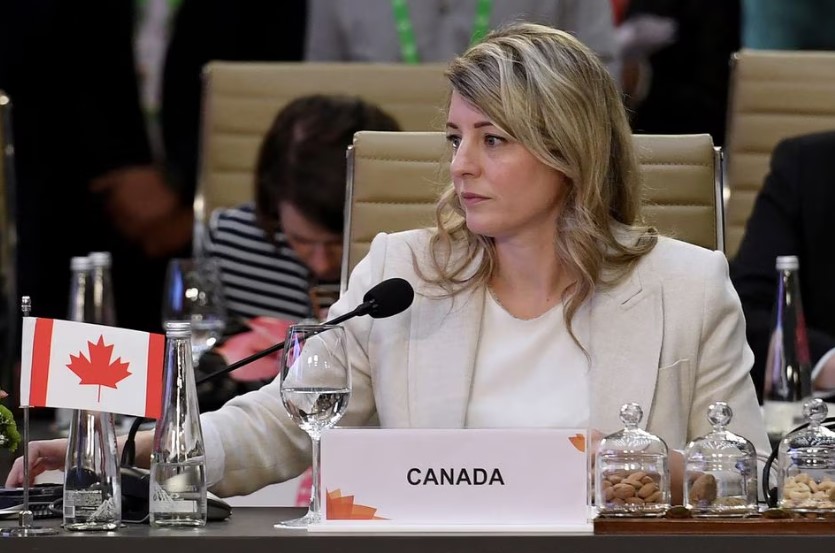
Minister of Industry, then Foreign Minister Melanie Joly attends the G20 foreign ministers’ meeting in New Delhi on March 2, 2023. OLIVIER DOULIERY/Pool via REUTERS
Industry Minister Mélanie Joly has outlined the conditions Chinese automakers must fulfil to establish a production base in Canada.
Speaking to reporters in Japan on June 22 during the second leg of her Asia trip, Joly said four conditions would need to be met under the Investment Canada Act.
The joint ventures must be majority Canadian-owned, labour standards need to be at the level of the Canadian auto industry, and supply chains must be local. “Last one is everything linked to security of software and security of data,” she added, without elaborating.
She also said establishing production in Canada is not a matter for negotiation with China.
“It’s much more the discussions are happening between the automakers from China that are private companies that will take their own decisions, and actually also Canada, and that is how also we intend to continue to engage,” she said.
Joly made the comments after visiting China last week, where she met with the leadership of four Chinese auto companies, including Geely, Chery, BYD, and Shanghai Launch.
She added that all the automakers she met are interested in exploring joint ventures in Canada to produce cars.
Industry and expert voices have warned since the Chinese EV deal was announced in January that importing Chinese cars poses a security threat.
Modern vehicles are internet-connected and loaded with sensors, and Chinese companies are compelled by law to cooperate with the state on intelligence collection. Some countries have blocked Chinese cars from entering military facilities, such as Poland and Israel. The United States recently blacklisted Chinese carmaker BYD for its alleged ties to the military.
EV Deal
Prime Minister Mark Carney outlined similar conditions for Chinese auto investments in Canada when speaking to reporters last week, but didn’t mention requirements around supply chains or security.
“We’re not interested in kits being put together in Canada,” he said. “We’re interested if there are joint venture partnerships, Canadian control, substantial value add, Canadian labour standards, substantial jobs, etc.”
Carney was asked to comment on the matter after a hot mic at the G7 Leaders’ Summit in France captured him discussing the China EV deal with U.S. President Donald Trump. Carney told Trump the deal was capping Chinese access to the Canadian auto market at “3 percent.” Trump responded, “That’s good, I like that.”
Trump had initially reacted negatively after Carney visited China and announced the EV deal, saying that Canada is “systematically destroying itself” with the deal.
Joly said all the carmakers she met in China are interested in accessing the quota of 49,000 Chinese electric vehicles (EVs) established by Ottawa earlier this year. The Carney government slashed the surtax on Chinese EVs from 100 percent to 6.1 percent in exchange for China temporarily dropping or reducing its tariffs on some Canadian agricultural and seafood products.
The quota will increase by 6.5 percent every year to reach 63,037 vehicles in 2030, for a total of 278,989 autos over five years.
Joly said she couldn’t comment on how the China deal could impact current negotiations around the review of the Canada-United States-Mexico Agreement (CUSMA) on free trade, slated for July 1. The U.S. side is pushing to have its trade partners follow more closely its tariff policies in order to mitigate dumping or transhipments from countries like China.
“I won’t give you exactly what is being discussed with the U.S., because we will let negotiators do their work, and that work is better done behind closed doors, but rest assured that the negotiating team is in charge of protecting Canada’s interests,” Joly said.
Forced Labour
Canada has been under U.S. pressure on various trade fronts, most recently with the threat of tariffs over goods made from forced labour. Canada was among a group of 60 countries the U.S. administration identified in early June as lacking rules strict enough to prevent the entry of goods made with forced labour.
The Carney government subsequently introduced Bill C-35 on June 12 to strengthen rules around forced labour.
Lawmakers have sought to confirm whether Chinese EVs will be allowed in Canada based on new rules contained in the bill. Human Rights Watch says forced labour is present in the Chinese vehicle supply chain, principally through aluminum produced in Xinjiang, where minority Uyghurs are persecuted.
Bill C-35 would allow the minister of foreign affairs to establish a list of goods suspected of being made through forced labour.
An official from the Canada Border Services Agency (CBSA) testified before a parliamentary committee last week and said he cannot speculate on what will make it on the list, but noted that automotives are currently being looked at.
“In terms of the targets that we currently have ongoing, automobile parts, textiles, seafood are some of the commodities that are in there,” said Graeme Hamilton, a director general at CBSA.