The renewed calls follow Alberta’s Oct. 19 referendum, in which roughly 55 percent of voters supported giving the province greater control over immigration.
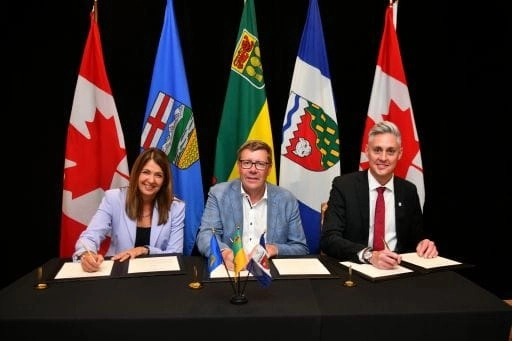
Alberta Premier Danielle Smith, Saskatchewan Premier Scott Moe, and Northwest Territories Premier R.J. Simpson sign a memorandum of understanding (MOU) on Sept. 14, 2026, in Saskatchewan Handout photo
Saskatchewan and Newfoundland and Labrador are joining Alberta in pushing the federal government for greater control over immigration, arguing that provinces should have more authority to select newcomers who can fill labour shortages and support their economies.
The calls follow Alberta’s Oct. 19 referendum, in which roughly 55 percent of voters supported giving the province greater control over immigration, including the ability to determine how many newcomers it accepts.
Saskatchewan Premier Scott Moe said on Oct. 22 that provinces should have most say over immigration priorities, numbers, and refugee policies. He added that Saskatchewan has sought greater autonomy over immigration since 2022 and has proposed an immigration accord that would give it powers similar to Quebec’s.
“I think there is an opportunity for provinces, as we’ve always said, to be much more involved in our national immigration system or national immigration procedures,” Moe said.
The premier said immigration should focus primarily on attracting people who can contribute to the economy, while ensuring newcomers have employment opportunities allowing them to support their families.
“Any time we’re talking about immigration across Canada and Saskatchewan, it should very much be focused on economic immigration,” he said.
Moe added that immigration discussions should include international students and refugees, while Saskatchewan’s needs could differ from those in Atlantic Canada.
Newfoundland Seeks Greater Role
Newfoundland and Labrador has also been pressing Ottawa for greater influence over economic immigration, particularly through the Provincial Nominee Program (PNP), which allows provinces to nominate foreign nationals for permanent residency based on local economic needs.
The provincial government has said that gaining more control over immigration may be an area of focus when the provincial legislature resumes next week.
Provincial Immigration Minister Lin Paddock joined federal, provincial, and territorial counterparts on June 23 to discuss immigration levels for 2027 through 2029. “Provinces and territories play a critical role in shaping immigration pathways that reflect regional labour market needs, support economic growth, and help communities of all sizes thrive,” Paddock said.
Provincial and territorial ministers called for higher allocations under the Provincial Nominee Program and Atlantic Immigration Program, along with greater transparency about how Ottawa sets provincial nomination targets, according to the statement.
The province announced consultations in May to improve oversight of immigration programs, protect foreign workers, and ensure employers could continue recruiting newcomers to address labour shortages.
Alberta Seeks Quebec-Style Agreement
Alberta Premier Danielle Smith has meanwhile indicated that her government intends to pursue an immigration agreement with Ottawa modelled on Quebec’s arrangement.
Quebec has considerably broader immigration powers than other provinces under a 1991 agreement with Ottawa, including authority to select economic immigrants and establish its own targets.
“We have been looking for some inspiration from Quebec’s 1991 Canada-Quebec accord,” Smith said on Oct. 21.
Prime Minister Mark Carney has said he would work cooperatively with the provinces. He has also said that his government wouldn’t “budge from overall levels that are sustainable.”
Asked on Oct. 21 whether Ottawa would consider granting Alberta immigration powers comparable to Quebec’s, Carney replied, “We’ll see.” However, he emphasized Quebec’s distinct language and culture and said the federal government would continue consulting provinces about immigration levels.
“We have been having discussions with the provinces’ first ministers around getting immigration, first and foremost, to the right levels,” Carney said.
Ottawa’s Response
During the June 23 meeting, ministers discussed Ottawa’s commitment to keeping annual permanent resident admissions below 1 percent of Canada’s population beyond 2027 and reducing the temporary resident population to less than 5 percent by the end of that year.
“Canadians expect their governments to manage migration responsibly, balancing sustainability and system integrity with efforts to attract the best talent in the world,” Federal Immigration Minister Lena Metlege Diab said in the joint statement.
Ottawa’s current immigration plan calls for admitting 385,000 permanent residents in 2026, followed by 370,000 annually in 2027 and 2028.
The issue is expected to receive further attention when Canada’s premiers meet in Ottawa on Oct. 26, ahead of the federal government’s next announcement on immigration levels.