In Japan’s two-chamber parliament, the lower house has more power, giving it more control over governing policy.
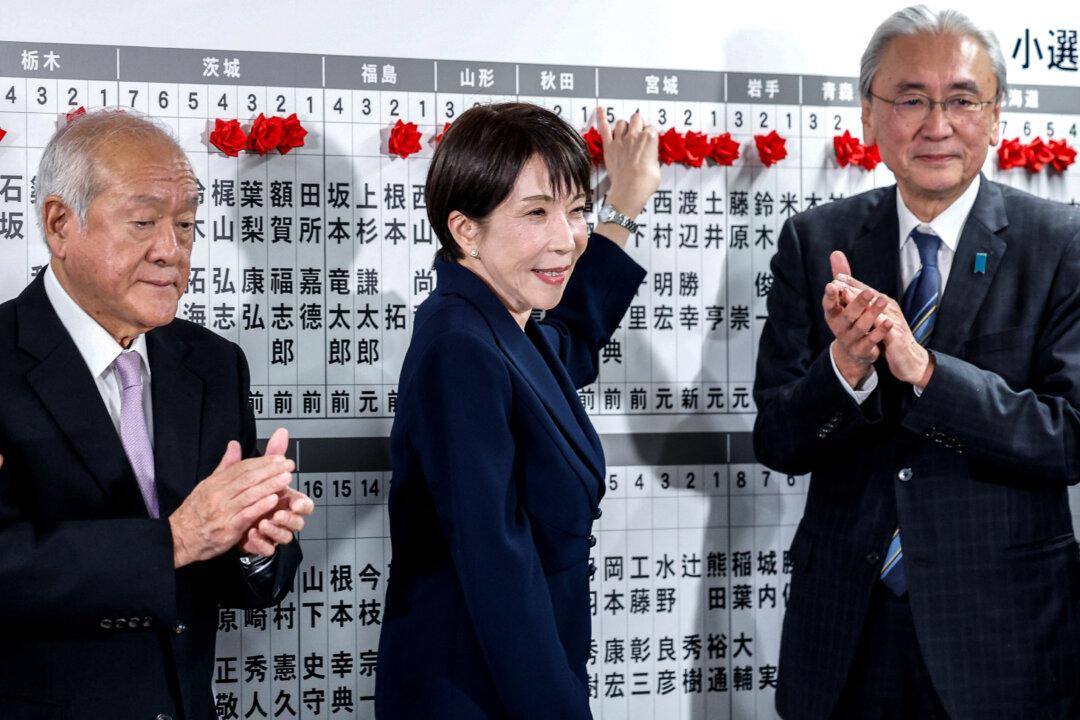
Japan’s Prime Minister and President of the Liberal Democratic Party (LDP) Sanae Takaichi (C), standing next to LDP Secretary-General Shunichi Suzuki (L) and LDP Election Strategy Chief Keiji Furuya, places a red paper rose on the name of an elected candidate at the LDP headquarters during the House of Representatives election in Tokyo on Feb. 8, 2026. Kim Kyung-Hoon/Pool/AFP via Getty Images
Japanese Prime Minister Sanae Takaichi’s ruling coalition swept to a single-party majority victory in a critical parliamentary election on Feb. 8, paving the way for the nation’s first female head of state to pursue her agenda of sweeping tax cuts and increasing military spending to counter Beijing’s influence.
Takaichi’s Liberal Democratic Party (LDP) was projected to clinch as many as 328 of the lower house’s 465 seats, a landslide supermajority, according to exit poll results cited by NHK public television and other major networks.
Her ruling coalition and its partner—the Japan Innovation Party, known as Ishin—is projected to win as many as 366 seats in the lower chamber, the more powerful house in Japan’s two-chamber parliament.
Takaichi’s LDP alone had already secured the 233 seats required for a majority roughly 90 minutes after polls closed on Feb. 8. Its sweep of 328 seats is the most that the party has ever won in Japan’s lower chamber.
Takaichi’s ruling coalition’s win allows the female prime minister, who has cited inspiration from Britain’s “Iron Lady,” Margaret Thatcher, to pursue a conservative agenda that seeks to improve Japan’s economy and military readiness amid ongoing tensions with China and as Tokyo fosters closer ties with Washington.
Serving as Japan’s first female leader, Takaichi, 64, has been in office since October 2025.
She has promised tax cuts, emphasized national security amid growing tensions with Japan’s powerful neighbor, China, and has seen popularity among many voters for her tough-talking and hardworking image.
However, Takaichi’s promise to suspend Japan’s 8 percent sales tax on food to offset rising prices has roiled markets and investors who worry how the country with the largest debt burden among advanced economies will pay for the initiative.
“Her plans for the cut in the consumption tax leave open big question marks about funding and how she’s going to go about making the arithmetic add up,” said Chris Scicluna, head of research at Daiwa Capital Markets Europe in London.
Yoshinobu Tsutsui, leader of Japan’s top business lobby Keidanren, said the nation’s economy is “now at a critical juncture for achieving sustainable and strong growth.”
Record snowfall in parts of Japan forced some residents to trudge through snow to cast their ballots, as some polling stations were forced to close early because of the inclement weather.
Elections are usually called during milder months of the year, making this Japan’s third postwar election to be held in February.
Although it has ruled for nearly all of the nation’s postwar history, the LDP had lost control of both chambers of parliament in elections over the past 15 months, while Shigeru Ishiba, Takaichi’s predecessor, was still in power.
Takaichi called the rare winter snap election to buoy her ruling coalition’s chances after enjoying warm approval ratings following her rise to the top of the LDP in late 2025.
She has succeeded in building a large social media following and has notably been popular among younger voters, according to opinion polls, going as far as igniting a “sanakatsu” craze, which roughly translates to “Sanae-mania,” making popular many of the products that she uses daily—including her handbag and pink pen that she writes with in parliament.
U.S. President Donald Trump gave Takaichi his “total endorsement” last week. The prime minister hosted Trump in Tokyo in October 2025 shortly after she assumed office.
Just weeks after she assumed office, Takaichi publicly addressed how Tokyo might respond to Beijing attacking Taiwan, marking the largest dispute with China in more than a decade.
In response, China retaliated with economic countermeasures, including urging residents to avoid traveling to Japan.
The landslide victory in the lower chamber could give Takaichi the mandate to bolster Japan’s military readiness and defenses, further roiling Beijing, which has accused Japan’s first female prime minister of attempting to return to the nation’s militaristic World War II era.
As election results began rolling in, Japanese Defense Minister Shinjiro Koizumi told TV networks that he hopes to move forward on policies that buoy Tokyo’s defense while engaging in talks with Beijing.