The president warned that the United States remains ‘locked and loaded and ready to go.’
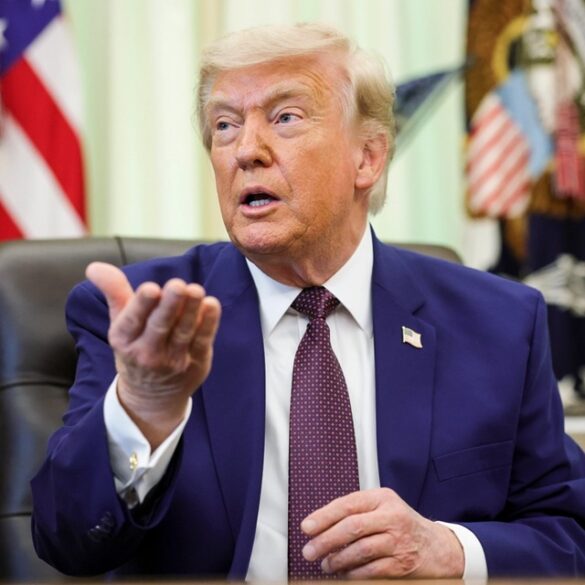
President Donald Trump in Washington on June 03, 2026. Kevin Dietsch/Getty Images
U.S. President Donald Trump said on Aug. 1 that he has agreed to pause or even cancel the pending U.S. attacks against Iran as negotiators have reached an outline for a deal.
Trump said in a post just after 10 p.m. ET on Truth Social that Iran and other Middle Eastern countries had requested that the United States “hold off any attack” because Iran has agreed to acceptable perimeters to end the conflict.
“Based on this request, I have agreed, for the future benefit of the WORLD and, likewise, the survival of a successful and prosperous Iran, to cancel the attack, subject to being able to rapidly make a deal,” Trump wrote.
Given Iran’s record of violating previously signed agreements, the president also noted that the United States remains “locked and loaded and ready to go against the Islamic Republic of Iran, at levels of Military Terror, Strength, and Power not seen since World War II.”
Trump said that for the attack to be canceled, Iran would need to show that it is abiding by the parameters of the deal, which include the immediate and complete opening of the Strait of Hormuz to international maritime traffic and an “end to Iran’s nuclear threat.”
He said that Israel has also agreed not to attack.
During a Cabinet meeting at Camp David on July 31, the White House signaled its plans for renewed U.S. strikes on Iran in the coming days aimed at forcing Tehran to surrender.
“The United States signed [a memorandum of understanding] with Iran and they broke it, shot at commercial ships, and killed American soldiers,” White House press secretary Karoline Leavitt previously told The Epoch Times by email. “President Trump is not going to stand by and allow this terrorist behavior to occur. Iran will continue to pay until they come to the table in, what President Trump deems, a meaningful way.”
Iranian Threats
Iranian officials earlier on Aug. 1 threatened new retaliatory attacks, including on U.S. allies in the region, if the United States were to act.
“We explicitly declare that Muslim countries must exercise foresight, monitor America’s crimes, and reconsider cooperation and alignment with the United States,” Iranian Maj. Gen. Ali Abdollahi said in a statement carried by the state-run Press TV on Aug. 1.
“Otherwise, any country that turns itself into a defensive shield for the criminal and aggressor United States will burn in the fire of war.”
Iranian state media reported that Iranian Foreign Minister Abbas Araghchi relayed similar warning messages in calls with Turkish Foreign Minister Hakan Fidan and Saudi Foreign Minister Faisal bin Farhan on Aug. 1.
Washington and Tehran reached a ceasefire agreement on April 8, and agreed to a memorandum of understanding for further peace negotiations in June. That ceasefire collapsed in July after Iranian forces renewed attacks on commercial shipping in the Strait of Hormuz and its neighboring countries that have hosted U.S. military bases.
Following the renewed Iranian attacks, Trump ordered U.S. forces to launch new strikes on Iran. Those U.S. strikes continued for 13 days before pausing on July 25.
U.S. forces launched another set of strikes on Iran on July 29, in response to an attempted Iranian missile attack on a U.S. military outpost in Jordan. Kuwait’s military on Aug. 1 reported that its air defenses had intercepted multiple Iranian drones. Kuwait has hosted multiple U.S. military bases since the 1991 Gulf War.
On Aug. 1, the U.S. State Department issued a new travel advisory urging U.S. citizens in the Middle East to “consider departing” or be prepared to depart “should there be escalation.”
The warning was issued more than a week after at least eight U.S. embassies in the Middle East urged American travelers in the region to “exercise caution and heightened vigilance” and prepare for “flight cancellations, periodic airspace closures, and potential travel disruptions.”
The Aug. 1 update reiterates vigilance for Americans around the world, noting that “U.S. diplomatic facilities, including outside the Middle East, have been targeted” for attacks.
“Iran and groups supportive of Iran may target other U.S. interests overseas or at locations associated with the United States and Americans throughout the world, including U.S. businesses and other institutions,” the advisory reads.