‘If we don’t accelerate … the risks will exacerbate,’ a U.N. official said.
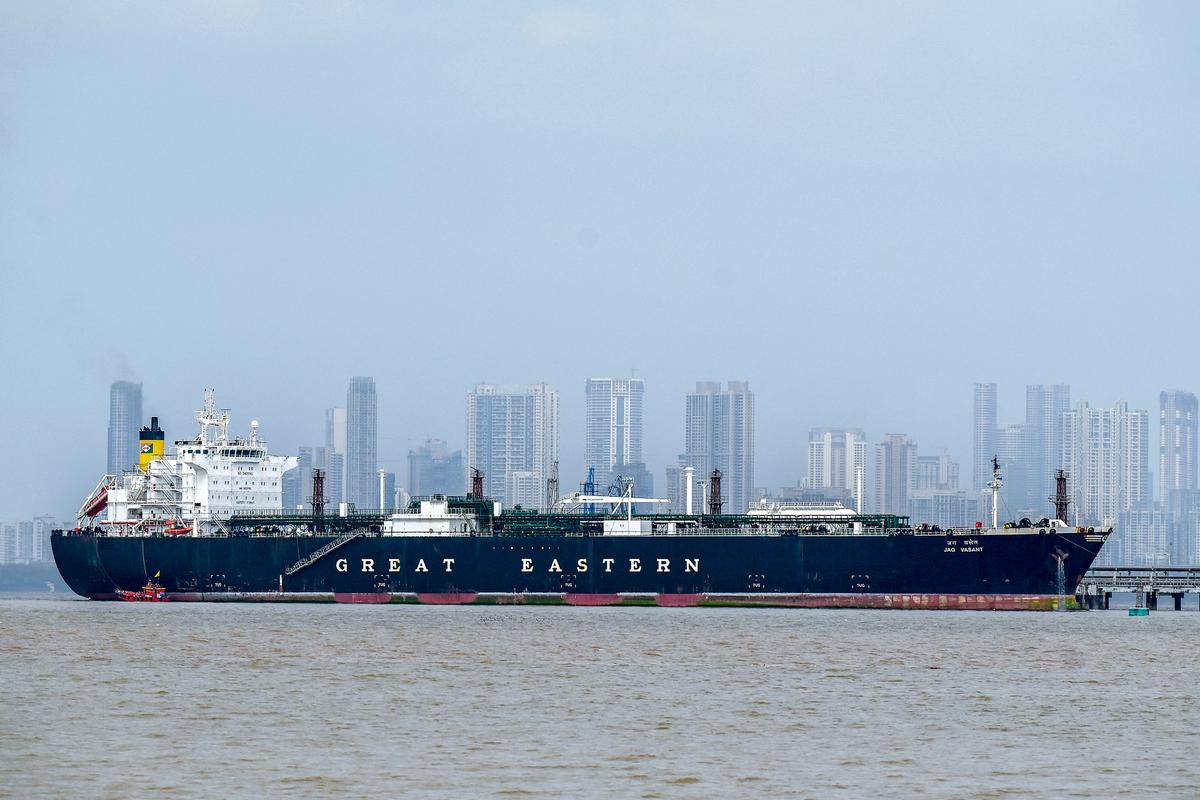
An India-flagged tanker carrying liquefied petroleum gas that transited the Strait of Hormuz amid the Iran war remains docked at an offloading terminal in Mumbai, India, on April 1, 2026. Punit Paranjpe/AFP via Getty Images
The U.N. Food and Agriculture Organization (FAO) warned on April 13 that ships with agricultural products must be allowed to transit through the disputed Strait of Hormuz, saying a protracted closure could trigger spikes in inflation later in 2026.
“The clock is ticking,” FAO Chief Economist Maximo Torero said, according to a U.N. statement, noting that poorer nations could be at risk of not being able to obtain scarce fertilizer and energy inputs due to the strait’s effective closure.
“The last thing we want is lower crop yields and higher commodity prices and food inflation for the next year.”
He also said higher interest rates and slower economic growth could occur.
“The risks are very clear,” Torero said. “If we don’t accelerate … the risks will exacerbate.”
Large proportions of the world’s supply of oil, natural gas, and fertilizers are unable to be carried by ships as they cannot safely transit the Strait of Hormuz because of the war. Iranian officials on multiple occasions have said that they would restrict the waters of the strait, accusing civilian ships of being used to support the U.S.–Israeli strikes against the country.
Since the war started in late February, Iran responded to U.S.–Israeli strikes by launching attacks on civilian ships in the region, including oil-carrying vessels, as well as firing missiles and drones at neighboring countries.
President Donald Trump and the U.S. military have both said that a naval blockade would be imposed on Iranian ports in the strait and elsewhere after talks between Washington and Tehran fell through in Pakistan over the past weekend.
In a post on April 13, Trump wrote that “34 Ships went through the Strait of Hormuz yesterday, which is by far the highest number since this foolish closure began.”
Trump said on April 13 that Iran has sought to have vessels passing through the Strait of Hormuz pay a fine, warranting the need to implement the U.S. naval blockade that went into effect on the morning of April 13. Ships that have paid a toll to Iran would be interdicted by the U.S. Navy in international waters as the blockade continues, he also said.
So far, no European or NATO allies have publicly stated that they would join the blockade, prompting more criticism from Trump. In comments to reporters on April 12, the president said the military alliance would need to be examined after the war.
Iranian officials, in response to the blockade, warned that the country’s military would potentially launch attacks on ports in the Middle East and would move to attempt to gain permanent control over the strait, which links the Persian Gulf to the wider ocean.
“The Armed Forces of the Islamic Republic of Iran clearly and decisively declare that security of ports in the Persian Gulf and the Sea of Oman is either for all or for none,” an official with the Iranian Revolutionary Guards Corps said through state-run Tasnim News.
The UK Maritime Trade Organization (UKMTO) stated in a notice that the U.S. blockade started at 10 a.m. EDT, coinciding with announcements made by Trump and U.S. Central Command.

A page on the Marinetraffic website shows commercial boat traffic on the edge of the Strait of Hormuz near the Iranian coast on March 4, 2026. Julien de Rosa/AFP via Getty Images
“The restrictions encompass the entirety of the Iranian coastline, including ports and energy infrastructure,” the UK group stated. “Transit passage through the Strait of Hormuz to or from non-Iranian destinations is not reported to be impeded by these measures.”
Some vessels may experience military presence in the region or other measures during their passage, the group stated, noting that neutral vessels that are currently at Iranian ports were “granted a limited grace period” to leave.
A Pentagon spokesperson, asked to comment on April 13, referred The Epoch Times to the UKMTO notice to mariners on the blockade.