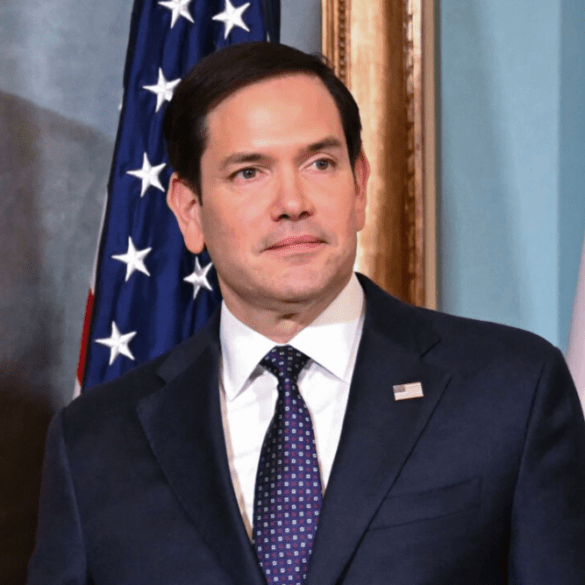
U.S. Secretary of State Marco Rubio at the State Department in Washington on Jan. 21, 2025. Andrew Caballero-Reynolds/AFP via Getty Images

The U.S. Department of State has announced sanctions against a number of individuals including the British head of the Global Disinformation Index (GDI) Clare Melford, whose organization issued a report this summer listing “digital denialism” of Canadian residential schools as one example of “hate speech” that harms democracy.
Undersecretary of State Sarah Rogers linked to a Sept. 25 GDI report on hate speech in Canada in an X post to announce Melford’s travel ban, saying that GDI has interfered with speech on American platforms, including by labeling opinions that “question” the nature of Canadian residential schools as hate speech.
“If you question Canadian blood libels about residential schools, you’re engaging in ‘hate speech’ according to Melford and GDI,” Rogers wrote Dec. 23 on X. “This NGO used StateDept taxpayer money to exhort censorship and blacklisting of American speech and press.”
For its part, a GDI spokesperson said the travel bans are “an authoritarian attack on free speech and an egregious act of government censorship,” adding that they are “immoral, unlawful, and un-American.”
The issue of residential schools in Canada has garnered further international attention since a 2021 announcement by the Tk’emlúps te Secwépemc First Nation in B.C. that ground-penetrating radar had identified possible burial sites of 215 “missing children” at the former Kamloops Indian Residential School.
No excavations have been conducted at the site to confirm the claim.
Rogers’s reference to “blood libel” appears to be related to this issue.
Sanctions
U.S. Secretary of State Marco Rubio said all sanctioned individuals will face visa restrictions upon entering the United States due to their push for censorship of free expression on American platforms.
Rubio said the sanctioned individuals belong to the “global censorship-industrial complex” and that travel bans are justified under the U.S. Immigration and Nationality Act which bars any foreign individual from entry to the United States who may cause significant harm to U.S. foreign policy.
“Their entry, presence, or activities in the United States have potentially serious adverse foreign policy consequences for the United States,” Rubio wrote in a Dec. 23 press statement, adding that his department is taking steps to ensure these individuals “will be generally barred from entering the United States.”
Rogers specifically cited the fact that Melford’s UK-based organization has signed on to what Rogers called the “deleterious EU Code of Practice on Disinformation.”
The European Union’s Code of Practice and Disinformation was integrated into the broader EU Digital Services Act (DSA) in February. The DSA regulates how platforms including Meta, Tiktok, X, and Google must respond to “disinformation” and “illegal hate speech.” The platforms can be fined for not complying.
The Trump administration opposes the DSA, saying it is being used to unfairly penalize U.S. tech companies and crack down on free speech.
The European Commission has said it has the sovereign right to decide what economic activity is allowed to take place in its nations and how it is regulated. It has also condemned the travel bans.
“The EU is an open, rules-based single market, with the sovereign right to regulate economic activity in line with our democratic values and international commitments,” the commission wrote in a Dec. 23 statement. “We have requested clarifications from the U.S. authorities and remain engaged. If needed, we will respond swiftly and decisively to defend our regulatory autonomy against unjustified measures.”
French President Emmanuel Macron also spoke out against the travel bans in an X post, saying they “amount to intimidation and coercion aimed at undermining European digital sovereignty.”
GDI Report
The Sept. 25 report from GDI on countering online hate speech in Canada lists a number of actions taken by users and groups on American social media and digital platforms, including “denialism” about Canadian residential schools.
“Digital denialism around residential schools and abuses against native communities reveals coordinated efforts to delegitimise truth and reconciliation, undermining national commitments to redress historic injustice,” the report reads.
Melford has previously stated that GDI’s objective is to identify hateful and false content to let advertisers more easily pull funding that may promote “polarizing” content.
‘Denialism’
In the previous session of Parliament, NDP MP Leah Gazan introduced a private member’s bill which proposed making it a criminal offence to deny, support, or downplay “harm caused by the residential school system in Canada.”The bill was supported by then-Crown Indigenous Relations Minister Gary Anandasangaree, who currently serves as the Public Safety Minister, but it didn’t pass after Parliament was prorogued in January.
The government of Canada issued a formal apology to former students of residential schools in 2008. As of 2021, more than $3 billion has been paid out through various compensation packages to those who attended residential schools. More recently, Saskatchewan disbursed $40 million this past September to former students of one of the province’s residential schools.
Tom Ozimek contributed to this report.
Paul Rowan Brian is a news reporter with the Canadian edition of The Epoch Times.