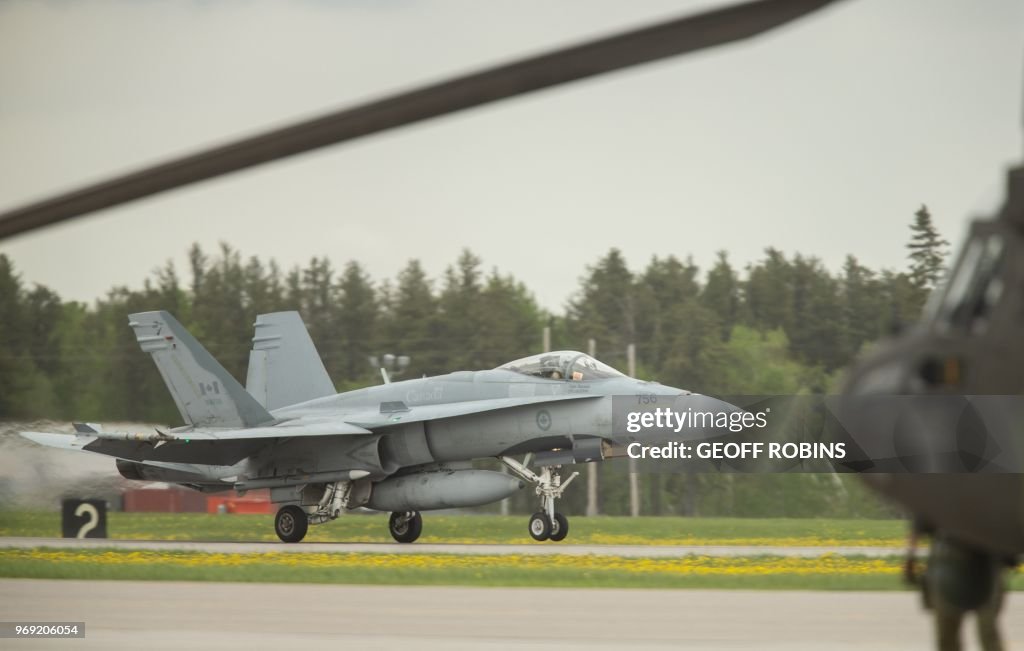
On the eve of the G7 summit, a Canadian Forces CF-18 Hornet takes off from CFB Bagotville, Quebec, on June 7, 2018. (Photo by GEOFF ROBINS / AFP)
Amid changing messaging about the war in Iran, Canada is now examining whether it could fill a defensive role in the region, its top general said this week.
What this effort could look like is open to speculation, and it’s not yet clear whether it would even be helpful.
Chief of the Defence Staff Gen. Jennie Carignan said on March 5 she’s considering what help could be provided to the Gulf states under retaliatory attacks from Iran, adding that the military has prepared recommendations for Ottawa.
The next day, however, Foreign Affairs Minister Anita Anand said her government is “not anticipating military involvement at this time.” Anand said Carignan would meet with her foreign counterparts and Anand would then engage with Defence Minister David McGuinty on the next steps.
Both Anand and Carignan have said there is no intention to participate in the U.S. Operation Epic Fury, underway since Feb. 28. The operation’s stated objectives are to degrade Iran’s nuclear and missile capabilities, destroy its navy, and prevent the country from backing regional proxy groups.
Prime Minister Mark Carney said on March 5 in Australia, however, that he can’t “categorically rule out” military involvement. “We will stand by our allies,” he said.
Carney initially backed the strikes on Iran, noting the unsuccessful diplomatic efforts. He later said he took this stance “with regret” as the conflict demonstrates the “failure of the international order,” and has been calling for de-escalation.
Middle East Operations
The presence of Canadian Armed Forces (CAF) personnel in the Middle East has been modest in recent years.
The last major effort was under Operation Impact to help fight the Islamic State in Iraq, and carry out capacity building in Jordan and Lebanon. The operation had been extended until March 2025 but has since been replaced by Operation Amarna.
The Department of National Defence (DND) says Amarna’s mission is similar to that of its predecessors but hasn’t said how many troops are involved.
“Op AMARNA marks a deliberate shift in Canada’s military engagement in the Middle East, allowing the Canadian Armed Forces (CAF) to adapt to changing geopolitical dynamics while maintaining its ability to respond effectively to emerging security challenges,” DND says.
At one point under Operation Impact, Canada had hundreds of troops in Iraq, including some posted in the northern Kurdish city of Erbil. This included special operations forces, Griffon helicopters, and a medical unit.
The base at Erbil International Airport, which hosts U.S. forces and others, has been a frequent target of Iranian proxies in Iraq. Those groups have claimed responsibility for drone attacks against the U.S. presence at the airport this week, while Iraqi Kurdish authorities have reported other attacks across their territory.
DND says the CAF still contributes to NATO Mission Iraq under Op Amarna. The Epoch Times asked the department whether Canadian troops are still permanently based in Iraq but received no response as of publication time.
Another active CAF operation in the area is Op Foundation, which typically involves 18 personnel. The CAF members are attached to U.S. military headquarters involved in counterterrorism missions.
Some Canadian CAF members are usually stationed with U.S. Air Forces Central (AFCENT) in Qatar, and others with U.S. Naval Forces Central (US NAVCENT) in Bahrain. Both countries have been targeted by Iranian attacks in recent days.
A small number of CAF personnel are also deployed in the Middle East as part of observer missions in areas such as Egypt and the Golan Heights.
Lt. Gen. Steve Boivin of Canada’s Joint Operations Command said on March 5 that a little over 200 CAF members are currently in the Middle East, but none are involved in the U.S. Operation Epic Fury. Boivin said the focus is on safety of personnel, which has involved moving troops to ensure adequate protection, including relocating them to different countries.
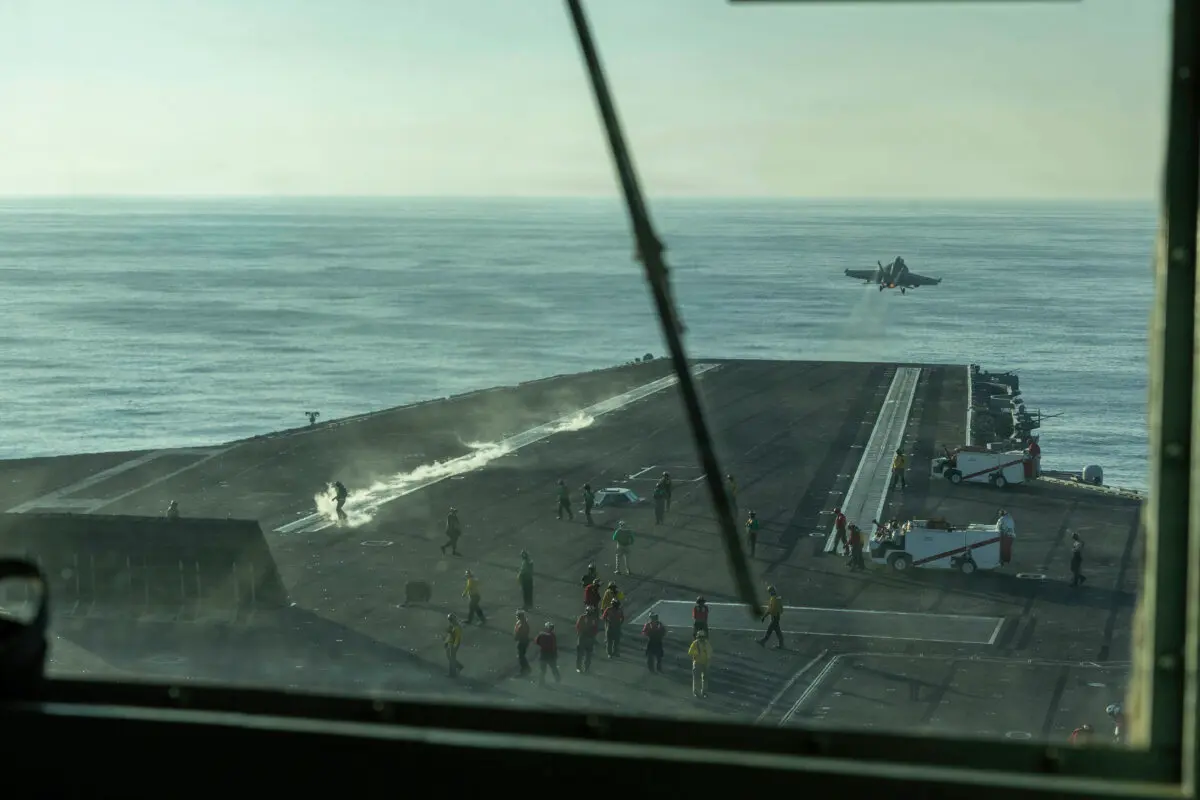
In this U.S. Navy handout, an F/A-18F Super Hornet, attached to Strike Fighter Squadron (VFA) 41, launches from the flight deck of Nimitz-class aircraft carrier USS Abraham Lincoln (CVN 72) in support of Operation Epic Fury on Feb. 28, 2026. U.S. Navy via Getty Images
Gulf Countries’ Needs
As for the Gulf countries’ defence needs, they have been mostly successful so far in intercepting the hundreds of Iranian missiles and attack drones sent at them. Gulf countries also host several major U.S. military installations, bolstering their defences.
The island country of Bahrain hosts the U.S. Navy’s Fifth Fleet, while neighbouring Qatar is home to the forward headquarters of U.S. Central Command at the 24-hectare Al Udeid Air Base.
The forward headquarters of U.S. Army Central is located at Camp Arifjan in Kuwait, while Al Dhafra Air Base in the United Arab Emirates (UAE) is a key hub for the U.S. Air Force.
France also has naval and air bases in the UAE and has deployed fighter jets this week to protect its assets. The jets have been able to intercept Iranian drones targeting the UAE, according to authorities.
Canada does not have similar assets to protect, nor does it have a robust fighter jet capability. Its aging fleet of CF-18s did see action in the mid-2010s during operations against the Islamic State in Iraq and Syria.
If Ottawa were to deploy fighter jets to the area, a defence expert who spoke to The Epoch Times said there would be an issue of where to stage them.
“You have significant U.S. air forces already deployed on the ground at their bases in Jordan, in Kuwait, etc.” said James Fergusson, director of the Centre for Defence and Security Studies and an associate professor in the Department of Political Studies at the University of Manitoba.
One question is whether the United States would require Canadian help, Fergusson said, and another question pertains to political ramifications for Ottawa.
Other military assets Canada could use include navy frigates for short range air defence against missiles and drones.
“But the problem with that is, where are they? How long does it take them to get there before this thing all comes to an end?” he said. Fergusson also raised doubts about Canada being able to provide any help in terms of ground air defence.
Fergusson said he was surprised that Carignan mentioned a potential Canadian military contribution to the conflict.
“In terms of Canadian military capabilities we really have nothing to offer,” he said.