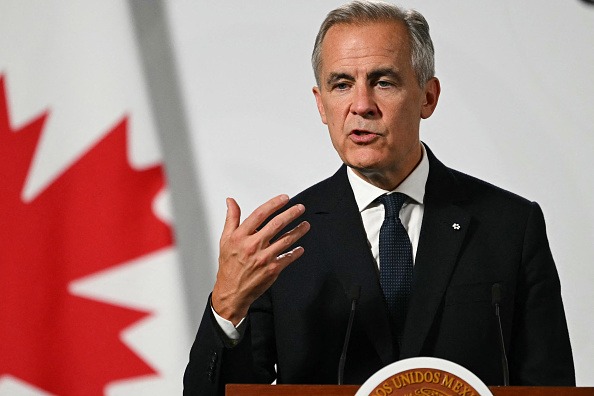
Prime Minister Mark Carney speaks during a joint press conference at the National Palace in Mexico City on September 18, 2025. (Photo by Yuri CORTEZ / AFP)
Prime Minister Mark Carney told the Assembly of First Nations (AFN) that the Liberal government will approve major projects in consultation with First Nations, hours after the body’s chiefs unanimously voted to call for Ottawa and Alberta to withdraw their recently signed pipeline deal.
“Canada’s new government is committed to working directly with you to build stronger nation-to-nation relationships … The question is not what we’re against, but what we’re for, what we want to build together, because this approach must be informed by and can only move forward with First Nations,” Carney told the AFN in Ottawa on Dec. 2.
Carney said that the Building Canada Act, which is meant to streamline federal approval processes for major infrastructure projects deemed to be in the national interest, must “by law, advance the interests of indigenous peoples.” He said the Major Projects Office, created to coordinate the financing and federal regulatory approval process for major infrastructure projects, has also held regional engagements with First Nations.
Earlier in the day at the AFN’s annual December meeting, the chiefs voted unanimously to demand that the federal government and Alberta withdraw the pipeline deal. The resolution also called for Canada, Alberta, and B.C. to uphold the United Nations Declaration on the Rights of Indigenous Peoples, which has been passed into law federally as well as in B.C.
In her opening speech, AFN National Chief Cindy Woodhouse Nepinak said the deal was “as if First Nations rights can be wiped away with one federal-provincial MOU.” She said the chiefs are “united” in their opposition to the pipeline.
On Nov. 27, Carney and Alberta Premier Danielle Smith signed an agreement that would pave the way for building a new oil pipeline to the West Coast should a private proponent come forward. The memorandum of understanding (MOU) signed by the two leaders pairs the pipeline project with the proposed Pathways Alliance carbon capture project.
Additionally, the agreement commits Ottawa to potentially adjusting the West Coast tanker ban if a pipeline project is approved as a project of national interest under the Building Canada Act, removes the oil and gas emissions cap on Alberta, and suspends Alberta’s requirements under the Clean Electricity Regulations. In exchange, Alberta must increase its industrial carbon pricing system to a minimum of $130 a tonne and reduce methane emissions by 75 percent over the next decade.
The MOU states that Canada and Alberta will “engage meaningfully” with First Nations in Alberta and B.C., and involve the B.C. government in engagement with B.C. First Nations. It also states that the parties must provide opportunities for indigenous peoples to participate in the consultation process and receive economic opportunities through indigenous ownership and benefits.
B.C. Premier David Eby has said he is opposed to the MOU and the lifting of the tanker ban, given that First Nations in the province have expressed opposition to parts of the plan, and it could distract from other projects that have indigenous support.
Coastal First Nations President Marilyn Slett also said last week that a pipeline to B.C.’s northern coast would not happen, adding that the “wall of silence” from the federal government her group has faced is “fundamentally at odds with Canada’s constitutional, legislative and international obligations to coastal First Nations.”
Carney told the AFN that at the start of 2026, he would be hosting the first-ever joint first ministers meeting with First Nations, where AFN leaders will set the agenda.
The prime minister also said the Liberal government intends to introduce clean drinking water legislation in the spring of 2026. He said 85 percent of drinking water advisories on reserves have been lifted since 2016, but Ottawa is committed to ending the remaining 38 advisories.
Minister of Indigenous Services Mandy Gull-Masty said in July that she would reintroduce legislation to ensure First Nations’ right to clean drinking water in the fall of 2025.
The Canadian Press contributed to this report.
Matthew Horwood is a reporter based in Ottawa.