The European Commission has called for a more robust response to surging Chinese imports and growing economic imbalance.
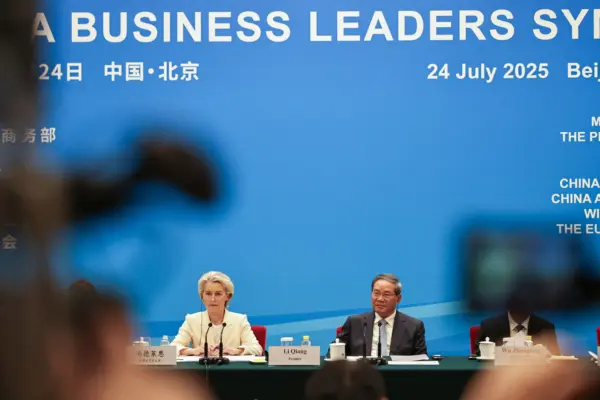
Chinese Premier Li Qiang (R) and European Commission President Ursula von der Leyen (L) attend the EU–China Business Leaders Symposium at the Great Hall of the People of Beijing on July 24, 2025. Andres Martinez Casares / POOL / AFP via Getty Images
The European Commission said on May 29 that the European Union’s current trade and investment relationship with China is no longer sustainable, reflecting growing concern in Brussels over industrial competition and economic security.
The assessment followed an internal orientation debate among commissioners ahead of the G7 summit and the European Council meeting on June 18 and June 19. Officials said the discussion would help shape future policy, although no major proposals are expected before the third quarter of the year.
The commission reiterated that it would continue engaging with China while pursuing a strategy of “de-risking” rather than full economic decoupling.
“China is a critical partner, and engagement and dialogue will continue. At the same time the current state of the trade and investment relationship is not sustainable,” the commission said in its official readout of the meeting.
“As economic and security interests become ever more intertwined, both dimensions will require a more robust and coherent response.”
Trade policy is handled centrally by the commission on behalf of all 27 EU member states. In recent months, Brussels has examined ways to protect key industries from a sharp rise in Chinese imports, particularly in chemicals, metals, and clean-energy technology.
Industry Commissioner Stéphane Séjourné has advocated broader use of existing trade defense tools, including import duties and quotas, across entire sectors where European manufacturers face sustained pressure.
The debate reflects a wider shift across Western economies, many of which are seeking to reduce dependence on Chinese supply chains after decades of outsourcing production.
The EU has already imposed tariffs on some Chinese electric vehicles, arguing that heavy state subsidies distort competition by lowering production costs. Despite those measures, Chinese manufacturers have continued to expand their share of the European market, especially in hybrid vehicles.
Brussels has also backed initiatives including “Buy European” policies and RESourceEU, aimed at strengthening critical mineral supply chains within Europe and through partnerships with countries such as Australia, Brazil, and states in Central Asia.
China’s Foreign Ministry has rejected accusations of unfair trade practices and warned that Beijing would respond strongly to any additional restrictions.
Tensions between Brussels and Beijing have intensified over several years as the EU’s trade deficit with China widened. In 2025, the bloc recorded a goods trade deficit of roughly 360 billion euros (about $420 billion) with China, fueling concerns among European policymakers about industrial overcapacity and competitive imbalances.
The latest debate forms part of a broader effort by the EU to reduce strategic vulnerabilities without severing commercial ties with China altogether. Previous measures have included the bloc’s Foreign Subsidies Regulation and a series of supply-chain reviews focused on critical sectors.
Divisions remain within the EU over how far trade protections should go. France has pushed for a more assertive response to Chinese subsidies and market distortions, while Germany has taken a more cautious position because of its exporters’ extensive business interests in China.
The commission described the May 29 meeting as a review of both the risks and opportunities in EU–China relations. It said dialogue with Beijing would continue alongside any future defensive measures.
EU leaders are expected to provide further direction at the June summit.