The next provincial election is set for Oct. 18, 2027.
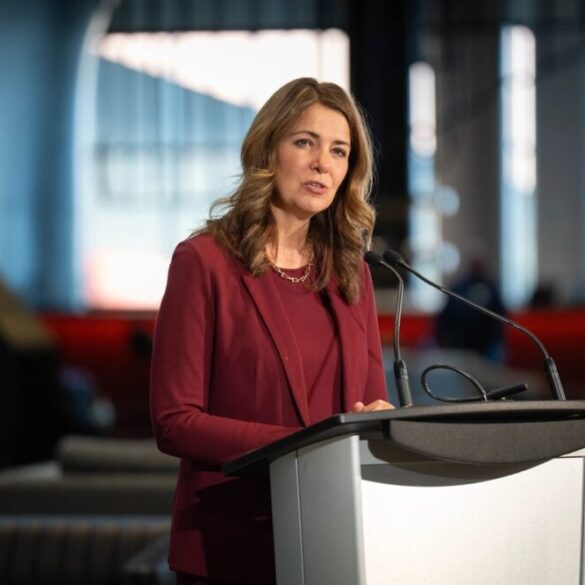
Alberta Premier Danielle Smith answers questions from the media following a speech in Calgary on Oct. 16, 2026. Carlos Herrera for The Epoch Times
The Alberta government has rejected Elections Alberta’s request to postpone next year’s provincial election after the agency warned that proposed electoral boundary changes could leave it without enough time to prepare.
Chief Electoral Officer Gordon McClure sent a letter to Legislative Speaker Ric McIver on Oct. 30, saying Elections Alberta typically needs 12 to 18 months to prepare for a general election, currently scheduled for Oct. 18, 2027.
McClure said implementing new electoral boundaries requires the agency to develop and verify maps, update electoral information systems, establish voting infrastructure, and coordinate election operations.
“The establishment of electoral boundaries has already extended beyond the timeframe typically afforded to Elections Alberta. With the October 18, 2027, election date approaching, the time available to complete the required mapping and implementation activities is constrained,” he wrote.
McClure also raised concerns about possible legal challenges to the proposed boundaries and limited staffing and resources, describing Elections Alberta as Canada’s leanest electoral management body per voter.
He said the agency had faced significant demands over the past two years, including several citizen-led petitions and October’s 10-question referendum, while also preparing for the 2027 election.
McClure proposed two options: retain the existing electoral boundaries for the scheduled election or postpone the vote if the province adopts new boundaries. He emphasized that his request was not intended to influence legislative or judicial decisions but reflected the practical requirements of administering an election.
“Our responsibility is to ensure the next Provincial General Election can be delivered in accordance with the law, with appropriate safeguards that ensure the integrity of the electoral process and instills confidence of voters,” he added.
Province’s Response
Justice Minister Mickey Amery rejected McClure’s request in a Nov. 1 letter, saying the province would maintain the legislated election date.
“Alberta’s government has no intention of changing the legislated date of the next provincial general election,” Amery wrote, noting that fixed election dates provide certainty for voters, who should expect elections to be conducted freely, fairly, and on schedule.
Amery said the legislature would receive a report on the proposed boundaries on Nov. 2, with the government planning to finalize them through legislation before the fall sitting ends. That would give Elections Alberta approximately 320 days, or nearly 11 months, to prepare for the election, he said.
Amery dismissed concerns about possible legal challenges, saying the government saw “no value in considering hypothetical judicial outcomes at this time.” He also pointed to Quebec and British Columbia as examples of provinces that had conducted elections with shorter preparation periods.
According to Amery, Quebec held an election in October after changing electoral boundaries 110 days earlier, while B.C. successfully administered a provincial election this year with a 32-day election period.
“It should also be noted that Alberta law does not guarantee Elections Alberta lengthy advance notice of a general election, and election readiness is a core part of Elections Alberta’s statutory mandate,” he wrote.
Amery highlighted Elections Alberta’s administration of October’s referendum, during which voters cast more than 22 million votes across 10 questions, compared with approximately 1.78 million votes in the 2023 provincial election. He said a provincial election would require less resources than that referendum
He also noted that the province had allocated approximately $51.18 million to Elections Alberta for 2026–27.
Amery said the agency’s independence from government did not diminish its responsibility to administer elections according to the law or manage its resources effectively.
Alberta NDP Leader Naheed Nenshi is accusing Premier Danielle Smith and the UCP government of undermining democratic rights, saying the government failed to adopt an independent electoral boundaries commission’s earlier recommendations. His comment refers to a commission earlier this year recommending to increase Alberta’s electoral districts from 87 to 89, adding seats in Calgary and Edmonton, while eliminating two rural ridings.
Three of five commissioners supported the proposal, but the Smith government declined to adopt it over concerns about rural representation and ordered another review in April.
The NDP is now accusing the government of redrawing boundaries to favour the UCP, allegations the UCP government rejects, saying the latest proposed changes are by a panel overseen by a retired judge, that included two members nominated by the NDP and two by the UCP.