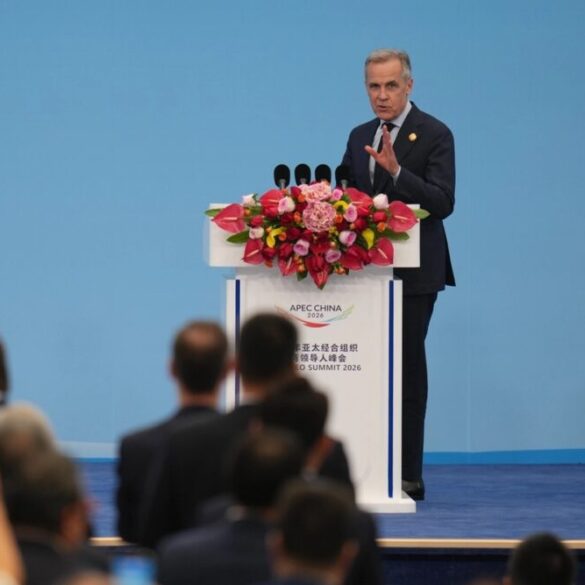
Prime Minister Mark Carney speaks at APEC summit in Shenzhen, China, on Nov. 18, 2026. Ng Han Guan – China Pool/Getty Images
Taiwan’s Deputy Foreign Minister Chen Ming-chi warned that closer economic ties with China could expose Canada to Beijing’s coercion tactics, citing Taiwan’s experience with the Chinese regime’s use of trade restrictions to advance strategic goals.
Taiwan has significantly reduced its reliance on exports to China in recent decades. In 2010, exports to China accounted for more than 80 percent of Taiwan’s total exports, Chen told the Associated Press in an interview during the Halifax International Security Forum.
“They are very good at weaponizing interdependence,” he said. “They are very good at leveraging our dependence to reach political goals.”
Chen also cited the cases of former Canadian diplomat Michael Kovrig and businessman Michael Spavor, both of whom were arbitrarily detained in China for nearly three year. Their detention came shortly after the arrest of Huawei executive Meng Wanzhou in Vancouver in December 2018 on a U.S. extradition request.
Chen’s comments come just days after Prime Minister Mark Carney met with Chinese leader Xi Jinping on the sidelines of the Asia-Pacific Economic Cooperation (APEC) Economic Leaders’ Meeting in Shenzhen, China.
Carney and Xi discussed expanding bilateral trade and economic cooperation, with Beijing agreeing to reduce tariffs on Canadian agricultural and seafood exports worth approximately CA$400 million annually, and Ottawa reciprocating with tariff relief on more types of Chinese steel and aluminum. In January, Canada agreed to allow the import of up to 49,000 Chinese electric vehicles at a reduced tariff rate in exchange for China providing tariff relief on Canadian canola and other agricultural products.
Kovrig, who is a senior adviser at the International Crisis Group, has warned that allowing Chinese EVs into Canada could help Beijing dominate the sector, undermine domestic manufacturers, and create long-term economic dependencies that China could exploit for leverage.
Speaking to reporters on the sidelines of the APEC summit, Carney was also asked when Canada would sign the Canada-Taiwan Trade Co-operation Framework Arrangement, which was finalized and initialled in March 2025.
“There’s been good progress on the economic cooperation agreement, and we’re hopeful that it will be signed soon,” he said.
Harry Tseng, head of the Taipei Economic and Cultural Office in Canada, has said he is concerned Ottawa might be delaying the signing to avoid upsetting Beijing, which has vowed to bring Taiwan under its control.
Ottawa has increasingly described China as a “strategic partner,” marking a shift from its 2022 Indo-Pacific Strategy, which characterized China as an “increasingly disruptive global power.”