
A screen displaying the title of Alberta’s United Conservative Party’s 2023 Annual General Meeting is seen at the BMO Centre in Calgary on Nov. 4, 2023. (Andrew Chen/The Epoch Times)
By Andrew Chen
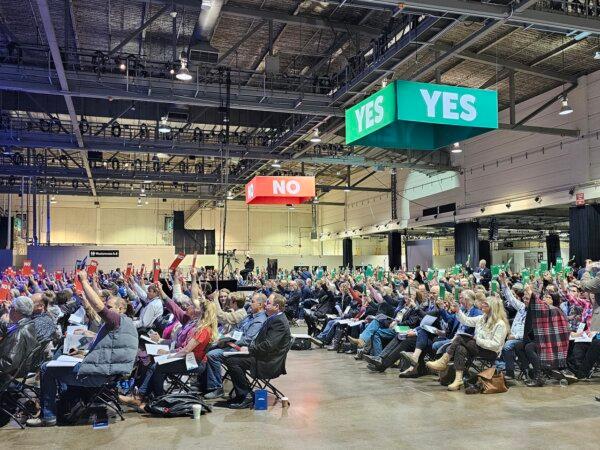
CALGARY—UCP delegates on Nov. 4 voted to adopt policies to reject Ottawa’s 2035 net-zero emission targets, along with a number of other policies, such as upholding parental rights in schools and not having sexually explicit content in schools.
Opposing the federal 2035 net-zero emissions target ranked as the top priority by the delegates. The motion on the issue calls on the Alberta government to protect the province’s economy and autonomy by opposing all attempts by the federal government to impose the target for the electrical grid.
Timothy Goertz, a convention participant and consultant in the oil and gas sector in Edmonton, said Canada possesses what he characterizes as the “most efficient and most ethically sourced resources in the world,” and advocated for continued resource development.
Tom Thacker, a farmer from Taber-Warner, highlighted concerns about blackouts in the rural regions if Alberta adopts 2035 net-zero emission targets in the electrical grid as required by Ottawa.
“2035 will not happen,” he told The Epoch Times. “If we go down this road, we will have blackouts. We can’t afford that in our feedlot, we’re going to have to get a generator to wire up stuff to generate electricity to keep all our waters warm in all the feed pens for all the cattle.”
The federal government has insisted that it’s important to keep the 2035 targets for all provinces.
“That is exactly what building a clean grid is all about: limiting unabated fossil fuels by 2035, not forbidding them, but making sure we have as much renewables and cleantech, while ensuring the affordability and reliability of our grid,” federal Minister of Environment and Climate Change Steven Guilbeault has said.
Parental Rights
Protection of parental rights was another key focus of the UCP convention, with a number of resolutions touching on this topic.
Members voted in favour of a resolution that requires teachers and school boards to obtain written consent of the parent or guardian of a student under the age of 16 prior to changing the child’s name or pronouns at school. Another resolution requires that students don’t have access to age-inappropriate sexual material at school.
Michael Ammeter, a father of three children and six grandchildren, considers parental rights as the “number one” issue, stating “I just can’t imagine where someone else should usurp those rights.”
Mr. Ammeter resides near Sylvan Lake in Central Alberta with his wife, Allison, and is a member of the Innisfail-Sylvan Lake UCP Constituency Association. Ms. Ammeter also holds a position within the UCP constituency association in Lacombe-Ponoka.
“Nobody cares about your children, wants the very best for them like [the parents] do. And if you don’t advocate for your children, I guarantee nobody else will the way you will,” she said.
Prior to each vote on a resolution, a video clip explaining the motion’s rationale was presented, and several individuals from both the proposition and opposition had the chance to voice their perspectives.
The proposed policy resolutions that are voted on by party members at the convention are non-binding and may not necessarily be adopted by the party leadership. Nevertheless, the resolutions serve as reflections of issues that concern the party’s grassroots.
“I want you to know that parental rights and choice in your child’s education is and will continue to be a fundamental core principle of this party and this government, and we will never apologize,” Ms. Smith said.
Another resolution passed at the convention involves the issue of transgender people in female prisons.
“Protect inmates who were female at conception and are housed at correctional and remand centres for women operated by Alberta’s Correctional Services by refusing to house any inmate who was male at conception at said correctional and remand centres,” the resolutions says.
The resolution that didn’t get the votes of the majority of the delegates required that a “voucher system” be established so that education funding follows each student.
Rejecting Medical Coercion
UCP delegates also voted to adopt a number of resolutions that oppose medical coercion.
Resolution 4, adopted by the majority of the delegates, aims to “Protect an individual’s right to informed consent decisions regarding their own body.”
“No government, business, corporation, entity, non-profit, or any other organization, institution or society has the right to mandate, force, or coerce an individual into a medical intervention or procedure, regardless of the societal benefit or otherwise,” the proposed policy says.
Another resolution adopted by the delegates calls for freedom of speech, especially when it comes to issues involving health sciences.
“Recent events saw Albertans being censored for their scientific, personal, and or religious beliefs regarding government policies because there was a perceived societal benefit to do so,” Resolution 2 says.
“Our Prime Minister, Chief Medical Officers, health care authorities, the media, employers, unions, police, military, border security, schools, universities, businesses, and many other people in positions of authority took it upon themselves to censor, isolate, vilify, place on leave of absence without pay, and or outright fire people that did not ascribe to their and or the government’s policy of the day.”