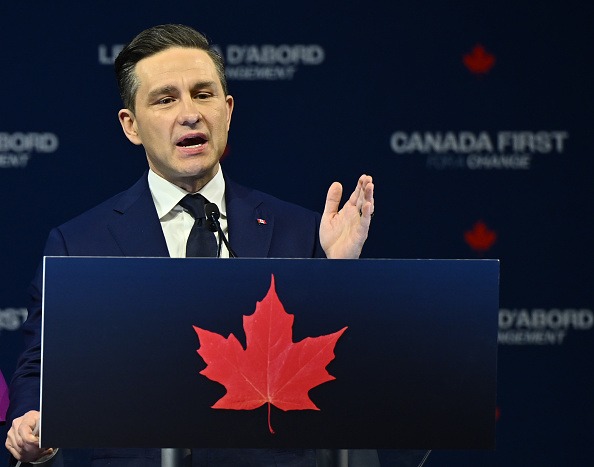
Conservative Party Leader Pierre Poilievre speaks to his supporters after losing the Canadian Federal Election on April 29, 2025 in Ottawa. (Photo by Minas Panagiotakis/Getty Images)
Pierre Poilievre is a likeable, thoughtful, empathetic person. If only he would show us that side more often, he could gain the support of Canadian voters, which has eluded him. He has begun doing so, and it’s been very well received with his long and personal interview on the Joe Rogan Experience and one with Steven Bartlett. Poilievre was candid, open, and personable, showing a side he rarely exposes. He may have finally found the formula for reaching Canadians, but it may be too little, too late.
I had the opportunity to interview Poilievre a couple of times when he was running to lead the Conservative Party of Canada. He was friendly enough and certainly said all the right things a conservative audience would want to hear, but he was also guarded and never strayed from what was a carefully constructed campaign script. It was frustrating for me as an interviewer, as I felt that despite being able to sit down in person and talk with Poilievre, I was getting no more information from him than I could have gotten from his campaign website. I couldn’t get a feel of who he is as a person, nor could my audience.
Poilievre is a career politician. This isn’t necessarily a bad thing. He knows the intricacies of party politics, the parliamentary system, and political policy inside out. With over 20 years serving as a member of Parliament, he is a veteran of federal politics while only being 46 years of age. With that much time in Ottawa, however, Poilievre became susceptible to and began suffering from what some call “Dome disease” or “Ottawashed.”
With so much time in the cloistered world of elected office, some members can lose touch with why they were drawn to electoral service and forget how to communicate with the people who put them there. The electoral world is a minefield where one poorly phrased statement can cost a person their career. Long-term politicians train themselves to carefully stick to the nuts and bolts of their policies, or, in the case of Poilievre, answer questions with slogans rather than extended thoughts. Slogans can be punchy when in opposition and stick in people’s minds, but they won’t endear people when they are seeking something deeper in leadership.
Policies are important, but when push comes to shove, many people vote for personality. Poilievre came off as more than competent for the job in the last election, but he couldn’t project relatability. The Liberal campaign successfully embraced portions of the Conservative platform, and the tactic wouldn’t have been successful if Poilievre had connected more effectively with people.
Whether we policy wonks like it or not, politics is largely a popularity contest. Justin Trudeau didn’t win elections based on his policy depth. He won his first one by offering what felt to enough voters like a refreshing and more human alternative than the astute but reserved Stephen Harper. Not that Poilievre should try to emulate Trudeau, of course. But he must let his guard down and let people discover who he is as a person.
The good news is that Poilievre does have a human side, and it’s appealing when we get glimpses of it. He doesn’t need to change who he is or be disingenuous. He just has to break out of his ingrained habits of caution and control. He has much to share, and he is becoming better at it.
Despite being in public office for decades, we learned more about who the man is in two recent interviews than in several federal elections. It surely took Poilievre out of his comfort zone when he spoke of his being adopted and shared more about his family. When he shares deeply personal stories, and when people hear them, they see Poilievre as a fellow person who has worked through challenges in life just like them. It makes him relatable and creates the sense of trust needed when asking people to commit to supporting him as the leader of the country.
Certainly, Poilievre is entitled to a degree of privacy, but upon entering public life there is an expectation that one will share more than the average person must. It just comes with the job.
Pierre Poilievre is a dedicated father who came from humble roots and who has commonalities to share with citizens.
If we see more of the Poilievre who was on the Joe Rogan show and less of the Poilievre who was on mine, he very possibly could turn the tide in the next election.