The move marks another step away from decades of ultra-loose monetary policy, with officials signaling that further hikes are possible.
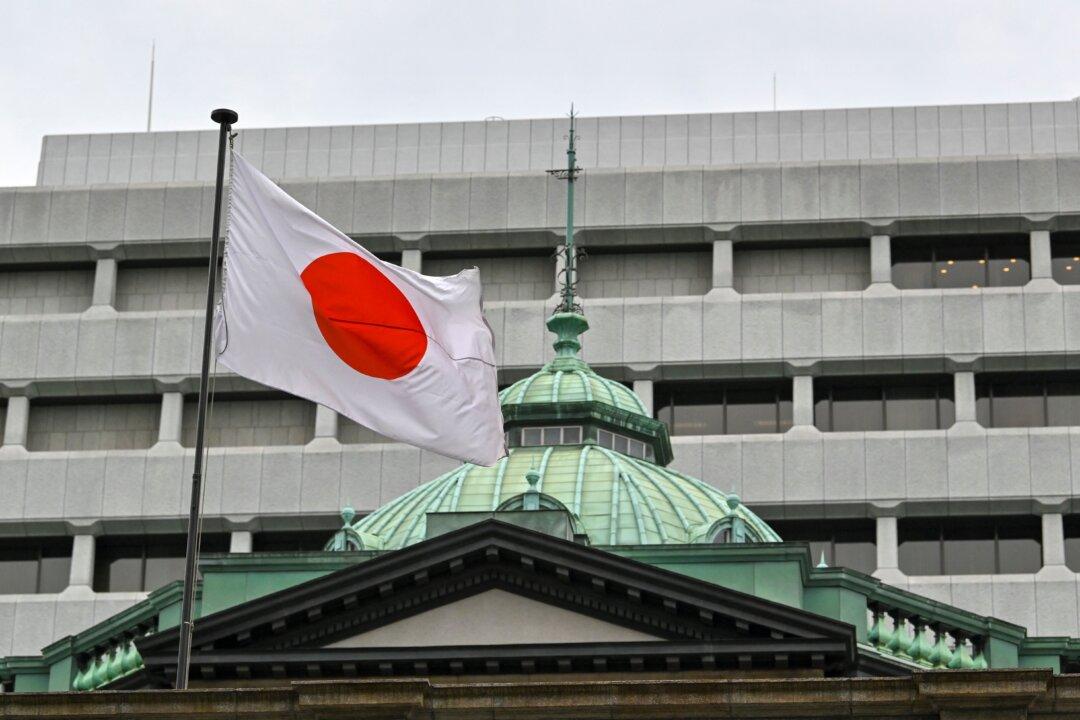
The Japanese flag flutters over the Bank of Japan (BoJ) head office building in Tokyo on April 27, 2022. Kazuhiro Nogi/AFP via Getty Images

Japan’s central bank raised its benchmark interest rate to the highest level in three decades, taking another step away from its long-standing ultra-loose monetary policy as officials seek to rein in persistent inflation pressures driven by rising wages and prices.
At a two-day monetary policy meeting on Dec. 18–19, the Bank of Japan (BOJ) voted unanimously to raise its short-term policy rate by 25 basis points, bringing it to around 0.75 percent. The move lifts borrowing costs to their highest level since September 1995.
The decision raises mortgage and other loan costs while boosting returns on savings, marking a further departure from decades of near-zero or negative interest rates aimed at jump-starting growth in an economy battling weak demand and deflationary pressures.
Japan’s inflation rate has remained above the BOJ’s 2 percent target since mid-2022, following a prolonged period of disinflation. Consumer prices excluding fresh food rose 3 percent year-on-year in November, highlighting the persistence of price pressures even as government subsidies helped cap some energy and food costs.
“It is highly likely that wages and prices will continue to rise moderately,” BOJ Governor Kazuo Ueda told reporters on Dec. 19.
“Risks to the economy have diminished, but we must remain vigilant.”
Inflation Outlook Underpins Rate Hike
In its policy statement, the central bank pointed to tight labor market conditions and steady corporate profits as factors supporting continued wage growth.
“Underlying CPI [consumer price index] inflation has continued to rise moderately, with moves to pass on wage increases to selling prices continuing,” the BOJ said.
“Based on these recent data and anecdotal information, it is highly likely that the mechanism, in which both wages and prices rise moderately, will be maintained.”
The BOJ said confidence has grown that its baseline scenario—under which underlying inflation converges toward the 2 percent target—will materialize in the second half of next year.
Despite the rate hike, the central bank said that monetary policy remains accommodative.
“Real interest rates are expected to remain significantly negative, and accommodative financial conditions will continue to firmly support economic activity,” it said.
Japan’s benchmark rate remains low by international standards, particularly compared with central banks such as the U.S. Federal Reserve, which raised rates aggressively after the pandemic and has since begun easing as inflation cools. But Japan’s prolonged reliance on ultra-easy policy has been unusual even by global standards.
As the country’s population aged and began to shrink, domestic demand weakened, pushing the economy into long bouts of deflation. The BOJ responded with years of aggressive monetary easing, including large-scale asset purchases and negative interest rates.
When the COVID-19 pandemic struck, the policy rate stood at negative 0.1 percent. The BOJ began raising rates only in 2024—its first hike in 17 years—after inflation stabilized above target and wage growth picked up.
Path to Further Tightening Remains Open
BOJ officials signaled in their Dec. 19 policy statement that further tightening remains on the table if economic and price trends evolve as expected.
“If the outlook presented in the October Outlook Report will be realized, the Bank, in accordance with improvement in economic activity and prices, will continue to raise the policy interest rate and adjust the degree of monetary accommodation,” they said.
Some analysts said the central bank’s statement reflects growing confidence that inflation has become more entrenched.
“The BOJ’s stance towards rate hikes reflects the fact that inflation is becoming entrenched,” Kei Fujimoto, a senior economist at SuMi Trust, said in a commentary.
“If drivers such as a further depreciation of the yen accelerate inflation going forward, it is possible that the pace of rate hikes will also increase accordingly.”
Analysts at ING said in a note that further rate increases are likely but not imminent, citing expectations that headline inflation will ease next year as subsidies take effect and food prices stabilize.
“Thanks to government subsidies on energy and falling rice prices, headline inflation is likely to drop below 2% in the first half of 2026,” they wrote.
“However, core inflation, excluding fresh food and energy, is expected to decelerate only marginally, in turn remaining well above 2%. Solid wage growth and fiscal stimulus are likely to keep inflationary pressures in our view.”
The BOJ’s move to hike rates comes despite signs of economic softness. Japan’s economy contracted at an annualized rate of 2.3 percent in the most recent quarter, though business sentiment has improved and price pressures have remained elevated.
Higher rates also mean higher debt-servicing costs for Japan, which carries the largest public debt burden among developed countries. Following the decision, Japanese government bond yields rose, while the yen weakened.
Reuters and The Associated Press contributed to this report.
Tom Ozimek is a senior reporter for The Epoch Times. He has a broad background in journalism, deposit insurance, marketing and communications, and adult education.