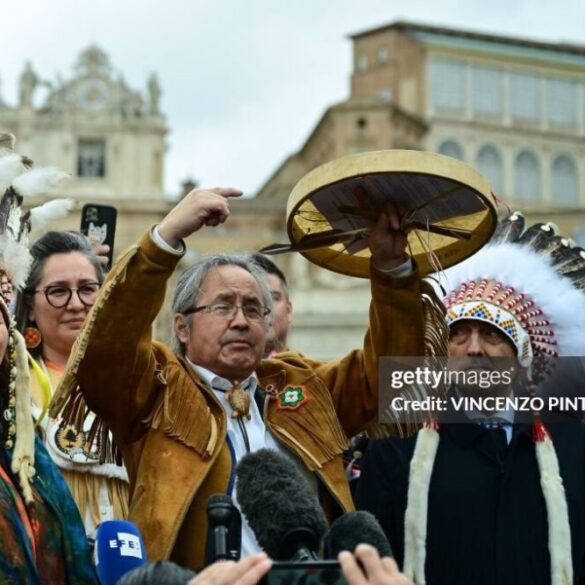
Dene Nation National Chief Gerald Antoine (C), former national chief of Canada’s Assembly of First Nations (AFN), Phil Fontaine (R), Grand Chief of the Crees, Mandy Gull-Masty (L rear), address the media on March 31, 2022 at St. Peter’s square in The Vatican, following a meeting with the Pope, as part of a series of a week-long meetings of Canada’s Indigenous elders, leaders, survivors and youth at the Vatican. (Photo by Vincenzo PINTO / AFP)
Commentary
The agreement between the federal government and Premier Danielle Smith’s government in Alberta—a series of undertakings including the construction of an oil export pipeline to the North Pacific Coast—is a great step forward, though it is lumbered with some excessive green baggage. The more recent decision of an Alberta court that the province cannot respond to a petition from hundreds of thousands of its citizens fulfilling existing legal conditions to hold a referendum on the issue of independence, is a timely demonstration of the congestive breakdown of Canadian federalism.
This nonsensical ruling will presumably be overturned when evoked to a more serious court. But the idea that any ostensibly competent court in this country could hold that any such referendum had to await discussion with the tiny minority who claim indigenous ancestry before previously unchallenged laws are invoked at the request of a much larger number of Alberta citizens than there are indigenous residents of that province (and doubtless including many indigenous among them), is both a farce and an outrage.
I have countless times declared myself a sympathizer with the argument that indigenous people have not been equitably treated and that we have to work out a better settlement with them. At the same time, I have often warned that the so-called reconciliation policy that has been pursued will ultimately cause the leaders of the native victimhood movement to allege that the European explorers who came to, settled, and set up government in Canada invaded their country, like Hitler and Stalin invaded Poland in 1939. The radicals have been pushing on an open door, and I cannot blame them when they are not resisted. But the entire subject has now reached a stasis in which the more militant activists topple statues of Queen Victoria, desecrate and topple statues of John A. Macdonald, and make all manner of outlandish demands that are effectively ignored by the elected authorities apart from placatory clichés and pieties.
We seem to have come to the end of useful royal commissions on the subject with the Dussault-Erasmus Royal Commission on Aboriginal Peoples, set up by Brian Mulroney in 1991 but which reported in 1996 when Jean Chretien was prime minister. It actually, supposedly seriously, proposed that approximately one-third of the entire area of Canada be parcelled out in small units not directly connected to each other and constituted as an independent country governed by natives and which would, at the expense of all the other Canadians, be set up with services and infrastructure comparable to the rest of Canada and would then carry on as a sovereign state. This was several leaps too far, even for the far left, and the commission’s report died, suffocated by the refusal of almost any sane Canadian to consider such a bizarre proposal for national suicide.
Then present government of British Columbia furtively and deviously blundered into compromising the fee simple ownership of the province by its property owners, in deference to the alleged descendants of the small number of natives who lived in B.C. when it was set up as a Canadian jurisdiction.
When the so-called white man arrived in what is now Canada, there were approximately 200,000 native people on its territory. Over 90 percent of them were nomadic. They were extremely adept and agile, but were representative of a Stone Age culture that had not discovered the wheel and did not have a written language. There were few permanent structures, little agriculture, and people dressed and sheltered in animal skins and lived off fish and game. The absurd recitations of unheard-of native bands that are inflicted on us at the beginning of any public event make no more sense than constantly broadcasting at airports the nationality of every foreign airline that has ever landed there; these are transitory activities.
It cannot seriously be stated that the natives occupied the entire country, and they certainly made no attempt to govern the entire country. The indigenous people do have many valid grievances, but they also benefited from a meteoric advance of 5,000 years in the sophistication of their civilization. The schooling of native children was in conformity with the requirement that all Canadian children be educated and enabled to participate fully in Canadian life. That does not whitewash the residential schools, but the implication that the schools were inspired by any notion of genocide is a self-inflicted blood libel on English and French Canadians.
The promised native opposition to the agreed-upon pipeline from Alberta to the Pacific coast and the court finding that the 95+ percent of non-indigenous Albertans do not have the right to vote on the question of independence without the approval of the indigenous population is not only a stupefying affront to any notion of democracy. It also must be the ne plus ultra in the movement of Canada to strip itself bare of any excuse for its existence and our collective prostration in guilt and shame before the alleged descendants of the small number of primitive people that our ancestors found here when they arrived.
This is a complex problem: the population of Alberta appears to feel that if the Liberal war on the petroleum industry of the last 10 years does not end, and Alberta is prevented from exporting oil and gas to the world—to the greater benefit of the whole country—most Albertans will probably wish to secede from Canada. The prime minister was personally opposed to the expansion of fossil fuel development, but apparently recognized the gravity of the issue and has compromised. We are wasting $16 billion on carbon catchment and making a few other gestures to the fading ghost of mortal climate change, but it appears an acceptable compromise.
But indigenous activists are trying to stop the pipeline, and they have no business doing that. If they succeed, there is a serious chance that the majority of Albertans will wish to separate from this country, which the natives claim Albertans have no right to do and have received some judicial support for that opinion.
Finally, this unutterable, long-hemorrhaging nonsense has to be faced. The indigenous deserve a new regime, and Canada has to throw away its sackcloth and wipe off its ashes and return to the mature self-government of what is waiting to become a great nation.