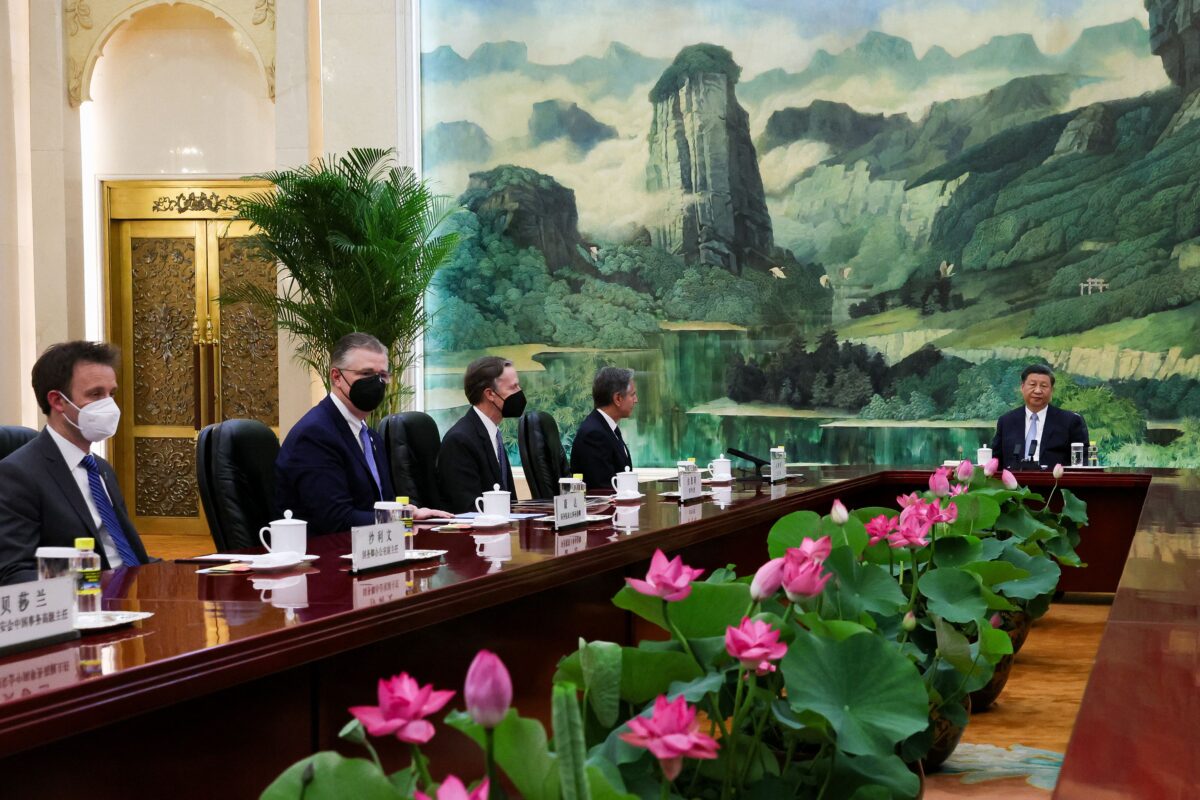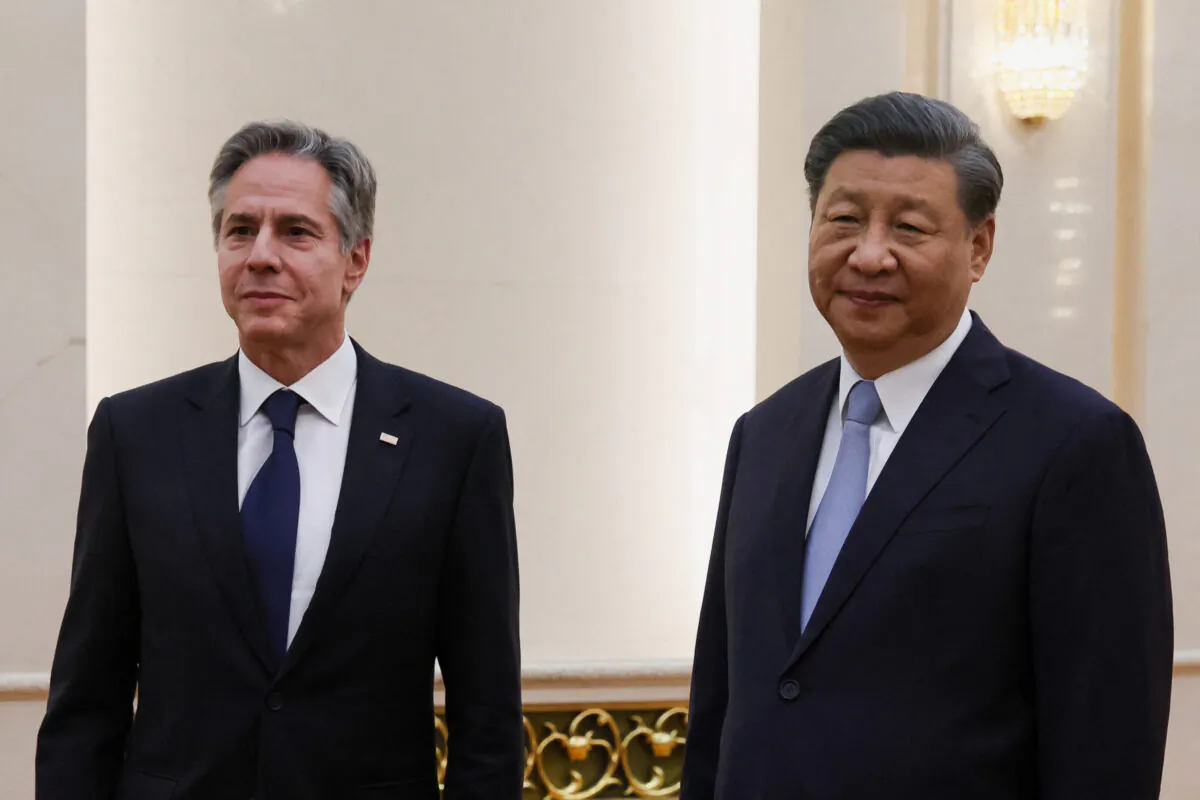
Chinese leader Xi Jinping receives U.S. Secretary of State Antony Blinken prior to their meeting at the Great Hall of the People in Beijing on June 19, 2023. (Leah Millis/Pool/AFP via Getty Images)
Blinken, the most senior U.S. official to travel to China since President Joe Biden took office, met with Chinese Foreign Minister Qin Gang on June 18 before holding talks with the regime’s top diplomat, Wang Yi, on June 19.
His trip marks the first visit to China by a U.S. secretary of state since October 2018.
Unlike talks with Qin and Wang, which lasted several hours, Blinken’s meeting with Xi lasted about 35 minutes.
“I came to Beijing to strengthen high-level challenges of communication, to make clear our positions and intentions in areas of disagreement, and to explore areas where we might work together when our interests align on shared transnational challenges. And we did all of that,” Blinken said at a press conference after the meeting with Xi.
“During those meetings, we had a robust conversation about regional and global challenges.”
Blinken said he raised issues such as “Russia’s war of aggression against Ukraine”; the CCP’s “provocative actions in the Taiwan Strait, as well as in the South and East China Seas”; and human rights violations in Xinjiang, Tibet, and Hong Kong.
The top U.S. diplomat said the talks also touched on the respective economic policies, including Washington’s “concern about China’s unfair treatment of U.S. companies.”
“It was clear coming in that the relationship was at a point of instability,” he told reporters in Beijing. “Both sides recognized the need to work to stabilize it.”
Among the U.S. priorities was to resume bilateral exchanges on the military level. But “at this moment, China has not agreed to move forward with that,” Blinken told reporters, even though he had “repeatedly” raised the issue during the two-day trip.
“We’re not going to have success on every issue between us on any given day, but in a whole variety of areas, on the terms that we set for this trip, we have made progress, and we are moving forward,” he said.
“But again, I want to emphasize none of this gets solved, resolved with one visit, one trip, one conversation. It’s a process.”

Taiwan
In recent years, Xi has repeatedly vowed to annex Taiwan, a self-ruled island that the CCP views as its own territory, and has directly threatenedwar to achieve that goal.
On June 18, Qin told Blinken that Taiwan is “the core of the core interests” of the communist regime and “the most prominent risk” in U.S.–China ties.
Blinken reiterated on June 19 that the United States will continue to advocate its “One China” policy, under which Washington officially recognizes Beijing rather than Taipei.
However, Blinken noted that the Taiwan Relations Act makes clear that the U.S. decision to establish diplomatic ties with China instead of Taiwan rests upon the expectation that the future of Taiwan will be determined by peaceful means.
“We and many others have deep concerns about some of the provocative actions that China has taken in recent years, going back to 2016,” he told reporters. “The reason that this is a concern for so many countries, not just the United States, is that were there to be a crisis over Taiwan, the likelihood is that that would produce an economic crisis that could affect quite literally the entire world.”
Visit ‘Bolsters Chairman Xi’s Image’
“That’s what [Xi] doesn’t want to see,” Li said, given China’s economy is a “very bad” shape.
China expert Feng Chongyi, an associate professor at the University of Technology Sydney, noted that the era of rapid growth in China relied on a strategy of deception to “parasitize” the capital market in the United States and the West to obtain technology and wealth.
Feng believes that the Cold War has never gone away, even though the communist regimes in Europe disintegrated, “because the Chinese Communist Party, which is among the worst, most stubborn, and most brutal front in the communist camp, still exists.”
After Xi took office in 2012, he revealed the CCP’s ambition, according to Feng.
“He wants to compete and confront the free world with its growing military and economic power,” he said. “That forced the West to acknowledge the reality that the cold war is still going on.”
While Blinken said the United States isn’t seeking to decouple with communist China, Feng believes that it’s already underway, although the West is using the term “de-risking.”
“The strategy adopted by the United States is to gradually decouple, starting from cutting technology and upgrading step by step. This is the general trend,” he said.
The CCP has also emphasized the need for self-reliance and food security, which Feng suggested is preparation for the decoupling from the West.