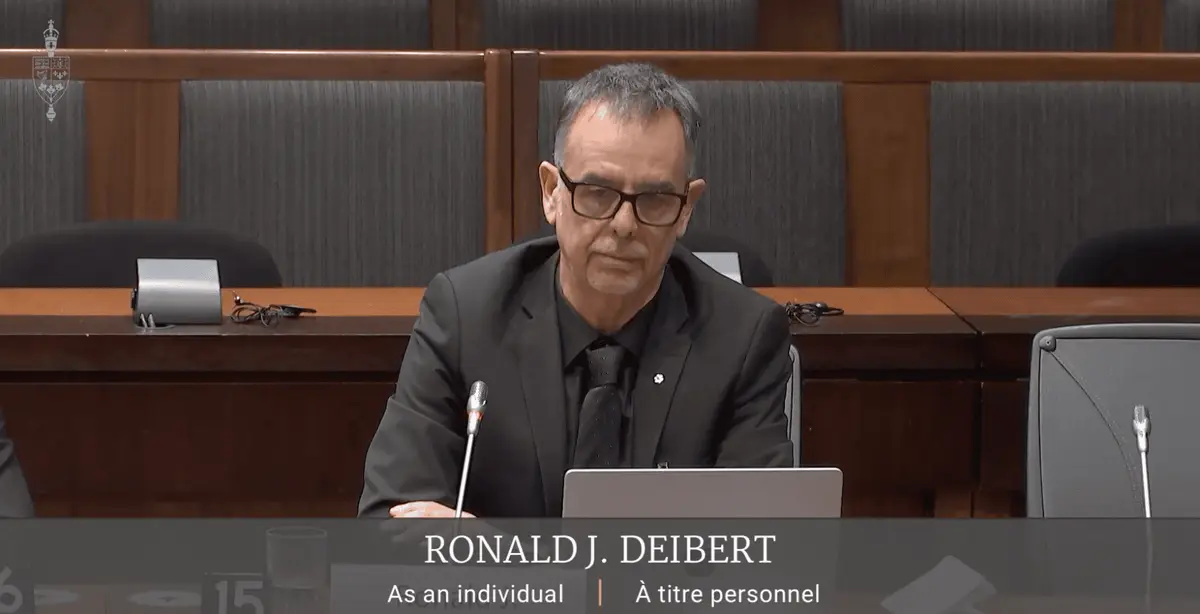
Ronald Deibert, political science professor and director of the Citizen Lab at the University of Toronto, testifies before the House of Commons Subcommittee on International Human Rights on March 23, 2025. House of Commons/Screenshot via The Epoch Times
As Canada warms diplomatically with China and certain other countries, Ottawa could be signalling to regimes such as the Chinese Communist Party that it is not serious about opposing transnational repression, a university professor told MPs.
“It sends a signal to those governments that we’re no longer serious about combatting that problem,” said Ronald Deibert, political science professor and director of the Citizen Lab at the University of Toronto.
“When you don’t speak up, when you don’t take a stand… you invite that sort of repression to happen,” he added.
Deibert made the comments in testimony on March 23 before the House of Commons Subcommittee on International Human Rights, which is examining the global impact of transnational repression.
When asked by Bloc Québécois MP Alexis Brunelle-Duceppe whether Canada should be more careful when warming up to states that undertake transnational repression, citing China and India, he said the government must speak out against the issue.
“Yes, I definitely think this is a problem,” Deibert said. “When you start putting aside the fact that these governments are major actors that have engaged in transnational repression against Canadian citizens, against immigrants and refugees in this country, you sweep all of that aside.”
“Our national security depends on international law and international human rights,” he added. “If we are not vocal about that, if we don’t take a serious stand about that, we act at our own peril.”
The testimony comes as Prime Minister Mark Carney’s government has been seeking closer ties with China in an effort to diversify trade away from the United States. Carney said during a visit to China in January that Ottawa and Beijing had entered a “strategic partnership” and had signed various agreements, including on law enforcement cooperation.
During the 2025 election campaign last spring, though, Carney called China is Canada’s “biggest security threat” and “one of the largest threats with respect to foreign interference.”
The more recent move to strengthen ties between the two countries has been criticized by Conservatives and China watchers, with Tory Leader Pierre Poilievre saying the federal government must explain how its tone on China has changed so drastically.
Concerns about foreign interference and transnational repression by China have intensified in Canada in recent years, with a public inquiry looking into the topic extensively. The final report of the Foreign Interference Commission said China is the “most active perpetrator of foreign interference targeting Canada’s democratic institutions.”
Hong Kong Diaspora Concerns
Landson Chan, advocacy officer of UK-based NGO Hong Kong Watch, told the subcommittee at the same hearing that the Hong Kong diaspora in Canada is a target of Chinese transnational repression, and have suffered harassment, intimidation and surveillance. “We have also documented cases where family members are targeted,” he added.
He said Ottawa’s agreement to cooperate with Beijing on law enforcement raises concerns about safeguards and information sharing, “especially given past concerns about alleged Chinese police service stations in Canada, where the outcomes of investigations remain unclear.”
Garry Clement, former national director with the RCMP, told MPs during a House of Commons committee meeting on March 12 that the police cooperation agreement involves the same Chinese ministry that operated secret police stations across Canada.
Clement said law enforcement in China is part of the Chinese regime’s apparatus. “You can’t separate them from the government, and they do not operate under the rule of law. I experienced it firsthand,” he added.
A 2023 House of Commons report found that “at least five” illicit police stations were operating secretly in Canada. A 2022 report by Spain-based NGO Safeguard Defenders said secret police operations target those sought by the Chinese regime, including dissidents and democracy activists.
Hong Kong Watch and nine other Hong Kong diaspora community groups said in a joint statement in February that the cooperation agreement between the RCMP and China’s Ministry of Public Security is “profoundly alarming” for communities who have fled repression.
The groups said that because Ottawa had not explained what safeguards, limitations, or oversight mechanisms are in place regarding the agreement, the lack of transparency has “intensified fears” that the agreement “could, intentionally or unintentionally, expose individuals or community networks to harm.”
Chan told MPs that transnational repression is “not solely a Hong Kong diaspora issue.”
“It concerns Canada’s sovereignty, security and democratic integrity,” he said. “Transnational repression silences voices within diaspora communities and discourages civic participation.”
Mehmet Tohti, executive director of the Uyghur Rights Advocacy Project, who also testified before the subcommittee on March 23, told MPs that the “basic intent” of the Chinese regime is to silence its critics in countries abroad, and that agreements like the one Ottawa made with Beijing on reducing tariffs on Chinese vehicles presents a “national security issue” to Canada.