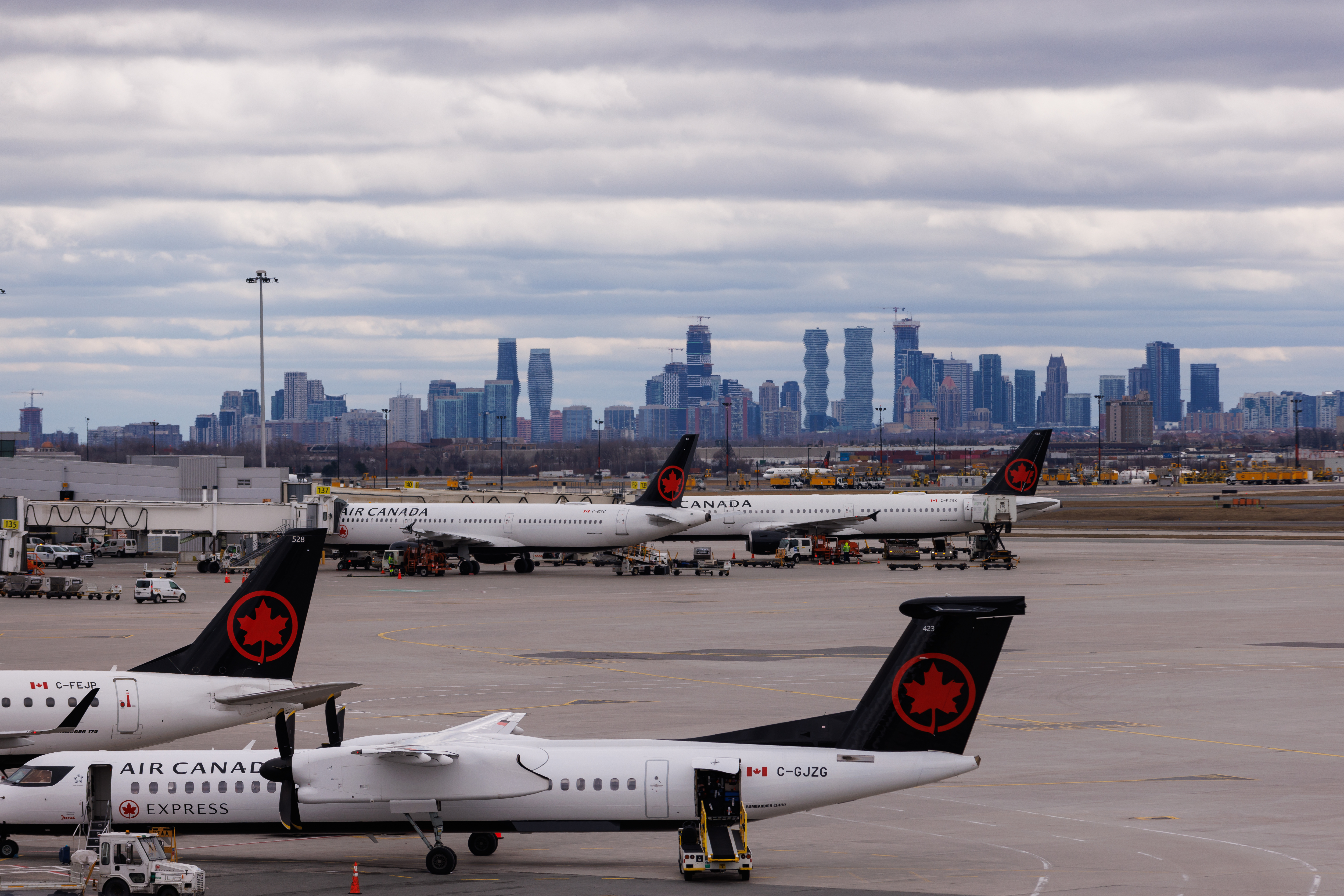
Air Canada passenger planes are seen at the Toronto Pearson International Airport on March 31, 2025. Cole Burston/Getty Images
In the latest swing, Ottawa announced on March 13 a relaxation of rules for the Temporary Foreign Worker (TFW) program in rural Canada. At the request of any premier, it will boost the allowable share of low-wage TFWs in rural workforces from 10 percent to 15 percent.
The move highlights a growing tension at the heart of Canada’s immigration system: Ottawa is trying to reduce overall immigration levels and respond to a more skeptical public, while managing millions of temporary residents already in the country and accommodating employers who complain of labour shortages. The result is a policy that loosens even as it tightens.
The pattern is clear in federal policy of recent years. The 2025 budget set out a plan to sharply reduce temporary resident inflows, with new admissions projected to fall from 673,650 in 2025 to 385,000 in 2026, including a drop in temporary foreign workers to 230,000 from 390,000. Yet even as those reductions are taking place, Ottawa is expanding opportunities within the system, including a program to transition up to 33,000 temporary foreign workers already in Canada to permanent residency over 2026 and 2027.
The March 13 change affects a cap imposed by the Trudeau government in September 2024, limiting the share of an employer’s workforce that can consist of low-wage TFWs to 10 percent. The new measure lifts the cap until March 31, 2027.
The reaction, predictably, varies from calls for even more relaxed policies from businesses and many politicians to a public clamour for politicians to deliver on earlier promises of a slowdown.
When B.C. Premier David Eby was asked by reporters on March 17 whether British Columbia would opt in to the new TFW rules, he said allowing more TFWs in rural areas would not address the province’s “long term” needs.
“It will bring in a group of people that will face deportation again in two more years when their licences expire,“ he said. ”How does that help us?”
The federal government also announced on March 13, in response to a request from Quebec, that it would grant 12-month extensions to some foreign workers in the province while the Quebec government processes their permanent residency applications.
Quebec Immigration Minister Jean-François Roberge welcomed the decision in a statement on X, while criticizing Ottawa for not going further: “What the Quebec government is asking for is that Ottawa renew the work permits of all temporary foreign workers on Quebec territory, outside of Montreal and Laval.”
Under the Canada-Quebec Accord of 1991, Quebec has control over economic immigration. The province has recently been asking for control over all types of immigration, including temporary immigration streams like foreign workers and students.
Meanwhile, prominent organizations representing Canada’s business sector celebrated the loosening of foreign worker restrictions for rural employers.
The national foodservice lobby, Restaurants Canada, came out strongly for the new rules, with President Kelly Higginson saying they “are a step in the right direction to help some restaurants address labour shortages in the near term.”
Restaurants Canada is a vocal advocate for the TFW program, arguing that “foreign labour is indispensable to the resilience of Canada’s restaurant industry” because restaurants face “severe staff shortages.”
Public Opinion
The general public, though, might not be as enthusiastic as the business sector. The public’s longstanding support for immigration, often referred to as Canada’s “immigration consensus,” was significantly eroded by surging immigration numbers after the pandemic, which fuelled intense population growth rates that reached nearly 1.3 million in 2023 alone.
A Leger poll released in August 2024 indicated 65 percent of Canadians felt current immigration levels were too high, with a majority in all regions, age groups, and genders sharing this view.
The government’s recent moves to soften restrictions on foreign workers seem to counter public opinion—as well as its own restrictive approach evident in the 2026-2028 Immigration Levels Plan announced alongside the November 2025 budget. The plan promised to “bring immigration back to sustainable levels” by cutting new temporary resident admissions from 673,650 in 2025 to 385,000 in 2026, and to 370,000 thereafter.
That, in turn, followed the 2025-2027 Immigration Levels Plan introduced in October 2024 by the Trudeau government, which centred on a promise to “pause population growth.”
The Carney government’s recent softening on immigration may be due in part to one of the indirect effects of the post-pandemic immigration boom—millions of temporary residents facing a mass expiry of permits.
Much of the immigration boom came from international students and foreign workers rather than permanent residents. Because of this, the proportion of Canada’s population composed of temporary residents shot up from 3.3 percent in 2018 to 7.6 percent in 2024.
Many of the temporary residents who came to Canada after the pandemic now face expiring permits. An estimated 2.1 million temporary residents are thought to hold expiring or expired permits this year. In a scathing report released on March 23, the auditor general said that Immigration, Refugees and Citizenship Canada failed to verify whether study permit holders are complying with the terms of their permits.
The Carney government’s Immigration Levels Plan promises to reduce temporary residents to 5 percent of Canada’s population by the end of 2027. Ottawa’s main tactic is to simply ensure that temporary residents leave the country when their time is up.
According to Statistics Canada data released on March 18, Canada’s population fell by 0.2 percent, or 102,436 people, in 2025 because of significant outflows of temporary residents. The total number of temporary residents has fallen from its 2024 peak of roughly 3.1 million to slightly less than 2.7 million.
Making Temporary Residents Permanent
The federal government has a secondary, lesser-known plan for ensuring temporary residents fall to 5 percent of the population: make some of them permanent residents.
The 2026-2028 Immigration Levels Plan promises to “accelerate the transition of up to 33,000 temporary workers to permanent residency in 2026 and 2027.” Immigration Minister Lena Diab has confirmed that this transition has already begun.
This is one of two “one-time initiatives to recalibrate our immigration system,” according to the document. The other is a plan to “streamline the transition of approximately 115,000 Protected Persons in Canada who are already on a pathway to permanent residence.”
These are foreign nationals who have been given refugee protection status and would have received permanent residency regardless, but will now obtain it sooner.
These initiatives get little attention because they are outside the official permanent resident admissions targets. Taking them into account reveals a very different picture of the current state of Canada’s immigration policy.
The official target is 380,000 permanent residents per year from 2026-2028. But these two initiatives represent an additional 148,000 permanent residents. Adding them to the official targets shows there will be a total of 1,288,000 permanent residents over the next three years—nearly 1.3 million.
This is on top of the federal government’s decision to tilt permanent resident admissions towards temporary residents already on Canadian soil rather than new arrivals.
In the 2025 Annual Report to Parliament on Immigration, Diab said Ottawa will “give priority for permanent residence to temporary residents already living and settled in Canada, further reducing the number of new arrivals.”
Some advocates for Canada’s business sector want the federal government to allow even more temporary residents with expiring visas to stay in the country.
The Canadian Federation of Independent Business (CFIB) warned on March 11 of “significant economic and labour challenges” from a mass expiry of over 1.3 million work permits in 2026.
The organization urged the federal government to allow TFWs currently in Canada to stay by creating a “grandfathering clause,” and “a pathway to permanent residency for lower-skilled TFWs who have maintained their legal status, acquired work experience in Canada, and paid taxes.”
Seen in this context, the federal government’s move to transition 33,000 foreign workers to permanent residency may be understood as an attempt to balance the expansive demands of business sector advocates with the mood among the general public, which is increasingly opposed to high immigration levels.
The Carney government’s pathway to citizenship for a limited number of foreign workers is a step down from a more dramatic proposal that circulated in the late years of the Trudeau government. In a 2021 mandate, Trudeau directed then-Immigration Minister Sean Fraser to “explore ways of regularizing status for undocumented workers who are contributing to Canadian communities.”
More Foreign Doctors, Managers, Soldiers Wanted
While the precise number of illegal immigrants in Canada is unknown, the number is often estimated at half a million. This estimate precedes the immigration boom after the pandemic, and could be much higher now, depending on how many temporary residents with expiring permits are staying in the country illegally.
This idea of a general amnesty for illegal immigrants was last floated by Immigration Minister Marc Miller in 2024, who at that time estimated there may be as many as 600,000. The idea generated controversy not only among the Canadian public, but even inside the Liberal caucus, and Miller backed down from the proposal.
While the Carney government has not sought to revive the controversial idea of amnesty, it is expanding immigration in other ways, notably through several programs aimed at attracting specific professions to Canada.
The federal government announced in December 2025 a new measure to grant permanent residency to more foreign doctors by reserving “5,000 federal admission spaces for provinces and territories to nominate licensed doctors with job offers.”
This was followed by the introduction of new immigration categories on Feb. 18 for researchers, senior managers, people in the field of transport “including pilots, aircraft mechanics and inspectors,” and even “highly skilled foreign military applicants.”
The “foreign military applicants” category will focus on “key roles such as military doctors, nurses and pilots.” In a social media post, the Immigration Department explained that this category “supports Canada’s Defence Industrial Strategy” by “adding a range of workers critical to supporting our sovereignty and security.”
These are far from the only measures meant to boost immigration of certain professionals.
While Ottawa has cut back on temporary resident admissions, its Immigration Levels Plan in the November 2025 budget promised to attract “international talent” in order to “fill critical labour gaps in priority industries where there is not enough domestic talent.”
The budget proposed $1.7 billion for “a suite of recruitment measures” to attract “exceptional international researchers,” as well as “top international doctoral students and post-doctoral fellows” and “international assistant professors.”
Also included was a pledge to “launch an accelerated pathway for H1-B visa holders.”
The H-1B program is a foreign worker stream in the United States that allows employers to temporarily hire foreign nationals in certain high-skill jobs, largely in fields like technology and engineering.
The Trump administration has cracked down on the H-1B stream, announcing in September 2025 that employers using the program would have to pay an additional $100,000 per H-1B visa.
Ottawa is seeking to divert some of those H-1B visa holders into the more welcoming Canadian immigration system, although no details have yet been announced.
As the federal government shifts immigration policy back and forth to satisfy employers who have become reliant on foreign workers and a general public increasingly fed up with high immigration, there is no sign that Canada’s “immigration consensus” will return anytime soon.
A January 2026 poll by Research Co. found that 48 percent of Canadians say immigration has “a mostly negative effect in the country.” This is a nine-point increase since July 2025, and up from just 26 percent of Canadians who viewed immigration negatively in February 2022.