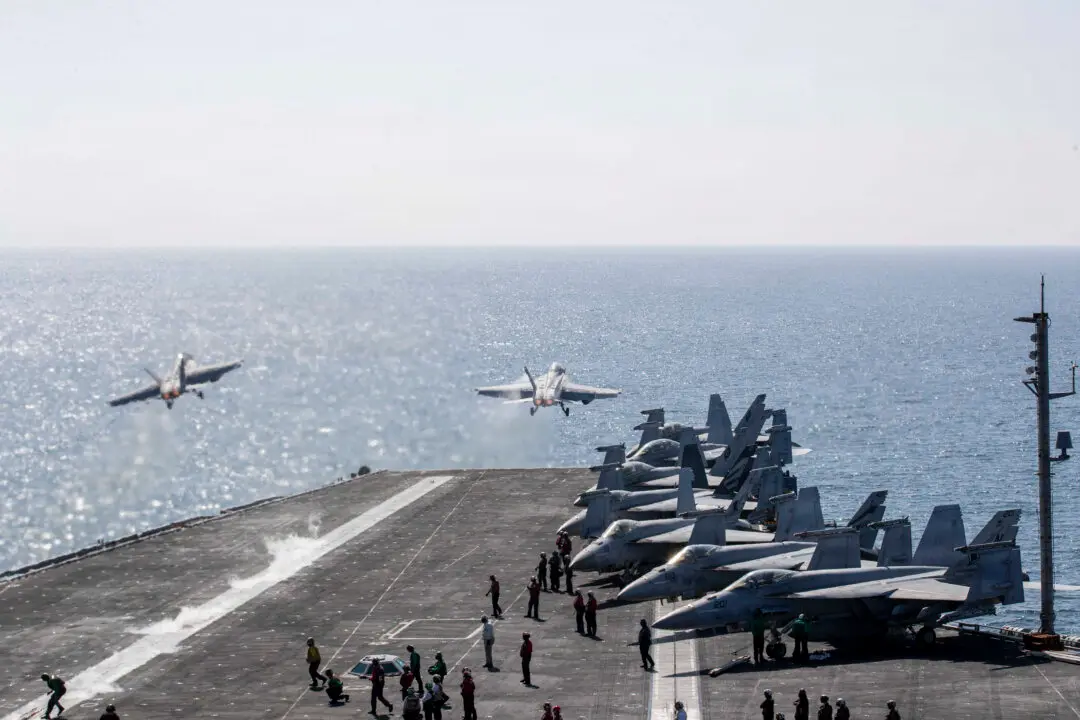
Two F/A-18 Super Hornets launch from the flight deck of the USS Abraham Lincoln in the Mediterranean Sea in support of Operation Epic Fury, on March 3, 2026. U.S. Navy via Getty Images
For the better part of the past decade, China’s leadership has operated on a single strategic assumption: that the West is in decline.
Communist Party leader Xi Jinping’s foreign policy has been built around that premise. The objective wasn’t to confront the United States directly, but to construct a geopolitical perimeter that would constrain American power and distract Western attention. Russia would pressure Europe through war in Ukraine. Iran would destabilize the Middle East through proxies. Venezuela would undermine the Western Hemisphere through narcotics flows, migration pressures, and anti-American agitation.
This loose alignment of regimes was never a formal alliance, but it served a clear purpose. Each actor kept the United States and its allies tied down in different theatres, diluting Western attention and buying Beijing time to consolidate its position in the Indo-Pacific. That architecture is now under severe strain. The current war with Iran, combined with the arrest of Venezuela’s Nicolás Maduro and renewed American control over the Panama Canal, has disrupted the geopolitical network Beijing spent years cultivating. What has occurred is not merely a regional conflict, but the gradual unravelling of a system designed to keep the West strategically distracted.
For China, Iran played a particularly important role. Beijing imported nearly 1.4 million barrels of Iranian oil per day last year, much of it purchased through sanctions evading channels at significant discounts. More importantly, Iran forced the United States to devote diplomatic, military, and intelligence resources to the Middle East rather than concentrating fully on Asia. That strategic distraction had enormous value for Beijing.
Today, that advantage is eroding. Since the Oct. 7, 2023, attacks in Israel, Iran’s regional proxy network has been systematically degraded. Hezbollah, Hamas, and other terrorist organizations have suffered severe losses. Syria’s Assad regime has collapsed into exile. Iran’s own economy remains crippled by sanctions and its military infrastructure has sustained repeated blows.
The death of Ayatollah Ali Khamenei now adds another layer of uncertainty to the regime’s future direction. Even before the recent conflict, Iran’s strategic leverage in the region had already weakened. Its proxies were under pressure, its economy was deteriorating, and its nuclear program faced constant disruption. The removal of its supreme leader compounds that instability and raises profound questions about Iran’s internal trajectory.
For Beijing, the consequences extend far beyond the Middle East. China’s long-term strategic planning has always assumed that any confrontation with the West, particularly over Taiwan, would occur in a fractured geopolitical environment. In such a scenario, sanctions imposed by the United States and its allies could be mitigated through alternative financial channels and commodity flows supplied by sympathetic states.
Iran and Russia were expected to play precisely that role. A Chinese invasion of Taiwan has often been analyzed primarily in military terms. Could the People’s Liberation Army successfully land forces and seize the island? Yet the more decisive question may be economic survival. Any conflict over Taiwan would trigger sweeping Western sanctions. For Beijing to withstand that pressure, it would need reliable partners capable of bypassing financial restrictions and supplying critical resources such as oil. If Iran becomes weakened or internally unstable, that strategic safety net becomes far less reliable.
For the United States and its allies, the current geopolitical shift strengthens the Western position in two critical theatres simultaneously: the Middle East and the Indo-Pacific. Washington’s ability to degrade Iran’s influence while maintaining pressure on Russia complicates Beijing’s long-term strategic calculations.
For Canada, the implications are significant and largely under-appreciated. Canada has spent much of the past decade treating foreign policy as a secondary matter, preferring rhetorical diplomacy to strategic engagement. Yet Canada remains a middle power whose prosperity depends on a stable international system anchored by Western alliances. The weakening of Iran and Venezuela reduces the pressure points authoritarian regimes have used to challenge that system. It also underscores the continuing relevance of Western military capability and alliance coordination.
Prime Minister Mark Carney now faces a strategic choice. He can continue Canada’s recent tendency toward cautious neutrality in global crises. Or he can recognize that the current geopolitical moment presents an opportunity for Canada to reassert its role within the Western alliance. That means strengthening defence capacity, supporting energy exports that stabilize allied economies, and contributing meaningfully to the security architecture that underpins the liberal international order.
The long-term consequences of the Iran conflict remain uncertain, but one strategic reality is already becoming clear: The loose coalition of regimes Beijing once relied upon to constrain the West is beginning to fracture. And when Xi Jinping next sits across the negotiating table from the president of the United States, he may find that the world he expected to inherit looks very different from the one he planned.
Xi Jinping’s geopolitical chessboard is starting to collapse.