The Iranian Revolutionary Guards stated that any companies with U.S. shares will be ‘completely destroyed’ if Washington targets Iranian energy facilities.
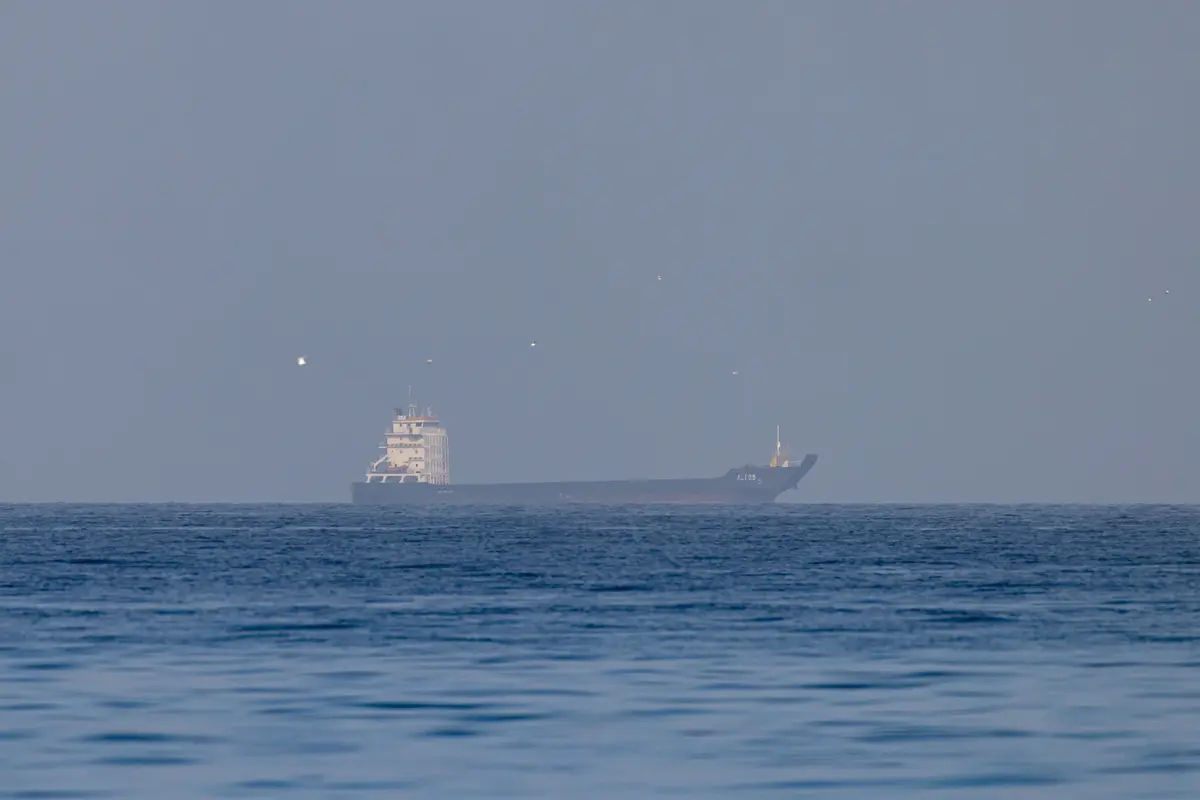
A cargo vessel in the Gulf, near the Strait of Hormuz, in northern Ras al Khaimah, United Arab Emirates, on March 22, 2026. Getty Images/Getty Images
Iran will move to shut down the entire Strait of Hormuz if U.S. President Donald Trump follows through with his threats to hit Iranian energy facilities, the nation’s Islamic Revolutionary Guard Corps stated on March 22.
Trump said that the U.S. military would “hit and obliterate [Iran’s] various POWER PLANTS, STARTING WITH THE BIGGEST ONE FIRST” if Tehran doesn’t fully open the Strait of Hormuz “without threat” within 48 hours of his social media post on March 21.
The announcement came a day after Trump suggested that the United States was “getting very close” to meeting its military objectives in the Middle East regarding Iran and would consider “winding down” the war after reaching the fourth week.
“The Strait of Hormuz will be completely closed and will not be opened until our destroyed power plants are rebuilt,” the Revolutionary Guard said in a March 22 statement.
The Revolutionary Guard stated that any companies with U.S. shares will be “completely destroyed” if Washington targets Iranian energy facilities. Energy infrastructure of nations that host U.S. military bases will be “lawful” targets, according to the statement.
Iran also threatened on March 22 to strike the energy and water facilities of its Gulf state neighbors if Trump follows through with his 48-hour ultimatum.
Trump, in his March 21 statement, said that the Strait of Hormuz “will have to be guarded and policed, as necessary, by other Nations who use it—The United States does not!”
“If asked, we will help these Countries in their Hormuz efforts, but it shouldn’t be necessary once Iran’s threat is eradicated. Importantly, it will be an easy Military Operation for them,” he said.
While only a small portion of U.S. oil imports travel through the Strait of Hormuz, roughly 20 percent of the world’s oil supply and 20 percent of its liquified natural gas supply pass through the critical waterway.
Iranian President Masoud Pezeshkian said in a statement posted to social media on March 22 that the Strait of Hormuz remains “open to all except those who violate [Iranian] soil.”
After Iran moved to effectively close the strait for vessels of any nation that does not seek explicit safe passage from its regime, disruptions to the global oil supply have caused large market fluctuations and uncertainty.
The international benchmark Brent crude oil price had risen to $112.19 per barrel by the morning of March 22 as the strait remains blocked, and Iranian leaders have said that prices could climb as high as $200 per barrel if the war continues.
Many Asian economies, including China, India, and Japan, rely heavily on energy imports that travel through the strait.
Japanese Foreign Minister Toshimitsu Motegi said on March 22 that his nation could consider using its military to conduct a mine-sweeping operation in the Strait of Hormuz if the United States and Israel reached a cease-fire with Iran.
“If there were to be a complete ceasefire, hypothetically speaking, then things like mine-sweeping could come up,” Motegi said during a Fuji TV program.
“This is purely hypothetical, but if a ceasefire were established and naval mines were creating an obstacle, then I think that would be something to consider.”
Motegi said Japan has no immediate plans to negotiate arrangements that would allow stranded Japanese vessels to pass through the Strait of Hormuz. He said that it’s “extremely important” to guarantee the ability for all ships to pass through the narrow waterway safely.
However, on March 20, Iranian Foreign Minister Abbas Araqchi told Japan’s Kyodo news agency that he had talked to Motegi about potentially allowing Japanese-related vessels safe passage through the strait.
Japan relies on the strait for roughly 90 percent of its oil shipments. Now that Tehran has effectively closed the waterway, rising global oil prices have forced Japan and other nations to release oil from their reserves.
The United Arab Emirates (UAE), on March 21, joined a growing list of nations that have pledged support for creating safe passage in the Strait of Hormuz.
“We express our readiness to contribute to appropriate efforts to ensure safe passage through the Strait,” the UAE and more than 20 other nations wrote in a joint statement released on March 21.
“We welcome the commitment of nations who are engaging in preparatory planning.”