
(Photo by Julia Avamotive/pexels.com)
Prices at the pump exceeding $2 a litre in Vancouver could be a sign of higher energy prices to come for all of Canada, as the conflict in the Middle East ends its third week.
According to GasBuddy.com, the price of a litre of gas in British Columbia averaged $1.94 on March 20, while the average in the city of Vancouver was $2.02 per litre—the highest in the country. Gas prices have risen in every province in recent weeks, with the average across Canada now at $1.72.
With Iran’s virtual closure of the Strait of Hormuz, coupled with the destruction of oil and gas facilities in the Middle East, prices at the pump are expected to continue rising for Canadians. That will likely lead to higher prices for food, consumer goods, and other items in Canada.
Dan McTeague, president of Canadians for Affordable Energy, said Canada is “far from the end” of the period of high gas prices. He said the longer the conflict goes on, the higher oil prices are likely to go.
“As far as energy costs and inflation go, we’re on borrowed time,” he said.
McTeague said the upcoming transition from winter to summer-blend gas in April will result in an additional 11-cent increase in gas prices. Additionally, McTeague said higher prices for diesel, the “workhorse of the global economy,” will raise costs for farmers, miners, and the forestry industry.
Stephen Randall, professor emeritus at the University of Calgary, said Canada does not have the export capacity to make up for decreases in the global oil supply, despite being a net exporter of energy. While North America is “reasonably self-sufficient” on the energy front, “prices for oil products would continue to be high were the Strait of Hormuz completely blocked,” he said.
Randall, who researches the geopolitical aspects of oil, said Europe and Asia will be the hardest hit by the loss of energy from the Middle East. However, he said the world’s oil markets are so intertwined that “what happens in one key sector like the Gulf impacts everyone.”
Closure of the Strait
Since the United States and Israel began their strike against Iran on Feb. 28, the Iranian regime has effectively shut down the Strait of Hormuz, impacting around a fifth of all oil transport and significant volumes of fertilizer. As a result, oil prices are hovering at around US$100 a barrel.
Additionally, Iran has launched attacks on energy infrastructure in countries like Saudi Arabia, Bahrain, Qatar, and the United Arab Emirates. On March 18, in response to Israeli attacks on Iran’s South Pars natural gas field, Tehran launched strikes on the world’s largest liquefied natural gas (LNG) production facility in Qatar, destroying as much as 17 percent of the country’s capacity for the next five years.
The United States also attacked military infrastructure on Kharg Island, which processes up to 90 percent of Iran’s oil products, and has threatened to destroy the island’s oil facilities.
As the conflict has escalated, Tehran has sunk more than 10 oil tankers in the Strait of Hormuz, and has said it will not re-open the waterway to let tankers through.
With global energy supplies remaining constrained, several Canadian banks have released oil price projections. TD Economics said in a March 17 report that if oil and LNG shipments were to “slowly resume” in April, the price of West Texas Intermediate would moderate to US$85 per barrel in the second quarter of 2026, with prices remaining elevated through mid-2026.
An escalation of the crisis and further reduction of oil supplies could mean oil prices average over US$100 a barrel in the second quarter, remaining at over US$90 a barrel through the end of 2026, according to the TD report. “Even if the jump in energy prices proves short-lived, it still leads to higher inflation in the near term, eroding purchasing power and slowing consumption,” the report said.
A BMO report released March 13 projects average oil prices of around US$75 per barrel in 2026, up from US$60 before the conflict. The report said the impact of the oil shock will be lessened because the global economy is “less energy-intensive today than during past oil price shocks.”
However, RBC Capital Markets had a more pessimistic projection for oil prices in its March 13 report. It predicts that if the conflict in the Middle East lasts three to four more weeks, oil prices could exceed the high of US$128 a barrel seen during the outset of the Russia-Ukraine war, as well as the 2008 peak of US$146 a barrel.
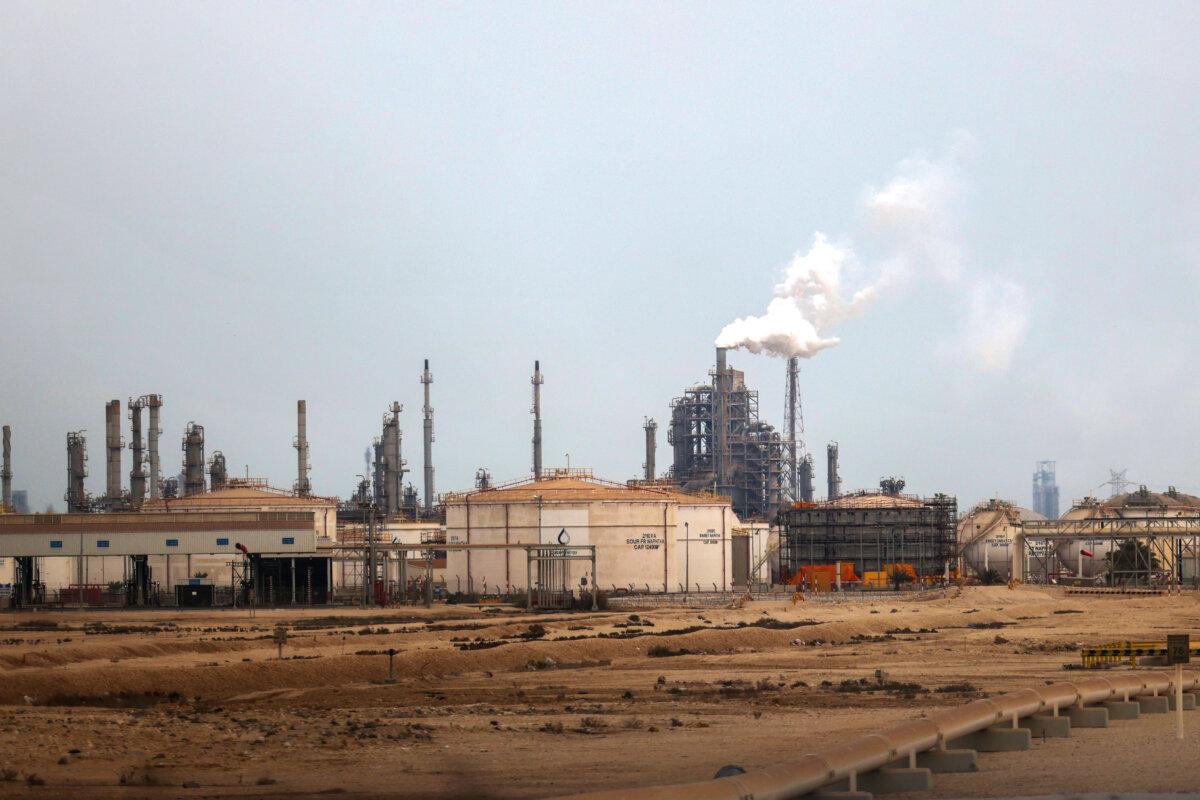
Qatar Energy’s operating facilities in Mesaieed Industrial City, south of Doha, Qatar, on March 4, 2026. Getty Images
Impact on Canada
In response to the energy crisis, International Energy Agency (IEA) member countries agreed to make 400 million barrels of oil from their emergency reserves available to the market. The stocks from Asia and Oceania will be made available immediately, while stocks from countries in the Americas and Europe will be made available starting at the end of March.
Natural Resources Minister Tim Hodgson said on March 11 that Canada would do “its part to contribute to the world’s supply,” and was discussing how to do so with its energy sector. However, Canada does not have a strategic petroleum reserve.
McTeague said that on a long-term basis, these IEA petroleum releases won’t solve the issue of 20 million barrels of oil per day being offline due to the Iran war.
“What happens in two weeks, three weeks, when you’ve used up 300 to 400 million barrels? Even the U.S. only has 395 million [barrels],” McTeague said.
“Considering this is probably the most significant geopolitical event since 1973 coming from the Middle East, there’s obviously a gulf between reality and the games that are being played behind the scenes to, in some way, keep these prices down,” he said.
The 1973 oil crisis, when the Organization of Arab Petroleum Exporting Countries embargoed countries that supported Israel during the 1973 Yom Kippur War, drove oil prices from US$3 a barrel to nearly US$12 a barrel. The embargo ended in March 1974, but inflation and oil prices remained high for years.
McTeague also said that while Canada is a net exporter of oil, it is unable to set its own prices at the pump, as it depends on global oil prices.
McTeague warned that with diesel prices spiking, the cost of living for Canadians will continue to rise. Since the conflict began, prices have risen from US$2.59 to US$4.25 per gallon.
“Fool around with that, and you basically fool around with the cost of living. That means jet fuel, trains, buses, trucks, tractors, mining and forestry. The entire plenum of your economy is dependent on diesel,” he said.
The Bank of Canada chose to leave its key rate at 2.25 percent for a third consecutive meeting on March 18, and said it faces a “dilemma” when it comes to whether to raise or lower rates. It said raising interest rates to slow inflation could further weaken the economy, while easing them to support growth could raise inflation.
“The longer this conflict lasts and the wider it gets, the bigger the risks,” Bank of Canada Governor Tiff Macklem said, adding that the bank would not let oil-fuelled inflation become “persistent.”