Buoyed by recent electoral wins, Takaichi is moving the country to a defensive posture against China.
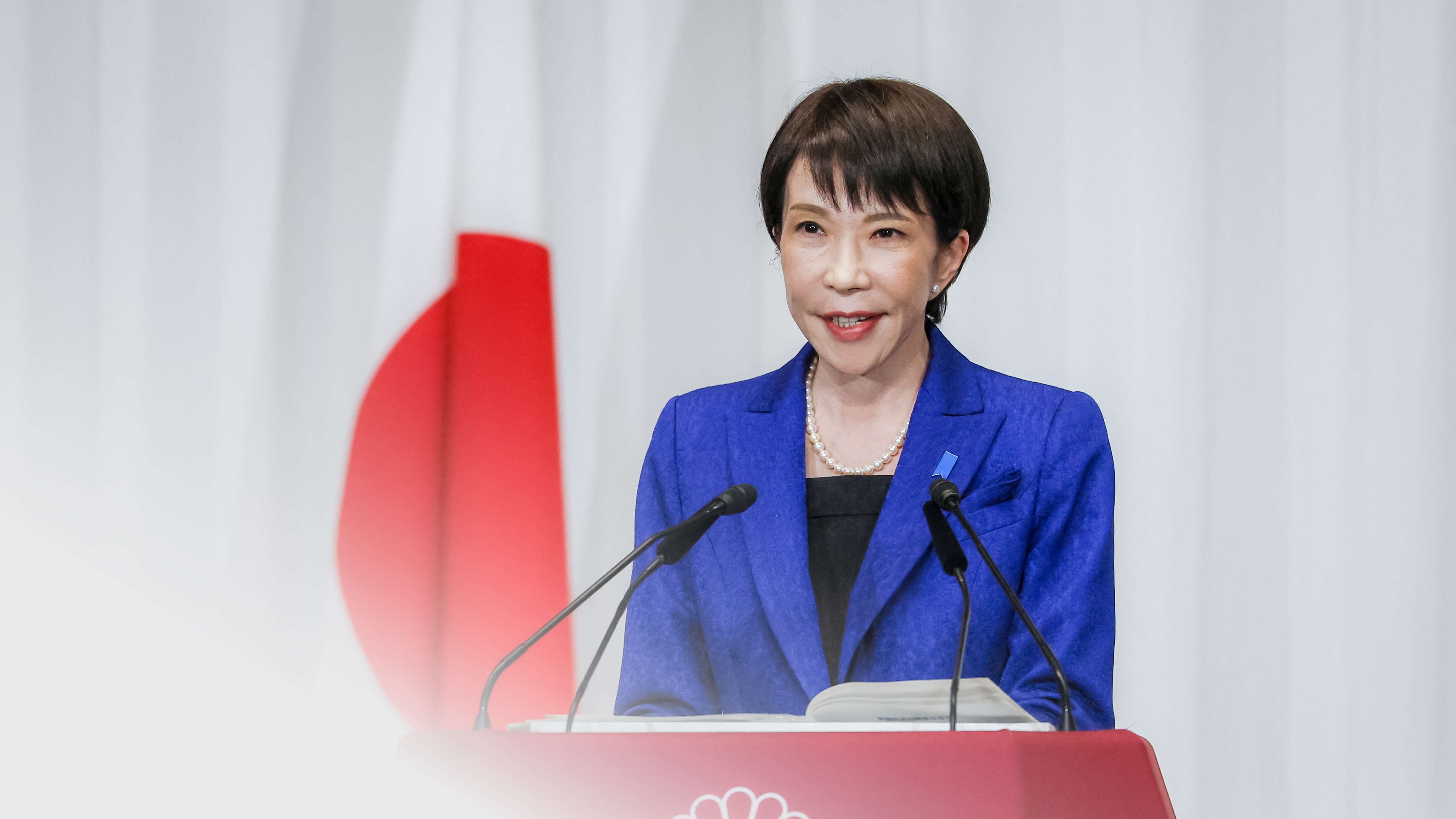
Japanese Prime Minister Sanae Takaichi, leader of the ruling Liberal Democratic Party (LDP), speaks during a press conference at the LDP headquarters in Tokyo on Feb. 9, 2026. Franck Robichon / POOL / AFP via Getty Images
Japanese Prime Minister Sanae Takaichi emerged from a snap election on Feb. 8 with a mandate rare in postwar politics: a two-thirds supermajority in the more powerful lower house.
The result capped a three-month period of strained Japan–China relations over Taiwan and Japan’s assertion that it had a right to respond if a conflict threatened its survival.
During a Nov. 7, 2025, lower house session, Takaichi said that a crisis involving Taiwan—such as Chinese “armed actions” including the deployment of warships—“could constitute a survival-threatening situation” for Japan, potentially justifying a military response.
Beijing then took a series of aggressive steps: It urged Chinese citizens to avoid traveling to Japan because of heightened tensions. It suspended Japanese seafood imports while citing inadequate water checks. A Chinese diplomat even posted a threat online to “cut off” Takaichi’s neck over her Taiwan stance.
Beijing’s response was widely read in Tokyo as an attempt to intimidate and isolate Japan’s new leader. Instead, it helped turn the Feb. 8 election into a referendum on national security.
The ruling Liberal Democratic Party won 316 seats in the 465-member chamber, and coalition partner the Japan Innovation Party added 36 for a total of 352. That gives Takaichi a degree of parliamentary control that can override the upper house in most cases and expedite major security legislation and budget changes.
Analysts told The Epoch Times that the victory gives Takaichi political cover to accelerate changes already underway: higher defense spending, longer-range weapons, tighter counterintelligence, and deeper U.S.–Japan operational integration. Those moves could reshape the Indo-Pacific security landscape, they said.
In Beijing’s worst-case reading, they said, it could also reopen politically sensitive debates over Japan’s nuclear posture and possible “nuclear sharing” arrangements with the United States—even if any actual deployment remains distant.

Troops from multiple nations exit a helicopter during a joint military drill conducted by Japan’s Ground Self-Defense Force 1st Airborne Brigade with participants from Britain, Canada, Germany, the United States, and others at Camp Narashino in Funabashi, Japan, on Jan. 7, 2024. Richard A. Brooks/AFP via Getty Images
Cold War-Like Dynamic
After the victory, Takaichi struck a familiar tone, saying her government would pursue a “constructive and stable” relationship with China and remain open to dialogue.
Akio Yaita, a veteran Japanese journalist and director of the Indo-Pacific Strategy Think Tank, said he expects that Japan–China relations may “settle into a long-term Cold War-like state” of persistent distrust and strategic competition, but they are unlikely to deteriorate further.
“In fact, I think both sides—especially China—will look for a way to step back gracefully,” he said.
One near-term stabilizer, he suggested, could be U.S. President Donald Trump’s plan to visit China in April. If Washington and Beijing want calmer optics ahead of that meeting, Beijing may have less incentive to escalate against Tokyo in the short term.
Li Shih-hu, an international affairs professor at Taiwan’s National Chengchi University and director of its Japan Studies graduate program, said Beijing is also dealing with a structural problem inside Japanese politics.
Political party Komeito—the Liberal Democratic Party’s longtime junior coalition partner that often acted as a moderating force—left the coalition in October 2025.
Li told The Epoch Times that Beijing had used Komeito as a political back channel to communicate and, at times, restrain a Liberal Democratic Party-led government.
With Komeito gone and the coalition now anchored by a more defense-forward partner, the Japan Innovation Party, Beijing has fewer familiar “handles” inside Japanese politics, Li said.
The consequence is not that Tokyo will become reckless, he said, but that it can move faster on policies Beijing dislikes, even if constitutional revision still faces hurdles in the upper house.

Tetsuo Saito (C), leader of the Komeito party, holds hands with his party’s candidates after delivering a speech during an election campaign rally in Kobe, Japan, on Jan. 27, 2026. Komeito—the Liberal Democratic Party’s longtime junior coalition partner that often acted as a moderating force—left the coalition in October 2025. Buddhika Weerasinghe/Getty Images
Faster Rearmament
The biggest shift may be speed, not direction, according to Su Tzu-yun, director of Taiwan’s Institute for National Defense and Security Research.
Japan’s defense policy, he told The Epoch Times, has already been shifting from an “exclusively defense-oriented” posture toward what he called “proactive defense”—buying longer-range missiles, developing counterstrike capabilities, and integrating more tightly with the United States and other partners.
Much of that does not require rewriting Japan’s constitution, he said. It can be done through budgets, procurement decisions, operational planning, and updated interpretations of existing authorities.
Takaichi has been explicit about that direction.
“It is essential that Japan take the initiative in fundamentally reinforcing its defense capabilities,” she said during the Jan. 24 National Diet session, tying the threat picture to China, North Korea, and Russia.
Her Cabinet has already approved a record defense budget for fiscal 2026—more than 9 trillion yen (about $58 billion)—as part of Japan’s five-year plan to raise defense spending to 2 percent of gross domestic product. The spending includes long-range “standoff” missiles, drones, and systems meant to deter or blunt attacks near Japan’s southwestern islands, terrain that would matter immediately in any Taiwan contingency.
Takaichi has also pledged to revise Japan’s national security strategy and to move faster on loosening restrictions on weapons exports.

Yonaguni Island, Japan’s westernmost inhabited island, about 111 kilometers from Taiwan, is pictured in Yonaguni, Japan, on April 13, 2022. Japan’s southwestern islands lie close to Taiwan, and any conflict there could threaten Japan’s sea lanes, airspace, and U.S. bases on its territory. Carl Court/Getty Images
“We will revise the three strategic documents ahead of schedule and fundamentally strengthen security policy,” Takaichi said in a Jan. 9 press conference. “No one will help a country that lacks the resolve to defend itself.”
With a two-thirds majority in the lower house, Takaichi can more easily pass bills even if the upper house tries to block them. Japan’s National Diet has two chambers, and most bills require approval from both. But if the upper house rejects or amends a bill passed by the lower house, the lower house can override with a two-thirds vote of members present.
Budgets are an even more favorable case: The upper house can only delay, not block, as the lower house’s version prevails after a one-month interval if there’s no resolution.
Constitutional change is different. Takaichi said on Feb. 9 that she will “press ahead” with efforts to revise the constitution, signaling that she wants to reshape the legal constraints on Japan’s military role.
But amendments require two-thirds approval in both chambers, followed by a national referendum with a simple majority. There is no lower-house override, meaning she would likely have to bet on the next upper-house election scheduled in 2028.
For Beijing, Su said, the problem is not only Japan’s budget number, but also what those capabilities do to the balance of risk with regard to Taiwan and the East China Sea.
A Japan that can operate integrated air and missile defenses, deploy longer-range fires, and support U.S. forces with fewer political constraints raises the cost of coercion and reduces the effectiveness of intimidation, he said.
Beijing will almost certainly accuse Japan of reviving militarism, Su said, but he argued that the more direct driver of regional insecurity is China’s own military buildup and coercive diplomacy.

Liberal Democratic Party President Sanae Takaichi is applauded after lawmakers in Japan’s lower house elected her prime minister in Tokyo on Oct. 21, 2025. Takaichi was reelected by parliament on Feb. 18 following a landslide victory in the lower house in the Feb. 8 snap election. Tomohiro Ohsumi/Getty Images
Li said that after a decade of modernization under Prime Minister Shinzo Abe and subsequent governments, Japan is moving from replacing old systems to figuring out how to use new capabilities in real contingencies—especially scenarios that threaten Japan’s interests even without a direct attack on Japanese territory.
He said Takaichi’s task is to turn high-quality hardware into credible, practiced deterrence.
More Operational US–Japan Alliance
Takaichi’s win also strengthens a trend Washington has pursued for years, Yaita said: turning the U.S.–Japan alliance from a political relationship into an operational war-fighting system.
He said Takaichi is likely to increase the defense budget in ways that align with Trump’s long‑running demand for allies to do more. He also expects that Japan will experience more pressure to take on more responsibility if Trump reduces U.S. troop deployments in Northeast Asia.
Some of the structural pieces are already in place. Japan established a joint operations command in 2025 to better integrate its ground, maritime, and air forces, and U.S. planners have initiated upgrades to U.S. Forces Japan to enhance its war-fighting capability.
Takaichi has signaled she wants to lock in that trajectory. After the election, she said she plans to visit the United States as soon as March and deepen cooperation centered on the alliance, framing it as the core of Japan’s security strategy.
For Washington, Yaita said, the strategic bargain is straightforward: Japan spends more, fields more capability, and plays a larger regional role. In return, the United States preserves deterrence and influence without having to expand its footprint proportionally.
Li described the likely result as a rebalancing within the alliance—less of a one-way security guarantee and more of a joint operating system.

Japanese troops take position during a joint military drill and demonstration with participants from Britain, Canada, Germany, the United States, and others at Camp Narashino in Funabashi, Japan, on Jan. 7, 2024. Richard A. Brooks/AFP via Getty Images
1st Island Chain Tightens
Japan’s southwestern islands sit close to Taiwan, and any Taiwan conflict would quickly threaten Japan’s sea lanes, its airspace, and the U.S. bases hosted on Japanese territory. That geography is why Taiwan policy has become mainstream in Japan and why Beijing reacts so sharply to Japanese statements linking Taiwan’s security to Japan’s own survival.

A Kyodo News poll during the China tensions showed Takaichi’s approval rating rising to about 70 percent. The survey also found that the public narrowly supported Japan’s right to collective self-defense if China were to attack Taiwan, with 48.8 percent in favor and 44.2 percent opposed.
Su said the strategic aim for Tokyo, Taipei, and Washington is to strengthen the “defensive line” that links Japan, Taiwan, and the United States, and to widen the network of access and basing options along the first island chain—including closer coordination with the Philippines—so that U.S. forces have more options in a crisis.
The first island chain—Japan through Taiwan and the Philippines—can box China’s forces closer to its coast.
From Beijing’s perspective, Su said, this is worse than “Japan gets tougher.” It is a denser regional system in which pressure on one actor pushes others to coordinate faster, share more intelligence, and tighten operational planning.
That dynamic, he said, limits Beijing’s ability to pick off partners one by one and raises the risk that any coercive move triggers a wider coalition response.

A U.S. Coast Guard ship (L) sails past a Japan Coast Guard support ship during exercises with Philippine and Japan Coast Guard vessels in waters near Kagoshima, Japan, on June 20, 2025. The joint exercises are seen as a show of unity against Chinese activity in disputed regional waters. Richard A. Brooks/AFP via Getty Images
Intelligence, Economics, De-risking
Some of the most consequential changes are not about missiles, Li said. They are about leverage—closing the seams that China can exploit through espionage, political influence, and economic dependence.
Takaichi has called for a stronger intelligence posture and tighter safeguards for sensitive information and technology. She says she plans to create a National Intelligence Bureau and toughen counterintelligence measures, partly to deepen cooperation with Washington and other security partners.
Li said that without stronger information protection, Japan’s partners will be cautious about sharing sensitive intelligence because of the risk of leaks.
A tighter Japanese intelligence system, he said, would make deeper intelligence exchange with the United States more feasible—and harder and costlier for Chinese penetration efforts.
Economic security is another front. Takaichi has treated advanced semiconductors as a national security issue and has made chip supply chains a strategic priority. Days before the election, Taiwanese semiconductor giant TSMC stated that it plans to produce advanced three-nanometer chips in Japan.
Su pointed to rare earths as another example. Japan has been exploring deep-sea deposits near Minamitorishima as part of a broader effort to diversify away from China’s dominance in rare earths.
Even if those projects take years, he said, they signal intent to reduce Beijing’s ability to weaponize supply chains.
Li also noted a quieter political shift in Tokyo in that, compared with a decade ago, Japanese business groups have been less visible in urging the government to “fix” relations with China.
As companies diversify their supply chains toward Southeast Asia, India, and elsewhere, dependence on China has fallen—shrinking one of Beijing’s traditional pressure points in Japan, he said.

TSMC Chairman Che-Chia Wei (L) speaks during a meeting with Japan’s Prime Minister Sanae Takaichi (R) at the Prime Minister’s Office in Tokyo on Feb. 5, 2026. Kazuhiro Nogi/POOL/AFP via Getty Images
What Beijing Fears Most
The most sensitive question, and the one Beijing likely watches with the most anxiety, is Japan’s nuclear posture, Li said.
Japan is in a uniquely exposed position, Li said: It sits near three nuclear-armed states—China, North Korea, and Russia—and faces the reality that it cannot solve that problem alone.
In her Jan. 24 policy speech, Takaichi mentioned all three, warning that their military developments are causing “grave concerns.”
For decades, Japan’s answer has been the U.S. nuclear umbrella, paired with strong domestic constraints against hosting or pursuing nuclear weapons. Those constraints remain.
But with a stronger mandate, Li said, Tokyo could speak more openly about deterrence options that fall between today’s posture and a dramatic break with postwar norms.
Yaita said that “nuclear sharing”—a NATO-style concept floated by Abe after he left office—could gain new attention under Takaichi, who has shown a more open attitude toward discussing it than many Japanese leaders.
Takaichi added to that sensitivity in November 2025 when she said she could not reaffirm that Japan’s decades-old Three Non-Nuclear Principles—no possession, no production, and no introduction of nuclear weapons—would be maintained in an upcoming revision of Japan’s security strategy.

Nuclear-capable DF-31BJ ballistic missiles are unveiled on transporters during a military parade in Tiananmen Square in Beijing on Sept. 3, 2025. Kevin Frayer/Getty Images
Su emphasized that Japan already relies on extended deterrence—the U.S. nuclear umbrella—and he said that, in practical terms, “nuclear sharing” can be understood as how credibly the U.S. would retaliate if Japan were threatened with nuclear weapons.
He also suggested that Japan could pursue nuclear-powered submarines to operate farther from Chinese forces while still stopping short of owning nuclear weapons.
Li described another politically plausible middle ground that could alarm Beijing: regular port calls by U.S. nuclear submarines. Because such submarines can carry nuclear missiles, a visible presence would strengthen deterrence without permanently stationing nuclear weapons on Japanese soil, allowing Tokyo to argue that it remains consistent with domestic anti-nuclear norms.
Whether that would be acceptable under Japan’s principles could become a contentious debate, he said, but he sees it as more thinkable in Japan’s new political climate.
Su said that Washington has historically been reluctant for allies in East Asia to acquire independent nuclear arsenals but would likely support nuclear-powered submarines.
For Beijing, however, even sustained debate is strategically costly, Su said. It signals that China’s military buildup and coercive posture are pushing a major neighbor to reconsider taboos—and to look for stronger ways to lock in U.S. commitments.
World Security Landscape
Takaichi’s win comes at a moment when regional theaters are increasingly linked. Japan has been strengthening security ties with European partners and engaging more with NATO as the Russia–Ukraine war forces countries to think in connected terms about Russia and China.
A more capable Japan gives Washington options, Su said. The United States can lean more heavily on Japan to assume greater responsibility in Northeast Asia while the United States focuses on broader competition with China.

U.S. President Donald Trump and Japan’s Prime Minister Sanae Takaichi arrive aboard U.S. Navy aircraft carrier USS George Washington at the U.S. naval base in Yokosuka, Japan, on Oct. 28, 2025. Andrew Caballero-Reynolds/AFP via Getty Images
It can also reassure European allies that the United States can sustain pressure on Russia without being overstretched—because a stronger Japan helps stabilize the Indo-Pacific side of the global map.
The upside for the United States, Taiwan, and other Indo-Pacific partners, Su said, is clearer deterrence—more Japanese capability, tighter alliance integration, stronger intelligence cooperation, and a regional network that is harder for Beijing to intimidate or fracture.
The downside is the risk of escalation, he said. Beijing can respond with more military activity near Japan, more trade restrictions, or more coercive messaging.
The lesson of this election, Yaita and Su said, is that such tactics as Beijing used can backfire—hardening public opinion, undercutting China-friendly voices in Japan, and accelerating the very security shifts Beijing wants to stop.
Li framed the choice as Beijing’s. If China continues to treat neighbors as actors to be pressured into compliance, it is likely to produce the opposite outcome: a tighter coalition and higher military budgets across East Asia.