Trump welcomed China’s new purchase commitments but noted there has been no breakthrough on the release of Jimmy Lai.
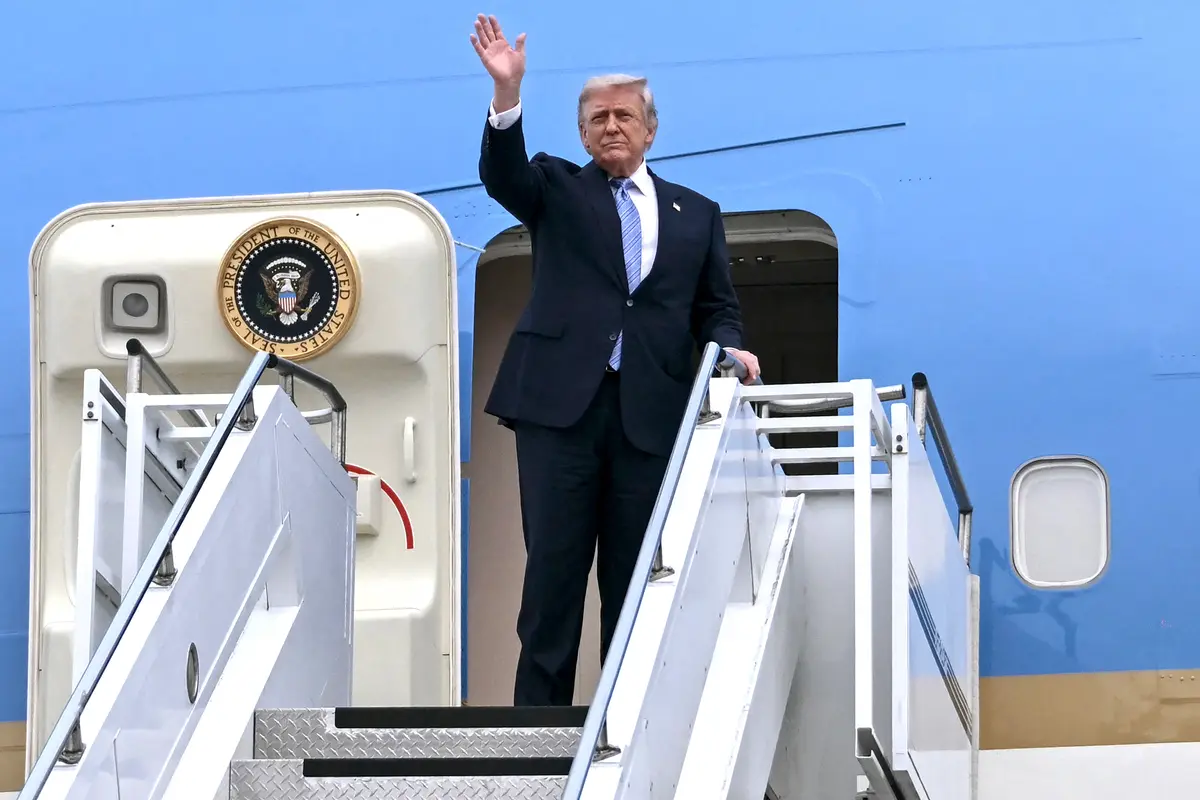
U.S. President Donald Trump boards Air Force One before his departure from Beijing Capital Airport in Beijing on May 15, 2026. Brendan Smialowski/AFP via Getty Images
President Donald Trump wrapped up a high-stakes two-day summit with Chinese leader Xi Jinping in Beijing on May 15. During the visit, Trump and his team discussed a broad spectrum of issues, from new purchase commitments to the tense situations in Iran and Taiwan, as well as wrongful detentions and human rights concerns.
During the trip, Trump was welcomed on May 14 with a grand ceremony outside the Great Hall of the People on the edge of Tiananmen Square, where Chinese authorities violently suppressed the 1989 pro-democracy movement in what is known as the Tiananmen Square Massacre.
On the second day of his visit, Trump held meetings at Zhongnanhai, the heavily guarded leadership compound that serves as the headquarters of the Chinese Communist Party.
Here are the key takeaways from Trump’s trip to China.
Tight Security Measures
During the trip, the White House took extra precautions to reduce the risk of surveillance, hacking, or data theft by the communist regime in Beijing.
Before leaving China, White House staff collected all badges and pins issued to journalists traveling with the president, according to the White House pool report. Reporters are typically not required to return such items provided by host countries.
White House staff were also observed throwing the collected badges, pins, and burner phones into a bin at the bottom of the stairs before they got on Air Force One, according to Emily Goodin, a New York Post reporter.
“Nothing from China allowed on the plane,” Goodin wrote on X.
Similar measures were implemented prior to entering China. U.S. officials traveling with the president were required to leave personal phones and laptops behind before entering Beijing. They were instead given burner phones for temporary, controlled use.
No Progress on Jimmy Lai
Trump told reporters that releasing political prisoner Jimmy Lai is a “tough one” for Xi. His comments lowered hopes for a breakthrough to free Hong Kong’s pro-democracy media tycoon.
Lai, 78, was sentenced in February to 20 years in prison under Hong Kong’s national security law.
Trump, however, said Xi is seriously considering releasing detained pastor Ezra Jin Mingri.
“I think he’s giving very serious consideration to the pastor,” Trump told reporters on Air Force One.
During a press briefing, Guo Jiakun, spokesperson for the Chinese regime’s foreign ministry, addressed questions regarding Lai after Trump’s departure on May 15.
“Hong Kong affairs are China’s internal affairs, and the [Chinese] central government firmly supports Hong Kong’s judicial authorities in exercising their duties in accordance with the law,” he said.
Rubio also told NBC News on May 14 that Trump had asked Xi about the release of Lai.
“We would like to see him released,” Rubio said. “It’s really at this point a humanitarian situation because of his age and health.”
On May 13, the U.S. House and Senate passed resolutions urging Trump to confront Xi over five political prisoners: Lai; Chinese pastors Jin Mingri and Gao Quanfu; Gao’s wife, Pang Yu; and retired Uyghur medical doctor Gulshan Abbas.
New Deals on Boeing Jets, Farm Goods
Trump said that China has agreed to buy soybeans, energy products, and Boeing jets from the United States following his meeting with Xi on May 14, the first day of the summit.
In an interview with Fox News host Sean Hannity on May 14, Trump said that China agreed to make major purchases of U.S. agricultural products, particularly soybeans, which are the top U.S. export to the Chinese market.
“Last time we signed like 36 deals. This time it’s much bigger than that,” he said. “They’re gonna do a lot of soybeans for our farmers … they’re gonna be buying a lot of our farm products, which is great.”
Last year, Beijing reduced imports from the United States amid tariff disputes.
China also agreed to buy 200 Boeing aircraft, in what would represent a major commercial order for the U.S. aerospace company.
On May 15, Trump confirmed the purchase commitment, telling reporters that it could potentially rise to 750 planes. Trump also said the planes would have GE Aerospace engines.
Trump also said that Xi responded positively to his suggestion that Beijing purchase oil and LNG from the United States. China is the largest buyer of Iran’s sanctioned crude oil.
“We’re going to start sending Chinese ships to Texas, and to Louisiana, and to Alaska. And I think that was another thing that was agreed to. That’s a big thing,” the U.S. president told Hannity on May 14.
When asked whether China would order 200 Boeing jets at a regular briefing on May 15, Guo Jiakun, a spokesperson for the regime’s foreign ministry, did not give a direct answer, saying only that the essence of U.S.–China economic and trade relations is mutually beneficial.
As for further agricultural deals, Guo said China is willing to work with Washington to implement the “important consensus” reached by the two leaders, expand cooperation, and achieve win-win outcomes.
Additionally, U.S. Trade Representative Jamieson Greer, in a May 15 interview with Bloomberg, confirmed that the United States and China would establish a “Board of Trade” to manage trade flows of non-sensitive goods.
Trump said he didn’t discuss tariffs with Xi.
“They’re paying substantial tariffs, but we didn’t discuss anything,” Trump told reporters on Air Force One. “It wasn’t brought up.”
US and China Align on Iran, Trump Says
According to Trump, Xi agreed during their discussions that Tehran must reopen the Strait of Hormuz. The president also stated that both countries agreed Iran must never possess a nuclear weapon.
During the visit, Trump and his team made it clear to Beijing that reopening the Strait of Hormuz is in China’s best interest.
“I didn’t ask him to put pressure [on Iran], because I don’t need favors,” Trump told reporters. “I think, automatically, he’d like to see it opened up.”
China is the main buyer of Iranian crude. In 2024, about 10 percent of its imports came from Iran, and around 90 percent of Tehran’s crude oil exports are directed to China, according to the U.S. Energy Information Administration.
Trump told Hannity that the Chinese regime does not intend to stop buying energy from Iran.
“[Xi] said he’s not gonna give military equipment [to Iran]. That’s a big statement,” Trump told Hannity. “But at the same time, he said they buy a lot of their oil there, and they’d like to keep doing that.”
Trump told reporters on Air Force One that he will decide in the coming days whether to lift sanctions on Chinese oil companies purchasing Iranian oil.
Earlier this month, the Chinese authorities instructed all companies to ignore U.S. sanctions against five Chinese refiners accused of trading Iranian petroleum.
Iran sourced much of its military equipment and conventional weapons from China in the 1980s, but due to increased international scrutiny, such transfers largely stopped over the past decade. A March report by the U.S.-China Economic and Security Review Commission said the Chinese regime’s cooperation with Iran has shifted toward selling technology that has both civilian and military applications, including those relevant to missile and drone development.
No Change on Taiwan Policy
Washington’s longstanding policies on Taiwan remain unchanged following the Trump–Xi meeting.
Trump told reporters he declined to clarify his position on Taiwan when Xi asked whether the United States would defend the island.
“That question was asked to me today by President Xi,” Trump said. “I said, ‘I don’t talk about that.’ He asked me if I’d defend them. I don’t talk about that.”
Regarding Taiwan arms sales, Trump said that he would “make a determination over the next fairly short period.”
Xi took on an aggressive posture toward Taiwan, warning the United States that it “must exercise extra caution in handling the Taiwan question,” according to a readout from China’s foreign ministry following the two leaders’ talks on Thursday.
“If it is handled properly, the bilateral relationship will enjoy overall stability. Otherwise, the two countries will have clashes and even conflicts,” Xi warned.
When asked whether Xi’s warning on Taiwan was the sharpest yet, Greer told Bloomberg on May 15 that the tone during meetings in China differed from the public statements released by Chinese officials.
“There’s a difference between the way we talk in a bilateral meeting and the statements that go out from the Chinese Ministry of Foreign Affairs, which … takes a wolf warrior approach,” Greer said.
China’s communist regime considers democratically governed Taiwan to be a Chinese province, even though it has never ruled the island. Beijing has demanded that countries adhere to its “one-China principle,” under which the regime claims sovereignty over Taiwan.
The United States has long maintained a “one-China policy,” acknowledging that there is only one “China” without recognizing Beijing’s sovereignty over Taiwan. Washington has also been Taiwan’s main arms supplier under the Taiwan Relations Act.
Rubio told NBC News on May 15 that U.S. policy toward Taiwan was “unchanged” and warned that it would be “a terrible mistake” for Beijing to try to seize Taiwan with military forces.
A proposed $14 billion U.S. arms sale to Taiwan is awaiting approval from Trump, who previously approved an $11.1 billion weapons package for the island in December 2025.