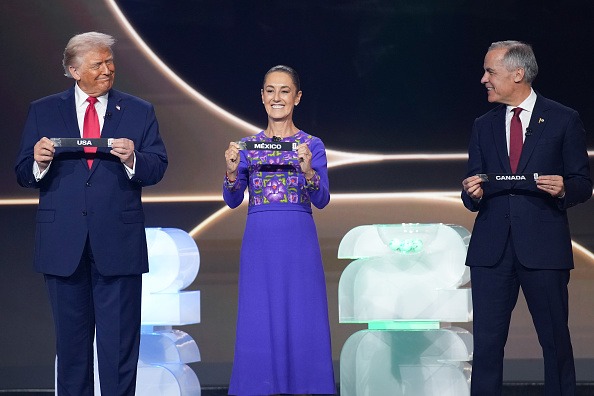
U.S. President Donald Trump, Mexican President Claudia Sheinbaum, and Canadian Prime Minister Mark Carney participate in the FIFA World Cup 2026 Official Draw with at the John F. Kennedy Center for the Performing Arts December 05, 2025 in Washington, DC. (Photo by Andrew Harnik/Getty Images)
U.S. President Donald Trump said this week he may not renew the trade deal with Canada and Mexico, adding uncertainty to already slow-moving trade talks with Ottawa.
Trump, however, did not use the word “withdraw” when discussing his intentions for the Canada-United States-Mexico Agreement (CUSMA) on free trade.
This distinction is significant, as there are markedly different implications between choosing not to renew the agreement and formally withdrawing from it. Unless the United States withdraws, it remains bound by CUSMA until 2036.
The text of the pact, which came into force on July 1, 2020, stipulates that parties are to conduct a joint review on the sixth anniversary of the deal, which falls on July 1 this year.
As part of the review, each country has to express its intent on whether to extend the agreement for a 16-year term. Canada and Mexico formally advised their CUSMA counterparts last week that they want a 16-year extension, but the position of the United States has not been made public.
If one party does not confirm during the joint review that it wants an extension, it would trigger annual reviews for the rest of the initial 16-year term—for another 10 years from now—or until parties decide to renew the deal for 16 years.
A separate clause of CUSMA deals with withdrawal. It says a party can withdraw six months after giving written notice to counterparts. The agreement would remain valid for the remaining parties.
Trump commented on his intentions for CUSMA when prompted by reporters in the Oval Office on June 10.
“I’m not looking to renew it,” he said, while speaking with reporters after signing the Secure America Act.
Trump repeated his longstanding grievances about Canada and Mexico, including the U.S. trade deficit and his view that the United States does not need what the two countries produce.
“We don’t need anything that Canada has, we don’t need anything that Mexico has, but they need everything that we have, and they have to treat us better,” he said.
The president concluded his remarks by saying his administration is in talks—presumably with Canada and Mexico—and that “we’ll see if we do something.”
What Happens Now
The absence of a CUSMA renewal is “not a cliff,” Canada-U.S. Trade Minister Dominic LeBlanc said on June 11.
If the July deadline passes without signing an agreement, uncertainty will continue but trade talks will not stop, barring a decision by a party to do so.
Prime Minister Mark Carney also responded on June 11 to Trump’s latest comments, saying the absence of a CUSMA renewal “doesn’t take away the possibility or even the probability of an extension.”
Carney said the way the United States is approaching the negotiations is to look for bilateral deals within the structure of CUSMA, while adding that Canada is also looking for a bilateral deal with Mexico.
LeBlanc hinted that bilateral deals could be the key to unlocking the broader 16-year CUSMA extension.
“If those agreements resolve issues that all three countries are trying to resolve, I’m hopeful that we might at that point have the extension, but if not, we’ll continue to do what’s necessary to preserve the trilateral framework, which is in the interest of all three countries,” LeBlanc said.
Progress of Talks
The U.S. bilateral talks with Canada and Mexico ahead of the CUSMA review, at least on the surface, have progressed at different speeds. Whereas Mexico concluded its first round of formal talks in late May, and has scheduled two more rounds in June and July, Canada has no formal talks announced.
A number of factors could explain the discrepancy, including differences in trade issues, diplomacy, public messaging, and general political and trade strategy.
Carney said last week the United States wants to address around 30 “technical” trade issues with Canada, whereas Mexico faces 60 such issues.
Even if Canada and Mexico manage to satisfy the Trump administration on some or most of these issues, based on U.S. officials’s comments, an extension of CUSMA would not necessarily head off tariffs.
U.S. Trade Representative Jamieson Greer said recently that CUSMA partners should still expect to face U.S. tariffs.
“The U.S. is going to have tariffs, even with [a country like] Mexico, or another country in our hemisphere,” Greer said in late May.
Whether this policy is set in stone or simply a negotiating tactic will play out in the coming weeks.
According to trade and strategy expert Eric Miller, Trump’s musings about not renewing CUSMA is “obviously an effort to ramp up pressure in the negotiations.”
Miller, president of the Rideau Potomac Strategy Group, said Trump is saying he wants to go to annual CUSMA reviews until he gets what he wants. Miller said Trump’s comments are an “important milestone to observe” but they might not signal “anything imminent other than that the negotiations are going to continue to be pretty brutal going forward.”
Nor are they likely signalling that Trump is seeking an imminent departure from the agreement, Miller said.
Miller said the 30 technical trade issues the United States has with Canada could include Canadian rules on dairy through supply management, a longstanding trade irritant, as well as the provincial bans on U.S. alcohol put in place in response to Trump’s tariffs.
Other issues could include Canadian restrictions on cultural industries and bilingual labelling, with Miller saying Canada would not have flexibility to address them.
Meanwhile, Canada has trade issues of its own with the United States, chiefly Trump’s universal sectoral tariffs on steel, aluminum, autos, and lumber.
Trump seeks to reshore manufacturing and has repeatedly said his country doesn’t need goods like autos produced by Canada.
Speaking at the same June 11 event as LeBlanc, U.S. Ambassador Pete Hoekstra said Trump’s remarks that Canada produces nothing the United States needs is his way of signalling, “we’re open to offers, make your case.”
LeBlanc said some “very specific offers” have been made to Trump which would favour the two economies. The minister did not elaborate.