The latest troop movements are precautionary measures intended to prepare for unforeseen contingencies, U.S. officials said.
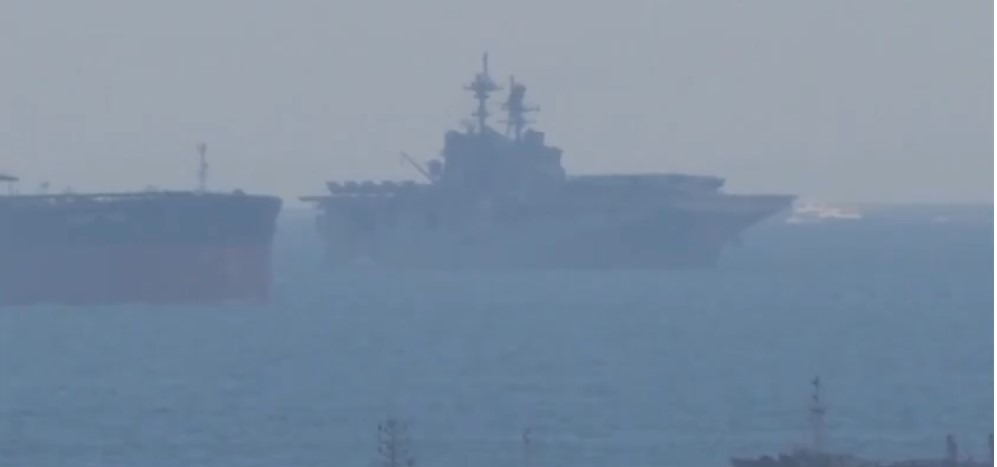
USS Tripoli Reuters
More than 3,500 U.S. sailors and Marines aboard the USS Tripoli have arrived in the Middle East as the Pentagon continues to build up forces in the region.
U.S. Central Command (CENTCOM) said on March 28 that the USS Tripoli had entered its area of responsibility. The amphibious assault ship is serving as the flagship of the Tripoli Amphibious Ready Group and the 31st Marine Expeditionary Unit, a combined force that includes ground, air, and naval elements.
One of the newest and most capable amphibious assault ships in the U.S. fleet, the USS Tripoli is designed to accommodate a larger air wing, including F-35 stealth fighter jets, V-22 “Osprey” tiltrotor aircraft, and other warplanes. It had been based in Japan before receiving orders nearly two weeks ago to deploy to the Middle East.
CENTCOM said the Tripoli brings transport aircraft, strike fighters, and amphibious assault capabilities to the region in addition to the Marines aboard.
The USS Boxer, another amphibious assault ship, along with the 11th Marine Expeditionary Unit, has also been ordered to the region from San Diego.
CENTCOM did not disclose more details on where the additional U.S. forces will be positioned, although they are likely to operate within striking distance of Iran, including near key locations such as Kharg Island, a major Iranian oil export terminal off the country’s coast.
In its most recent update on March 25, marking the fourth week of the campaign, CENTCOM said that more than 11,000 targets had been struck since the United States and Israel launched joint operations against Iran on Feb. 28.
On March 27, Secretary of State Marco Rubio said the United States could achieve its objectives in Iran without deploying ground troops and expected the operation to conclude within weeks. He described the latest troop movements as precautionary measures intended to prepare for unforeseen contingencies.
Speaking to reporters after a meeting in France of foreign ministers from the G7 group of leading industrial nations, Rubio said Washington was meeting its war goals, which he described as destroying Iran’s missile and drone capabilities and the factories that produce those weapons, as well as elements of its navy and air force.
He said the campaign was “going very well” and was expected to conclude in “weeks, not months.”
“We are ahead of schedule on most of them, and we can achieve them without any ground troops,” Rubio said.
At a Cabinet meeting on March 26, Middle East special envoy Steve Witkoff said Washington had delivered Tehran a 15-point “action list” that the United States hopes could serve as a framework for a possible cease-fire.
The proposal would place restrictions on Iran’s nuclear program, the issue at the center of tensions with the United States and Israel, as well as reopen the Strait of Hormuz, a critical waterway through which a significant share of the world’s oil and gas passes.
Iran has responded with its own five-point counterproposal, calling for an end to the war, compensation for war damage, and recognition of Iranian sovereignty over the Strait of Hormuz.
Later on March 26, President Donald Trump extended for a second time his deadline for Iran to reopen the Strait of Hormuz before the United States launches strikes on Iran’s energy sites, giving Tehran until April 6, while saying that U.S.–Iran talks were continuing.