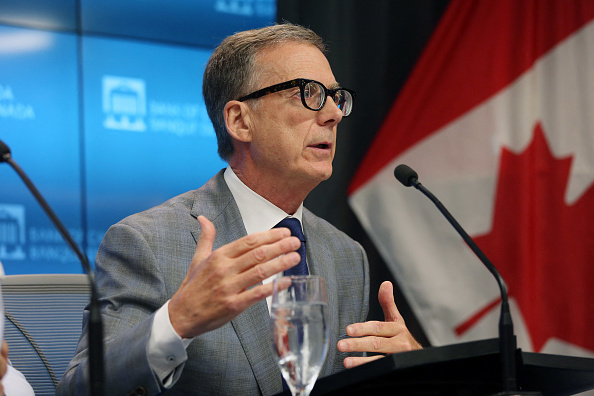
Tiff Macklem, Governor of the Bank of Canada, speaks during a news conference at the Bank of Canada auditorium in Ottawa, Ontario, Canada, on July 12, 2023. (Photo by Dave Chan / AFP)
OTTAWA—The Bank of Canada has kept its key interest rate at 2.25 percent for a fourth straight meeting, while saying rates could either fall due to U.S. tariffs or rise due to higher energy prices.
Speaking to reporters on April 29, Bank of Canada Governor Tiff Macklem said his baseline forecast is that oil prices will trend downwards after spiking due to the war in the Middle East, and the United States will not levy any more tariffs on Canada.
“If this holds true, a policy rate close to current settings looks appropriate to support adjustment in the economy and return inflation to target,” Macklem said. “However, uncertainty is unusually elevated, and there are many possible outcomes. Monetary policy may need to be nimble.”
Macklem said if Washington were to impose “significant” new trade restrictions, the central bank may need to cut rates to support the economy. If oil prices continue to rise, stoking inflation, “there may be a need for consecutive increases in the policy rate,” he added.
Oil prices surged to over US$100 a barrel after the United States and Israel launched strikes on Iran on Feb. 28, and Iran effectively closed the Strait of Hormuz waterway. While a ceasefire has held for over two weeks, Iran has kept the waterway closed and the United States has imposed its own naval blockade on Iran.
The central bank said that following a contraction in Canada’s economy in the fourth quarter of 2025, growth is forecast to have resumed in early 2026, with consumer and government spending supporting economic activity, and tariffs weighing on exports and business investment. The labour market remains soft, with the unemployment rate ranging between 6.5 percent and 7 percent due to weak hiring and fewer job seekers.
Consumer Price Index (CPI) inflation rose to 2.4 percent in March because of higher gas prices, which had followed several months of slower inflation. Inflation is expected to rise further, to around 3 percent in April. The bank said there is “little evidence” that higher energy prices have so far fed into higher prices for goods and services, but that needs to be monitored over the next few months.
The bank expects the Canadian economy to grow by 1.2 percent in 2026 and 1.6 percent in 2027.
Monetary Policy Report
The Bank’s April Monetary Policy Report said economic activity is estimated to have grown “modestly” in early 2026, as the economy adjusted to U.S. tariffs. Consumption growth remained solid, but higher energy prices squeezed Canadians’ budgets and weighed on spending, according to the report.
The report said some economic sectors hit by U.S. tariffs have performed better than others, with Canadian exports overall faring better than anticipated as the federal government and businesses quickly adapted. Canada’s steel industry has been hit hard, with exports falling by more than half. Aluminum exports fell sharply when tariffs were first introduced but have since recovered.
Softwood lumber exports have continued their multi-year decline, while copper exports have surged as producers increase output of copper products not subject to U.S. tariffs. Motor vehicle exports have held steady, partially due to federal policies to offset some of the tariff burden.
The bank said industries hit by U.S. tariffs have seen productivity and employment declines, but there are “no signs of rapid inventory accumulation” that would signal the need for larger cuts to output or employment.
The report also said there is uncertainty about the future of the Canada-United States-Mexico Agreement (CUSMA) and the upcoming negotiations, which are the “main factors” in the growth outlook for Canada. The bank’s base case is that current U.S. trade policies remain in place.
While the war in Iran pushed up oil prices and transportation costs, the Liberal government’s temporary suspension of the federal fuel excise tax will “cushion” part of the increase. The bank’s “base” assumption is that oil prices will fall to an average of US$90 by mid-2026 and US$75 by mid-2027 as the Strait of Hormuz gradually reopens.
However, a more prolonged war in the Middle East could lead to even higher energy prices and disrupt shipping. The report provides a single illustrative scenario in which U.S. tariffs remain unchanged, but oil prices remain at US$100 until 2028.
Such a scenario would increase the likelihood of higher inflation due to shipping disruptions and higher freight and insurance costs, as well as shortages of “critical imported intermediate inputs such as semiconductors.” This would lead to higher government revenue due to oil exports, with half of that increase being given back to Canadian households.
Also in that scenario, inflation would peak at 3.1 percent in the first quarter of 2027 and remain close to 3 percent for over a year, according to the report. The bank would be forced to raise interest rates, which would bring inflation back down to the 2 percent target and limit GDP growth.