With substantial reduction in use, researchers found little or no impact on test scores, attendance, and engagement in class.
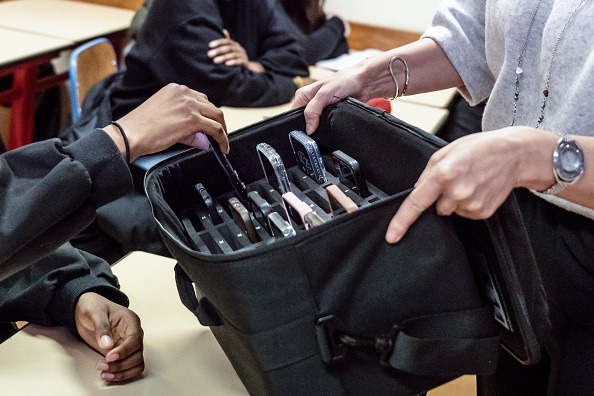
A teacher collects a student’s mobile phone, set aside during classes at the Jean Mermoz vocational high school in Montsoult, in the northern suburbs of Paris, on January 14, 2026. (Photo by BERTRAND GUAY / AFP via Getty Images)
School cellphone bans, implemented by states and school districts across the country, resulted in substantial reduction of phone use, positive benefits for teachers and students, and a “close to zero” effect on test scores, researchers said in a new study.
Adoption of lockable phone pouches “substantially reduces phone use as measured by GPS pings and teacher reports,” the researchers said in a working paper published by the National Bureau of Economic Research on May 4.
They also found that teachers reported improved satisfaction after the bans were implemented, and students reported higher well-being after initially experiencing a decrease in well-being.
On the other hand, researchers found an average effect on test scores “consistently close to zero” and also estimated there was little evidence showing an impact on school attendance, engagement in the classroom, and online bullying.
The results present “a mixed and complex picture,” Brian Jacob, the Walter H. Annenberg professor of education policy and professor of economics at the University of Michigan, and one of the researchers, told The Epoch Times in an email.
Dozens of school districts and states, such as West Virginia, have imposed restrictions on cellphone use in classrooms.
A previous paper, released by the bureau in the fall of 2025, found evidence that Florida’s cellphone ban had positive impacts, including recording a jump in test scores in the second year after the ban was introduced. The researchers also saw disciplinary incidents jump in the first year after the ban started, but then drop after that.
Those researchers, with the RAND Corporation and the University of Rochester, looked at test scores and incidents in a large county in Florida—pre- and post-ban.
For the new paper, a different set of researchers, including academics with the University of Pennsylvania and Stanford University, compared changes in schools that utilize lockable phone pouches to schools that are similar but do not use the pouches.
Nearly 5,000 schools are using pouches in the United States.
The researchers obtained data from Yondr, one of the largest providers of the pouches in the country. They also used results from two surveys they conducted between April 2025 and February 2026.
In addition to finding that the bans reduced phone use and improved well-being, while not having much effect on test scores and attendance, the researchers recorded an initial increase in disciplinary incidents in the first year after adoption. However, the number of incidents later dropped.
“I think the results are sobering, but by no means the ‘final word’ on cellphone restrictions in schools,” Jacob said. “This is a rapidly evolving policy landscape, with schools experimenting with different methods and learning how to best implement phone restrictions. I think it is certainly possible that future research will find more encouraging impacts on student achievement.”
Funding for the research came from a number of institutions, including the Bezos Family Foundation and the National Governors Association. The researchers did not list any conflicts of interest.